Every year on the day before Thanksgiving I head out with Chuchubob for some pre-holiday railfanning along Amtrak's NEC. This year due to COVID not only was sharing a car and a meal not considered a good idea, but Amtrak's schedule had been drastically cut back due to the collapse in ridership. Not to be deterred Bob and I realized that there was nothing stopping us from taking separate cars to an outdoor NEC location to continue the tradition. North Philadelphia station was chosen due to R7 and R8 SEPTA trains filling in for missing Amtrak Regionals. Since Bob had a number of other things to do we split up early leaving me to continue on to Holmesburg Junction and then Croydon where I did some outdoor dining in view of the tracks. The photos from the entire day can be found here ( mirror ).
We began at the NJT RiverLINE's 36th St station in Camden where sibling units #3513 and #3512 passed eachother.
In Pavonia Yard NS AC44C6M #4035 was performing some flat switching.
Due to track work in Amtrak's LEHIGH interlocking, inbound R7 trains on Track #4 were getting Stop and Proceed signals. (Thack 3's signal wasn't even lit!). SEPTA Silverliner IV #317 was the first to navigate the work area.
NORTH PHILADELPHIA tower is still standing, but has been boarded up.
A northbound Acela Express trainset with power car #2034 was the first Amtrak train on the scene.
Once again it's time for a trip to Reading Country and with most of the surviving Conrail signals already accounted for my goals for 2020 were to check out the surviving Reading interlocking tower at Lebanon Valley Junction along with the new/rebuilt NS Harrisburg Line interlockings CP-LORANE and CP-BIRD. This trip also afforded me my first shot at the popular railfanning location of Wyomissing Jct as well as some other Reading area points of interest. The full set of photos can be found here ( mirror ).
My trip started out well enough when upon leaving the Maryland area I caught the head end of an eastbound CSX intermodal train passing over US Route 1. Swinging onto local roads I was just in time to catch distributed power in the form of ES44AC #936 passing through the site of the old Elkridge MARC station.
I met up with Reading area guru Kevin Painter at the Reading and
Northern North Reading station. Although nothing was moving from an
R&N point of view, an odd couple pairing of yard power featuring SW8
#802 and MP15DC #1548 was hanging out along with SD40-2 #3055 and
SD50-2 #5018 in the new Fast Freight scheme.
Heading to Wyomissing Jct we passed by CP-BELT where an eastbound NS
manifest train was waiting on a signal on the old Reading Belt Line with
NS C40-10W #7523 and Ac44C6M #4331 on the head end.
After visiting the eastern portal of the Moffatt Tunnel back in July 2020, upon my next visit to Colorado I made plans to visit the western portal which just happens to be located at the site of the Winter Park Resort rail station, western terminus of the famed Denver Ski Train, where some luck and timing allowed me to catch the westbound run of Amtrak's California Zephyr. Later that weekend I had some extra time to visit the new Denver RTD commuter rail stations at 41st-Fox and Denver International Airport. These and other Denver related photos can be seen upon visiting the entire gallery located here ( mirror ).
The Winter Park Resort station has served as the terminus of the Denver Ski Train since the days of the Denver, Rio Grande and Western Railroad. After issues with insurance and the Great Recession caused an extended hiatus between 2008 and 2014, the Ski train officially returned as an annual Amtrak sponsored event in 2017. Demand was such that a fresh platform was constructed at the Winter Park Resort terminus to better support the ridership. Fun fact, this is the highest point on the Amtrak network at 9300 feet.
The reason for the Ski Train's popularity is the proximity to the ski
lifts at the Winter Park resort and the limited highway capacity
dictated by the mountainous terrain. If the Berthoud Pass
or I-70 are blocked or congested the only alternate routes in the
winter are a 190 trip via South Park or a whopping 260 mile detour via
Fort Collins.
As a plus, the station platform is located directly adjacent to the western portal of the Stephen Moffatt Tunnel.
While not as involved as the eastern portal with its crazy fan plant,
it is still treated with the same marquee label and dates. At 6.2 miles
in length it is not the longest tunnel in North America, but it is
pretty important cutting many miles off the previous Tennessee Pass
route and delivering water to the City of Denver.
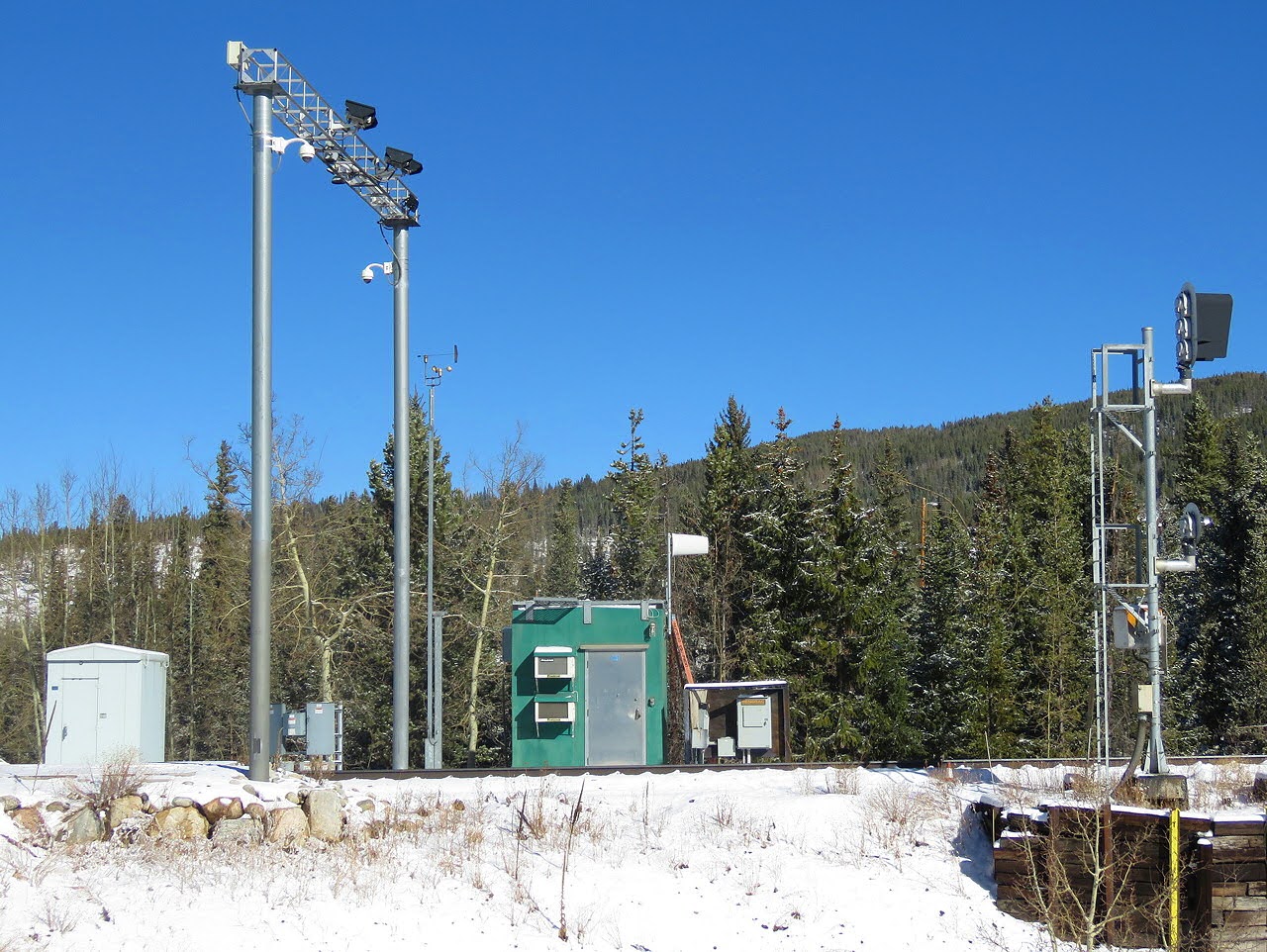
The western portal area is equipped with anti-intruder sensors and a repeater signal for the East End of the Winter Park siding.
The approaching Amtrak Train 5 could be heard from quite a distance back
in the tunnel and took a white to emerge despite the 40mph track speed.
The Covid shortened consist was powered by Amtrak P42DC's #69, #133 and surprise 3rd engine #62.
In the fall of 2020 I was jazzed to go on a second trip to the Front Royal, VA area for a brewery tour and to get more N&W signal photos on the NS H-Line. Unfortunately when I took the trip I didn't encounter many trains and those I did encounter I wasn't in a position to photograph well. Therefore I am going to pivot to the B Plot where I briefly stopped by SEPTA's Highland Ave station south of Chester on the R2 Wilmington. Also animals. Photos can be found here ( mirror ).
Highland Ave is one of the least used stations on SEPTA's Regional Rail system and currently consists of wooden one car low level platforms on either side of Amtrak's 4-track NEC. It is under constant threat of being shut down as happened to the Lamokin Street Station about a mile to the north in 2003.
Amtrak was still running a COVID schedule so I only managed to catch a
single Regional in each direction. The southbound was led by ACS-86
#650.
Highland Ave used to be adjacent to the milepost 15.6 automatic signal
location that broke up the longer than normal signal block between the
old LAMOKIN interlocking to the north and the still existing HOOK
interlocking to the south. At some point after 1992 this signal was
deemed unnecessary as it is possible to clearly see HOOKs southbound
signal in the distance and it became a cab signal change point for HOOK.
Popping back over to South Jersey I managed to catch sibling NJT GP40PH-2's #4105 and #4106 on MoW duty at the Cherry Hill Atlantic City Line station. These engines were part of a batch of 13 built for the Central Railroad of New Jersey in 1968 to augment its aging fleet of GP7 based passenger diesels.
The City of Cleveland was not just parked randomly on the shore of Lake Erie, it was built around the mouth of the Cuyahoga River, which provided port infrastructure that later allowed the city to become an industrial hub where iron ore delivered via boat could be combined with coal delivered via rail to create steel. Later the river port became useful in international trade with other industrial concerns able to send and receive their goods via the St. Lawrence Seaway. Although the river is best known for catching fire several times in the mid-20th century due to extreme amounts of pollution, the more lasting legacy are the large number of drawbridges that span the river as it winds its way through the historic Flats part of the city to the large industrial zone several miles inland.
In the fall of 2020 I went on a little walk from the east side of DRAWBRIDGE interlocking, located at the mouth of the Cuyahoga River, to the west side. DRAWBRIDGE interlocking and its associated Bridge One srawbridge are located on the former Conrail Chicago Line and is today owned by Norfolk Southern as part of its New York - Chicago corridor. Also included in this set are photos from Berea, OH, about 20 miles west of Bridge One and a major train watching hotspot where NS and CSX lines briefly meet. The full set of both Drawbridge and Berea photos can be found here ( mirror ).
The New York Central's BE tower, later renamed BEREA under Conrail, still stands in Berea, Ohio although the interlocking it once controlled has been split between Norfolk Southern and CSX. The late model Central tower was built at the western junction of the Water Level Route main line and the Cleveland Short Line with a 144 level GRS Model 5 pistol grip type interlocking machine. Closed at the very tail end of the Conrail era in 1997, the interlocking itself remained unchanged for another decade despite the fact that the two lines it controlled had been sold to competing railroads. Not surprisingly, the entire complex was rebuilt split between the two railroads, but BEREA tower itself has remained standing as an NS crew facility.
When I arrived at BEREA early on a Saturday morning a a spike of local railfans
were already on site with lawn chairs due to the impending arrival of a
Canadian Pacific heritage unit as run-through power on a CSX intermodal
train. While waiting quite a few NS trains passed by on the Chicago
Line, the first of these being an eastbound stack train led by NS
AC44C6M's #4214 and #4168.
Berea Union Depot
has been since transformed into a railroad theme restaurant, likely
knowing the tastes of the majority users of the Station's parking
facility. The need for a Union station here predates the Central's
takeover of the Lake Shore and Michigan Southern and Big Four railroads.
A westbound TOFC train featured NS ES44AC #8067 and #4380, one of the latest AC44C6M conversions.
The next train, and eastbound NS manifest job, featured a bevy of power
including two AC44C6M's, #4163 and #4241, C40-10W #7606, SD70ACe #1177
and two SD40-2's #3229 and #3301. Note the signal masts in the
foreground located on the former Short Line to Chicago Line connecting
track where the ownership changes between NS and CSX.
The Canadian Pacific SD70ACU #7018 heritage unit eventually arrived with
a second CP unit, ES44AC #8867, on the rear of the eastbound
doublestack train.
DRAWBRIDGE tower is another former New York Central structure built in
the 1960's to manage Bridge One and the surrounding trackage. Under
Conrail DRAWBRIDGE came to control the critical junction between the Chicago and Cleveland Lines
that linked both of Conrails main routes between the East Coast and
Chicago. After the Conrail split, Chicago Line through traffic was
shifted to the Cleveland Short Line under CSX, but the operator at
DRAWBRIDGE was still on hand to orchestrate movements of boats and
freight trains as Bridge One's deck sits only a few feet above the water
level. DRAWBRIDGE was closed as an interlocking tower around 2018 and
for a time the work of raising and lowering the bridge was done
remotely as well, however this caused massive delays to marine traffic
and NS ultimately put bridge operation back on site.
If you don't know what Larry's Truck and Electric company of McDonald, Ohio is, you have certainly seen the photos of derelict locomotives stretching as far as the eye can see. Better known by its LTEX reporting mark, Larry set up shop on the grounds of an old US Steel mill and started purchasing just about every cast off locomotive under the sun to become a major player in the locomotive leasing and parts market. In the fall of 2020 I used the opportunity of an unrelated trip to Cleveland to pay my first visit to the famous Larry's Truck Electric facility followed by an additional stop at CP-RAVE in Ravenna, Ohio to document the former Conrail signals at the interlocking there as well as the NS freight traffic on the line. You can see the complete set of photos here ( mirror ).
Larry's Tuck is best known for images like these of his massive storage yard. The crazier part is that there is an equally large separate stash of engines on the western end of the facility.
Some of the standout engines visible from the bridge include this pair
of ex-US Navy GE 44-ton switchers along with Raritan Center Railway
B23-7 #3110 that used to operate in North Jersey.
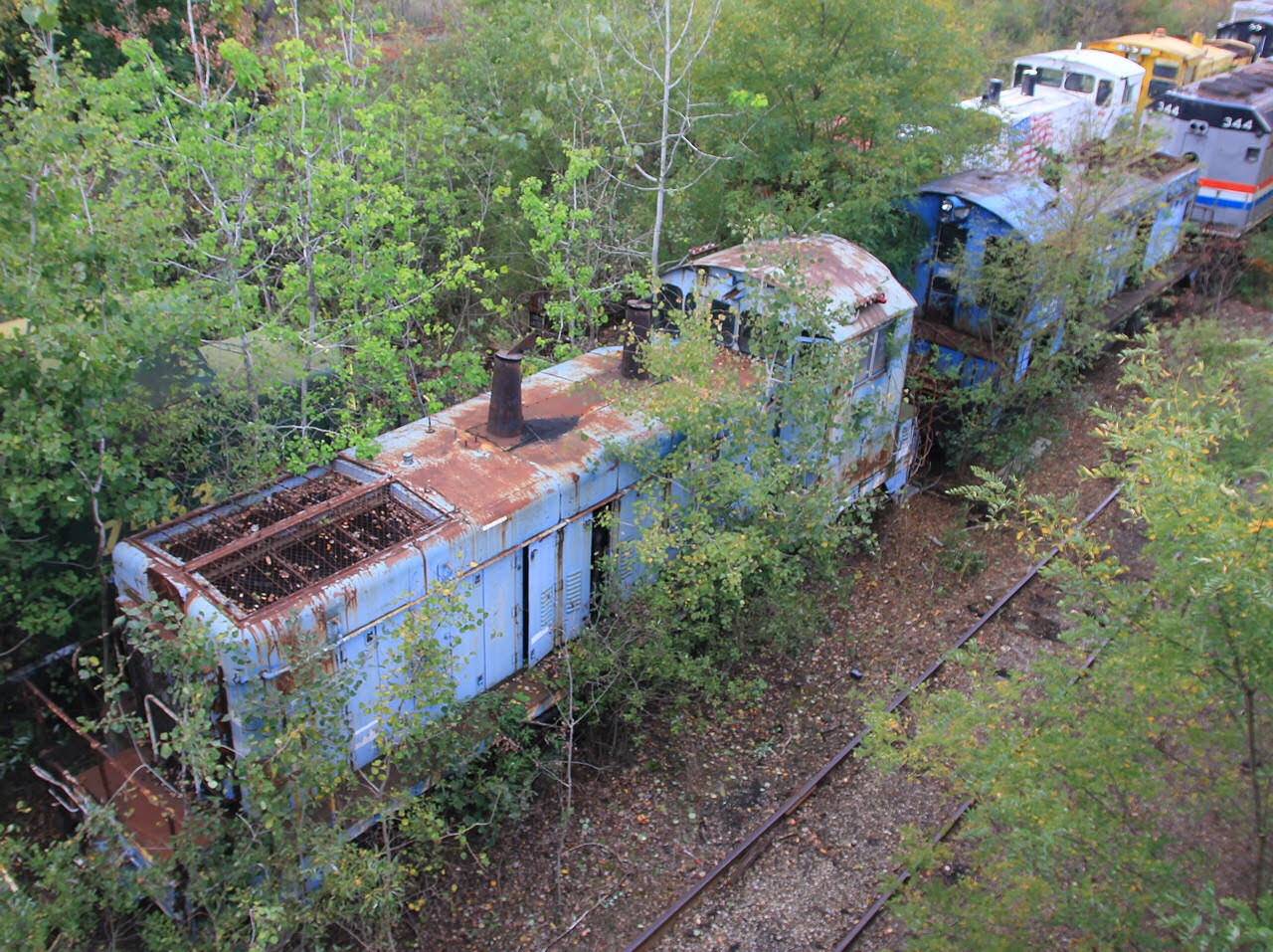
On the other side of the bridge was former Amtrak F40PH #344 that still looks to be in pretty good condition.
The whole place reminds me of the aircraft boneyard at Davis Montan Air
Force Base where all sorts of historic oddities are just littered about
like these END SW series switchers with trees growing out of them.
Of course not everything Larry owns
is up on blocks and a number of MP15DC's including #1563 and #1551 were
hanging out in fresh paint with brand new engine modifications.
SW1500 #1532 in B&LE colors was parked out a bit further away.
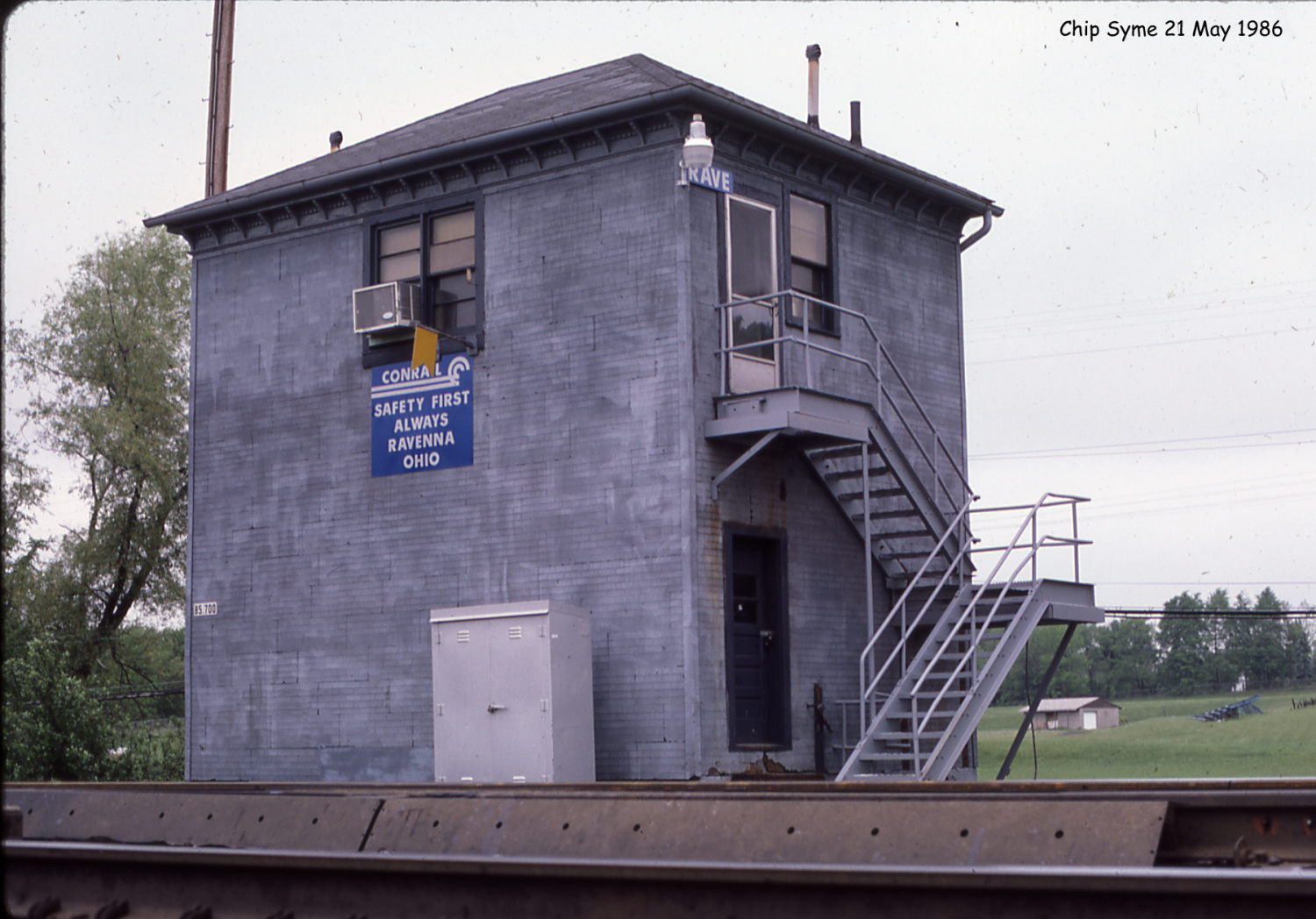
Moving on to CP-RAVE, once a side operation off the PRR Main Line to
Chicago via Fort Wayne, the Cleveland Line had seen a massive increase
in traffic starting in the 1980's as traffic patterns changed under
Conrail to send "PRR" freights via the former NY Central's Lake Shore
and Michigan Southern route by way of Cleveland. Despite this new
traffic, by the time of the Conrail split in 1999 the line still
retained its PRR era single direction ABS Rule 251 signal configuration
with limited crossovers. A late term closure of RAVE tower in 1995 resulted in a fairly modern interlocking with Conrail style target signals replacing it.
When Conrail moved forward on the second phase of its Pittsburgh to
Cleveland cab signal project in the 1998 time frame, there was no reason
to re-replace such a new interlocking and when the project was
completed under Conrail successor Norfolk Southern, 'C' lamps were
simply bolted to the existing color light masts to support the Rule 280a
Clear to Next Interlocking indication that were part of Conrail's
process of eliminating wayside intermediate signals in favor of cab
signals.
I didn't have to wait long for a train to show up in the form of an
eastbound manifest freight with NS C40-10W #7658 and C44-9W #9184
leading and AC44C6M #4271 with C44-9W #9184 helping mid-train.
In the 1880's Pittsburgh industrialists conspired with the Vanderbilt Organization in an attempt to undermine the transportation services of the Pennsylvania Railroad. The enterprise, known as the South Pennsylvania Railroad would attempt to construct an alternative rail alignment along the southern tier of the state. As this route lacked a natural waterway to break through the various mountain ridges it would have to rely on a series of 9 tunnels to forge its own path. Work on these tunnels as well as other grading along the right of way commended in 1881, but by 1885 Vanderbilt was learning why the name brand Pennsylvania Railroad had followed the sinusoidal path of the Juniata river. Even with the tunnels and generally favorable conditions for the 50 miles in the Cumberland Valley west of Harrisburg, Vanderbilt faced the reality that even if the South Pennsylvania Railroad were completed, the result would be a lackluster alignment beset with sharp curves and steep grades. The solution was to admit defeat and declare a truce with the PRR, exchanging the SPRR right of way for the PRR's interest in the budding NY Central competitor West Shore Railroad.
For the next 50 years little was done with the SPRR right of way and in a move that may have ultimately proved short sighted the PRR sold it to the newly established Pennsylvania Turnpike Commission in 1938 for conversion into the nation's first inter-city limited access motorway. The most attractive part of the alignment for the Turnpike were the 9 mostly completed tunnels, with 7 being incorporated into the final design. Motor vehicle technology of the time made hill climbing particularly fraught and allowing 1930's cars and trucks to blast through mountain ridges at grade was critical to the highways success connecting the Pittsburgh and Philadelphia markets. However as motor vehicle technology and highway demand increased over the next 30 years, some of the tunnels became both less necessary and increasingly congested. The result was a bypass plan that would replace two tunnels just east of Breezewood, PA and a third at Laurel Hill with new alignments and open cuts. In 1968 13 miles of the original turnpike near Breezewood was abandoned in place and for the next 40 years it remained a curiosity for urban explorers. In 2012 it was re-opened as a bike trail with full access to both tunnels and their related support structures and in 2020 I was able to document the complex with the resulting photographs available here ( mirror ). Also included are some rail photos from Hagerstown, MD.
The abandoned section of the PA Turnpike included both the longest, Sideling Hill, and shortest, Rays Hill, tunnels on 8 tunnel system including the Northeast Extension. The first 4 miles of the abandoned section starting from the eastern end is still owned by the Turnpike Commission with parts being used for storage and police training. The eastern end of the bike trail is adjacent to the abandoned Sideling Hill service plaza, however that is pretty much just a parking lot with nothing to see. The first point of interest is the 6782 foot long Sideling Hill tunnel.
The intact 1938 tunnel portals show off the Art Deco design along with
unsmoothed concrete facing designed to imitate the aesthetic of local
rock formations. It is important to remember that this is a railroad
tunnel adapted for automotive use and the original design makes that a
bit more clear.
The headhouse located at each portal used a common design with a two
story support building built into the left side of the abutment and a
fan plant located on top. The support building consisted of a loading
dock on the ground floor and general repair and mechanical room on the
intermediate level. Here we have a view of the westbound Sideling Hill
tunnel's loading bay with the door providing access to the tunnel.
Each support building had an internal staircase that in most cases have
completely rusted away at the base making their use impractical.
Therefore access to the fan rooms is obtained by walking up the slopes
adjacent to the headhouse and then circling around behind to enter via
the stairs at the rear of the fan plant.
Located on both ends of the fan plant are two e-motor rooms where the
electric motors that run the fans were located and maintained.
Each plant has two fans of the squirrel cage type that would provide positive pressure to push the noxious automobile exhaust fumes out from the main portals.
Each fan house providesaccess
to a plenum that runs above the complete length of the tunnel to
distribute the fresh ventilation air. Also visible are the remains of a
metal trackway that runs just to the right of the plenum centerline.
The railroad nature of the tunnel is even more apparent from the profile
of the tunnel's true ceiling.
The slab of concrete diving the plenum from the roadway is supported in part by steel rods extending down from the ceiling.