Search This Blog

Showing posts with label pneumatic. Show all posts

Friday, August 26, 2022

22-08-26 PHOTOS: JO

The JO section of the once sprawling ZOO interlocking complex is a surprisingly accessible yet under visited portion of the former PRR Main Line. Named for the former interlocking tower that was absorbed into the larger ZOO scheme in 1930, the JO section is where the west end of the New York-Pittsburgh Subway joins with the PRR Main Line from Suburban Station and today is used to shuffle westbound Amtrak and SEPTA traffic after the discontinuation of main track 4 over the Valley Flyover in 1994. Conveniently located under the Girard Street overpass, of Route 15 trolley fame, I traveled via the nearby SEPTA trolley Route 10 out to get what photos I could ( mirror ) on a weekday morning in August 2022.

Arriving back in Philly the evening before, I snagged this nighttime photo of the PRR Suburban Station main entrance across from Love Park.


The next morning I transferred from the MFL to the Route 10 at the Juniper Street trolley terminal. Here is K-Car #9055 on a Route 13 run.


From the Girard Street overpass one can make out the current arrangement of JO, from right to left one sees Main Track #1, the NY-Pittsburgh Subway, Main Track #4 and then Main Track #2.


This part of ZOO interlocking doesn't get much in the way of photos due to the high catenary shields on the bridges and the right of way being bordered by rowhomes. However some breaks in the development allow some views such as here where SEPTA Silverliner IV #406 is passing under the westbound PRR position light signal bridge. One can see that the 134R high signal for movements off the NY-Pittsburgh Subway has been recently converted into a pedestal.


While an Amtrak catenary maintenance vehicle waits at the 142L signal on Main Track #1, a SEPTA shop move consisting of Silverliners V #801 and #802 and Silverliner IV #277 crosses over from Main Track #4 to Main Track #2.


Until 1994 Main Track #4 would continue on straight ahead over the Valley Flyover, crossing above Main Track #2 and a number of freight yard tracks to drop back down onto the right side of the right of way. The Overbrook Maintenance Facility, that the Silverliners are moving towards, was constructed in 1994 to replace the ailing Paoli MU shoppes. This necessitated the realignment of Main Track #4 off the increasingly rickety flyover truss bridge, that soon saw use only for Cynwyd trains with a blanket 10mph speed restriction. The flyover would remain in service until 2018(!) until the opening of a new Cynwyd branch ground connection at PAXON interlocking. Here you can see how the Valley Flyover ramp has been recently cut at the 143 switch.


After the passage of the shoppe move, the catenary maintenance vehicle got its lineup and crossed into the NY-Pittsburgh Subway. The Subway was previously used by premier PRR east-west passenger traffic avoiding a time consuming stop/reverse move at 30th St or Broad Street stations. To save additional time the Subway track was given a straight movement onto the Main Track #4 flyover, a configuration that now delays all westbound Main Track #4 trains that have to make a 30mph diverging move through the JO section.


Friday, October 6, 2017

17-10-06 PHOTOS: HOME

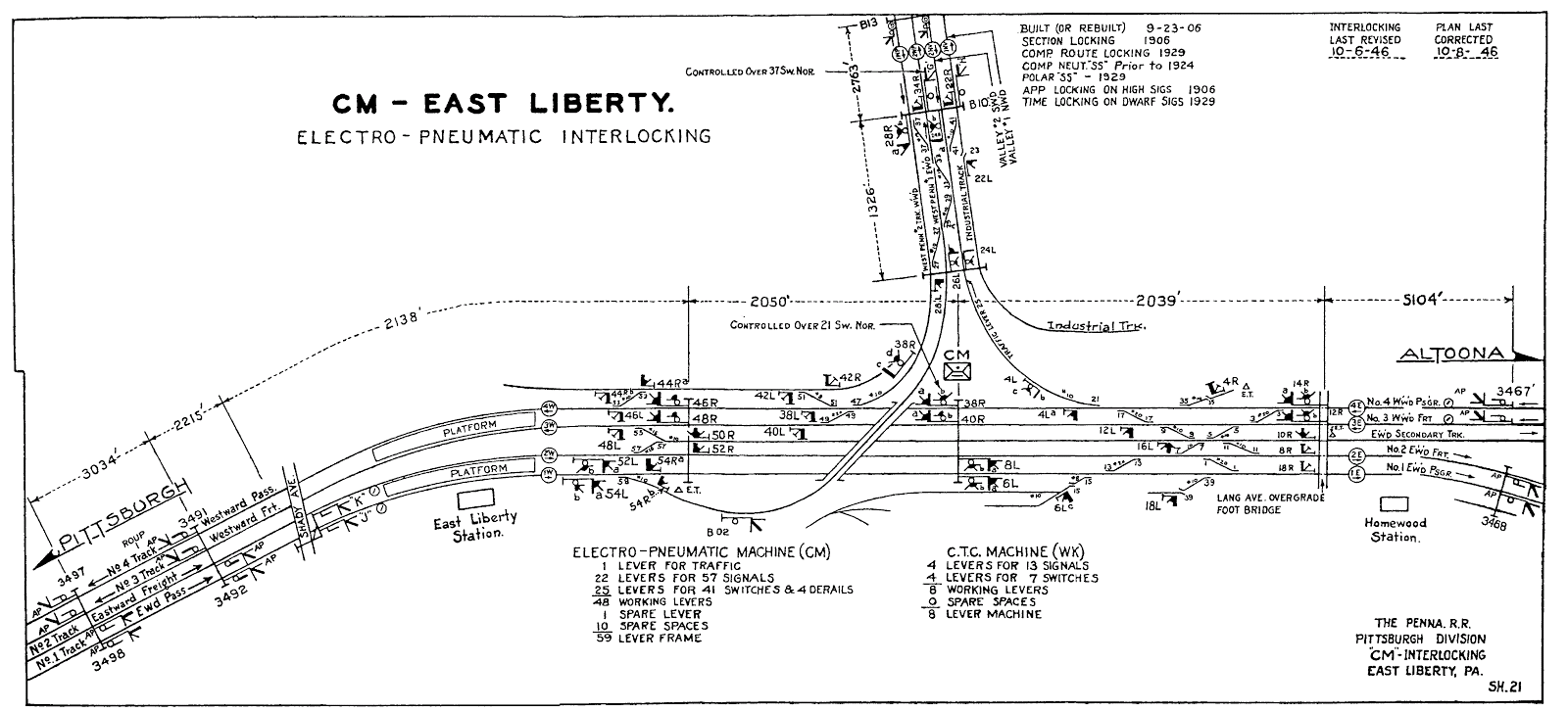
CP-HOME is located in the Homewood neighborhood of Pittsburgh (not to be confused bot Homewood, PA of strike fame) and is the last Main Line interlocking before the Pittsburgh Terminal complex about 4 miles to the west. It is the junction of the old Brilliant Branch, which served as a north side counterpart to the Port Perry Branch which turns off to the south at CP-WING *LINK*. Both of these branches were intended to diver freight traffic around the congested downtown passenger terminal and associated slow speed trackage. Today only the Port Perry bypass is still used by NS, the Brilliant Branch having been first abandoned before being reactivated by the Allegheny Valley Railroad. CP-HOME's other claim to fame is being the location of Pittsburgh's turning wye and every evening after Amtrak Train 43, the Pennsylvanian arrives, it reverses from the downtown station all the way to CP-HOME, then forward onto the Brilliant Branch then back over the west, non-interlocked leg of the way to re-join the main line and shove all the way back to the downtown station to be ready for the next day's departure.

Also included in this set are some photos of downtown Pittsburgh and of the often photographed MP 321 signal in Greensburg, PA.

The Pittsburgh Terminal corridor stretching from CP-WING through the Fort Wayne Bridge was rebuilt by Conrail around 1980 to eliminate redundant and slow speed trackage as well as manned interlocking towers. The 4 track right of way was turned into a compact 2 track bi-directional line with space left over that was eventually used to built the East Pittsburgh Busway in the 1990's. As a result we see things like this pedestrian overpass at Lang Ave also supporting a pair of PRR Position Light signals.


In addition to a crossover, CP-HOME featured an interlocked connection to a small freight yard on the south side and the Brilliant Branch on the north.While the interlocking looks fairly straightforward today, in the PRR era there was a 4 track crossover, a flying junction from the west, another 4 track plant on the Brilliant Branch and a 5th pocket track running to a seperate "west end" interlocking plant.


CP-HOME also remained a pneumatic interlocking after it's Conrail rebuild because back then it made sense to save money on hardware.


Three track bridge over Kelly Ave on the old Brilliant Branch. Today this is used for the daily Train 43 wye move and a couple of AVR local freights.


The north end of the wye is interlocked. Trains from the east remain within interlocking limits, while the west leg is an un-signaled track re-connecting with the main via a hand operated switch. The "Begin Block" sign indicates the start of DCS territory.


The north end of the interlocking has it's own pneumatic air plant, pumping up an ancient riveted air reservoir all to power the single #9 switch which is possibly thrown just once or twice per day.


The north end air infrastructure features a near historical relic in the form of an "engine tap". These devices, marked on the interlocking sheets, were installed to allow locomotives to supply a pneumatic interlocking plant with compressed air via a standard air brake hose connection. This was an occasional occurrence back in the days of unreliable power and air compressors and the PRR wanted to be ready for it.


Back on the main line, a westbound manifest freight led by NS C44-9W #9328 with two SD60E's, #6738 and #6742 behind, coasted through the interlocking.


On the rear of the train was a sequential pair of SD40E helpers consisting of #6332 and #6331. As trains have made better use of dynamic braking, many helpers are no longer cut off at the top of the slope in Galitzin, instead riding the rear all the way to Pittsburgh. Previously there was a helper base at Pittsburgh station, but today the trains stop past one of the area interlockings, CP-TRAFF, CP-WING or CP-HOME and then have the helper disconnect and head back to Altoona.


Here we see the helpers having just uncoupled from a long string of empty tank cars for their lite run home.


The same helpers passing by and taking the Medium Clear signal at CP-HOME to cross over to the normally eastbound track #1.


Friday, July 1, 2016

16-07-01 PHOTOS: TRAFF

CP-TRAFF in Trafford, PA is located at the east end of the former PRR Pitcarin Yard, just outside of Pittsburgh on the old Main Line. Today the yard has been mostly gutted and now stands as Norfolk Southern's Pittsburgh area intermodal terminal. However what Conrail designated as the Pittsburgh Line, still runs through it all carrying 40-60 trains per day. While CP-TRAFF lost the last of its high position light signals in the late 1990's, it still features a lot of heritage elements as well as a great place to catch more dynamic rail action. Included in this set are a number of photos taken in downtown Pittsburgh where the other members of my party had decided to stop for the day. You can view the full set of photos here.

The interlocking logic dates from the Penn Central era of the early 1970's and was installed as part of a general West End CTC project stretching from Johnstown to Pittsburgh. The all relay plant has held up well over the years, even if it requires a bit more physical space than modern installations.


Another throwback would be the compressor hut supplying air to the pneumatic point machines. Popular in the days before reliable mains power was available in rural areas and household voltage buried wires could be reliably insulated, air operated interlocking plants are facing extinction both in North America and abroad due to the increased maintenance requirements. 


Conrail blue is still flies proudly next to the 4W mast signal, displaying an Approach indication for an upcoming westbound movement on track 2.


In due time a doublestack intermodal train shows up with NS SD70ACe #1075 in the lead, SD70ACe #1001 behind and ES44AC #8136 in the number 3 position. I'm sure 1001 makes some sort of emoticon, but so far it has not gained the same notoriety as NS "barcode" unit #1111.


As the doublestack train braked to a halt for the Stop signal at CP-WING, a helper pack consisting of SD40E's #6312 and #6308 drifted past as an eastbound manifest train roared by on track #1.


Saturday, July 11, 2015

15-07-10 PHOTOS: Pttsburgh Rade

This summer I had the opportunity to take a road trip to Pittsburgh and as usual I was able to convince my ride to throw in some railfan stops along the way. These consisted of a number of locations along the former PRR Main Line / Conrail Pittsburgh Line as well as some stops in downtown Pittsburgh. This was my first visit back to Pittsburgh since 2010 and I was also able to try out the new North Shore light rail extension, which is part of the downtown free travel zone.

You can find the entire set of photos here.

On the way to my first stop I got lucky and caught some road power laying over on the Radebaugh Secondary. It consisted of new SD70ACe #1145 and C40-9W #9652, along with CN SD75I #5639.


Traffic on the Pittsburgh Line tends to come in waves and the fleeted westbound signal at CP-RADE showing Approach was an indication that I had arrived right in the middle of one. Sure enough a westbound coal train with ES44AC's #8115 and #8129 soon appeared.


Next up was an eastbound helper set running light presumably to Johnstown for its next assignment. Power consisted of two 6300 series SD40E's, #6325 and #6310, which were originally SD50's. SD40E's are NS's preferred power for PRR Main Line helping.


Clear PRR position light signal for an eastbound doublestack train.


That was quickly followed by a westbound double stack train with C40-9W's #9917 and #9277


Later that day I caught the SRS truck out at CP-PENN.


CP-PENN is the interlocking that still features a 4-track PRR PL signal bridge and is also the tri-junction between the Pittsburgh, Conemaugh and Fort Wayne lines.


The clear signal was for a westbound manifest freight with C40-9W #9853 and SD60I #6792.


Friday, April 19, 2013

13-04-20 PHOTOS and VIDEOS: (1) South Ferry (1)

Due to my whiplash trip to Boston during the lockdown weekend I am really having to break my photoset up simply because I took such a wide variety of pictures as my plans careened back and forth from cancelling my trip and pressing on to Boston. If you remember the last set of Photos I was left on the Sandy Ferry with no hope of completing my trip and my sights set on an Amtrak train from Philly to Baltimore departing at 9:30pm. Well I got as far as Robeling, NJ when I got word and Train 66 was un-cancelled and after booking a ticket I headed back to NYC and found myself in Penn Station with about 4 hours to burn before the 2AM scheduled arrival.

Luckily there was one major sight I had wanted to see that would not be affected by the darkness and that was the brand new old loop at the South Ferry terminal on the (1). I had previously gotten photos and video of the loop operations with my old camera, but the video was low def and I had lamented never being able to capture the squealing wheels and gap fillers in HD. Well just like with the Rockaway Ferry is was Sandy to the rescue once again, destroying the new station and pressing the 1905 technology back into service.

My first checkbox item was to use the railfanable window in the R62 to get front end video all the way around the loop. I had to split the video between two trains of course, but you can watch the whole thing here as I go from Rector to South Ferry and back again all without changing perspective.


Here we see R62 #1841 waiting for the few passengers that might arrive at 11pm.


The 102 gap filler signal illuminates when the fillers have extended.


The #103 gap filler. The South Ferry fillers are pneumatically operated using standard US&S pneumatic switch hardware. If you look closely you can spot the pneumatic piston.


Noisy 5 train squeals by on the inner loop while #1841 waits patiently for its departure time.


1905 station art. Much nicer than what was installed 100 years later and a lot more cost effective.


Gap filler control panel inside the dispatcher's office. While interlocked and signaled like any other appliances on the NYCS, the SF gap fillers stand apart from the regular signaling system. There are 5 distinct "fillers", one for each of the first 5 cars on an arriving train. Each of these in turn has three filler units that extend to meet the doors on an IRT dimension subway car. The filler panel has a unit lever for each of the per-car fillers, and each of the per-car fillers is connected to its own track circuit. Normal position is retracted and reverse is extended. Normally operation is fully automatic, but the dispatch staff can take manual control. I suspect the fillers automatically engage when the first five cars fill their track circuits and then disengage when the train edges forward over the insulated joint in front of the 102 signal.

Click for a larger version.

http://acm.jhu.edu/~sthurmovik/Railpics/13-04-19_PUT_IT_IN_H!/NYCTA_South-Ferry-Int-Gap-Filler-Panel-lg.jpg

Dispatch office and exit to the Ferry terminal. The TA had done a remarkable job cleaning the station up for service.


Mind the Gap? Not here!


Saturday, August 4, 2012

12-08-04 PHOTOS: SONOTOMO

I really wish I had something Christmas-y to post, but even though I have chopped my processing backlog down to 2 months from 11, that's not close enough to get in my photos from the Baltimore Streetcar Museum Santa Special or anything with the Nostalgia train which I didn't bother to ride this year. So everyone is going to have to sit back and yawn as I dig up some photos from August when myself and an all-star cast of Subhcatters including Chuchubob, Fred G and Alex converged on South Norwalk, CT for a visit to the preserved New Haven Railroad interlocking tower there.

Now this is not my first trip to the museum, but with the M-2's due for retirement I needed to get out on the New Haven Line anyway and this was probably the best destination available. For those of you looking for an in depth description of how turn of the century electro-mechanical interlocking machines functioned I am going to save that for another essay in the future, but there are plenty of non-signaling related visual treats available.

We start off with a string of classic M-2 railcars departing Stamford inbound towards New York City. I took Amtrak to Stamford and then got a ride from Alex there instead of trying to make the 1 minute transfer to Metro-North.


Enter the bag guy, track left as an outbound train of M-8's pulls in.


Inbound Stamford local train with M-2 #8832 in the lead.


Roof shot of M-2 #8832.


Video of 8832 and friends departing Stamford from above.


MNRR BL20-GH #115 pushing at the rear of an outbound Danbury shuttle train. The Beeps have been suffering from some overheating problems which is why one of the side doors is open.


Amtrak Acela Express #2039 in the push position as it heads through the Norwalk truss bridge.


Brand new Metro North catenary structure bolted to the original 1918 New Haven gantries is at least a nice consolation prize after the original catenary was removed.


The original New Haven electrified wire warning sign needs to be updated as voltage was raised to 12,000. At least its better than the "High Voltage SEPTA" signs.