Search This Blog

Friday, May 24, 2019

19-05-24 PHOTOS: West Slope Pickup

Over the summer of 2019 the clock was ticking on classic signaling on the PRR Main Line between Harrisburg and Pittsburgh.  While I had made multiple trips to document the old stuff, there were still a few accessible locations that I had either bypassed, failed to notice or simply screwed up the first time around.  Three of these were located on the famous West Slope rail heritage corridor between Gallitzin and South Fork with the third on the track 3 Slow Road near New Florence and the Seward generating complex.  You can find the full set of photos here (mirror).

 First stop was the popular railfan hangout at Lilly, PA.  While I had first visited this location just 5 months before, the weather had been blah, I discovered that some of the photos were a bit soft and I had generally missed a lot of angles. It was time for a re-do and the May weather did not disappoint with the MP 354 signal bridge all lit up with a Clear indication on tracks 1 and 2.  In terms of the re-signaling project I was about to get these and following photos about a week or two before they were taken out of service.


The source of the approach lighting was a loaded eastbound coal train on track #1 with NS C44-9W's #9610 and #9773 in the lead.


The trains bulk was such that two SD40E (rebuilt SD50) helper packs were attached with NS #6303, #6306, #6309 and #6325.


All 6 units were making a lot of noise as they struggled to get the ~10,000 ton train up the stiff grade.


Next stop was the Milepost 256.5 westbound signal bridge located halfway between the Cassandra cut and the eastbound signals at Jamestown Rd  This is one of the oldest style of PRR signal bridges that likely date from before 1920 and were originally fitted with semaphores. 


In the few minutes since I had stopped at Lilly, traffic had been thrown on the bi-directional center track #2 so both westbound signals were displaying Clear.  This specific signal bridge was still in its original four track single direction Rule 251 configuration.


The next signal is located in the town of South Fork and is an uncommon PRR pedestal type automatic signal serving as a distant to CP-W for trains coming off the South Fork Secondary.  While not on a Main Line main track, it is nevertheless given a Main Line milepost number of 265.6. 


While I was there an eastbound oil train showed up with NS SD70ACU #7251 and ES44AC #8146 in the lead .


As the tail end helper pack rolled by with SD40E's #6310 and #6317, they passed the tail end of a westbound doublestack intermodal train on track #2.


#6310 and #6317 pushing hard through South Fork.


Tuesday, May 21, 2019

19-05-21 VIDEOS: Cal Cables

As an interactive living history museum, the San Francisco cable cab system is pretty conducive to shooting full line videos.  However the last time I had been inclined to shoot cable car line videos was before I had purchased my mountable GoPro and it getting a second set of videos, including a first set of the somewhat underwhelming California Line.  The weather wasn't entirely cooperative so the videos on the Bay-Taylor line had to be taken in a slight rain, but the Hyde-Beach line turned out much better. If you missed the static photography from this trip you can find that here.

We start with the MUNI California Line running from Market to Van Ness and back.  It actually took me two takes to get this due to an outbound camera malfunction and you can see the rather backlit first take returning from Van Ness, here.


Here we have the rainy morning trip on the Bay-Taylor (Mason) line from Market to the Bay St terminal near Fisherman's Wharf and back.


Finally, to complete the trifecta of MUNI Cable Car lines, here we have a round trip on the Hyde Line under markedly better early morning conditions. This route is the most popular with the tourists as it stops at the top of Lombard St.


Hope you enjoyed the ride.  Next time join my for an inside look at the disused PRR GWYNN tower.

Monday, May 20, 2019

19-05-20 PHOTOS: T Third Bis

Back in 2008 I rode the MUNI's new T-Third light rail line when it was new.  Fast forward 11 years and numerous San Francisco trips later I realized I did not really have a good photo survey of the T-Third line and made it my objective of my 2019 stay.  Of course when one is in San Francisco for a week there are many different transit oppurtunities to take advantage of and therefore this set will also include trips along all three cable car lines, the L Taraval to the Pacific ocean and walks along the E Embarcadero.

The full set of photos can be found here (mirror) and stay tuned for a second video post covering the Cable Car lines.

On the first day of my trip, traveling from San Jose Airport I got off Caltrain at Bayshore and transfered to the T Third at the Arleta station.  Breda LRV #1464 was on hand to take me downtown.


Passing Breda LRV #1529 at Armstrong Ave.


Passing by a New Flier XT40 Oakdale-Palou station.  All stops on the T-Third provide for level boarding.


There is a level crossing with the San Francisco Belt Railway immediately before the Islais Creek Brawbridge.


Breda LRV #1457 at the southern Metro East yard lead junction.


New crossovers and platforms were being constructed to support additional traffic to the equally new Chase Center area, future home of the Golden State Philadelphia Warriors.


Arriving at the Embarcadero terminal station I caught new Siemens LRV #2022 running behind my Breda LRV #1464.  These are scheduled to replace the Breda LRVs by 2027.


MUNI California Line Cable car #57 sitting at the Market Street terminal.


To collect my Three Day tourist pass of shame, I had to travel to the ticket kiosk at Powell.  Since my times MUNI ticket was still good, I caught the St. Louis heritage PCC #1050 running on the F market.   Note any PCCs with the "school bus" style drop windows are former SEPTA cars.


The operator of Breda LRV #1433 is getting a quick job briefing at the Embarcadaro terminal.


On Day 2 I set out to shoot video on both directions of the MUNI California Line.  The video mount was hands free so I was also able to get some stills like MUNI #58 sitting about a block east of the Anglican cathedral. 


MUNI California Line cable car #49 sitting at the Van Ness terminal.


Sunday, May 19, 2019

19-05-19 PHOTOS: Caltran Caltrain VII

While I am a frequent visitor to the Bay Area, it had been some time since I was last able to conduct a full survey of the Caltrain line between San Francisco and San Jose.  In 2019 however I was forced into flying in and out of SJC airport for an event in San Francisco which would allow for multiple opportunities to see what was new on the old Peninsula commuter line. On the inbound leg of my trip I wound up getting a ride part way from family and the remainder of the trip was on Bombardier trainsets without a front view.  However the return leg allowed me an express run from San Francisco to San Jose with a short return hop back to Santa Clara where the airport bus connection is made.

You can find the full set of Caltrain photos here (mirror) and San Francisco transit photos will be covered in a separate post.

We begin at San Carlos where I was catching a northbound Sunday afternoon local to San Francisco just as a light drizzle was picking up.  Lead car of the Bomber trainset was car car #113.  Note the mix of LED and sealed beam headlights.


Instead of  riding all the way to the 4th and King Street terminal, I alighted at Bayshore to make a connection with the T-Third light rail line. Power was being provided by Caltrain MP36PH-3C #927 and the train departed under a Limited Clear signal indication at CP-TUNNEL.


Skipping ahead about 5 days, I again found myself on Caltrain catching "Baby Bullet" express train #330 south out of San Francisco's 4th and King street terminal on a Thursday Morning.  Often these late express runs will operate with a normal Gallery Car trainset as opposed to one of the Bombardier Baby bullet sets.  Departing 4th and King I captured MP36PH-3C #926 at the head of a Gallery Car trainset and #928 at the head of a Baby Bullet trainset on the lower tracks to the north. 


F40PH-2 #902 and MP30PH-3C #925 were hanging on tracks to the south.


South San Francisco is the Union Pacific staging area for all freight in San Francisco and a pair of UP GP40-2, including #1433, were on hand in the grey morning fog.  The signal bridge is a Southern Pacific original and construction is underway for the new electrification project which will place one of the substations just out of frame to the left. 


Caltrain has been slowly grade separating its line in busy downtown areas since 2004 and the most recent segment to be completed was in the town on San Bruno.  A new elevated station was constructed with closer proximity to BART, replacing the old station at the southern end of the viaduct.  Here we see Caltrain MP36PH-3C #923 with a northbound Baby Bullet trainset passing through San Bruno.  Note the newly installed overhead catenary supports.


Caltrain F40PH-2CAT #219 seen pushing northbound with a morning peak period train just south of the Millbrae station.


A new grade crossing project is underway through the town of Hillsdale with the viaduct going up adjacent to the current right of way.  This is somewhat reminiscent of the way the LIRR Babylon branch was reconstructed in the 1970s.  Here Caltrain F40PH-2CAT #901 is passing one of the new concrete overpasses.  It appears that the design involves both raising the tracks and lowering the road.


Saturday, April 27, 2019

19-04-27 PHOTOS: Avalon

In the spring of 2019 I was a bit hard up for content so I decided to just look around me and go to the railroad points of interest closest to me.  These happened to be either end of the Avalon siding on the former B&O Old Main Line (OML), that was built westward out of the City of Baltimore in the early 1830's to help the city become a major east coast port. The Avalon siding is located between the Junction with the New Main Line (Capitol Sub) at Relay/St. Denis and the Illchester tunnel and bridge and I will cover both ends including the aforementioned tunnel and bridge.

Also included in this post are additional Amtrak trips between Baltimore and Philadelphia and a day trip into Washington, DC via Metro and MARC. You can find the entire set of photos here (mirror) and please check it out or at least scroll down because its not all CSX GE's, I swear. 


The OML was converted into the single track back in the 1960s and the Avalon siding, situated just 2 miles from the junction at St. Dennis, is often used to store trains the dispatcher has nothing else to do with.  When I arrived at the East End of the Avalon siding (EE AVALON), not only was one of these unwanted trains siting in the siding led by CSX C40-10W #5337, but I also got there just in time to see it overtaken by another loaded eastbound coal train led by CSX ES44AC #3225.  You can see the various options that GE provides in regards to numberboard and door placement.


The OML was one of CSX's earliest victims of re-signaling in the Darth Vader era, coming just a few years after the Philly sub got a refresh that retained the Color Position Light signals.  The Darth Vaders went up in 2003 and here we see #3225 passing the westbound mast signal that can display such aspects as R/Y/R Medium Approach, R/Y/*G* Medium Approach Medium and R/L/R restricting.  Second unit on the head end was CSX AC4400 #5106.


CSX has also caught the DPU bug and a total of 4 units were assigned to this coal train with two additional ES44ACs on the rear, CSX #3232 and CSX #3115.


The train on the siding had CSX C40-10W #5337 and ES44AH #920.


Although normally approach lit, the eastbound main track signal was able to display the progression as the moving coal train passed because the siding train was triggering the approach circuit.  As EE AVALON is back to back with ST DENIS interlocking the signal went to Restricting and then Approach as ST DENIS signal stayed at Stop.  The milepost 8 is the distance to the old B&O terminus at Mt. Claire where the museum is today.


Artifacts in the Avalon area included this old concrete B&O phone booth.  The booth was replaced by a simple box in the original CTC project and while the block line was long out of service, the phone still present.  The base for the pre-2003 relay hut was also still there.


The West End of the Avalon siding is a good half mile from the nearest parking area, but immediately adjacent to the Patapsco Valley State Park.  The Illchester tunnel that the B&O built in 1903 to cut a corner in the Patapsco Valley that reduced speeds on the line.  Since reduced to a single track there was ample clearance on either side and the tunnel is frequently used by locals.


Hiking out to WE AVALON I was passed by another eastbound coal train.  All of these trains were likely en-route to the coal export terminal at the Port of Baltimore, although there are still a few coal fired power plants in the area.  Power was a pair of ES44AH's, #3079 and #3210.


No, DPU's on this train with the EoT passing the eastbound signal at WE AVALON.


The interlocking was experiencing a rather serious erosion problem with some of the buried signal cables now being exposed.


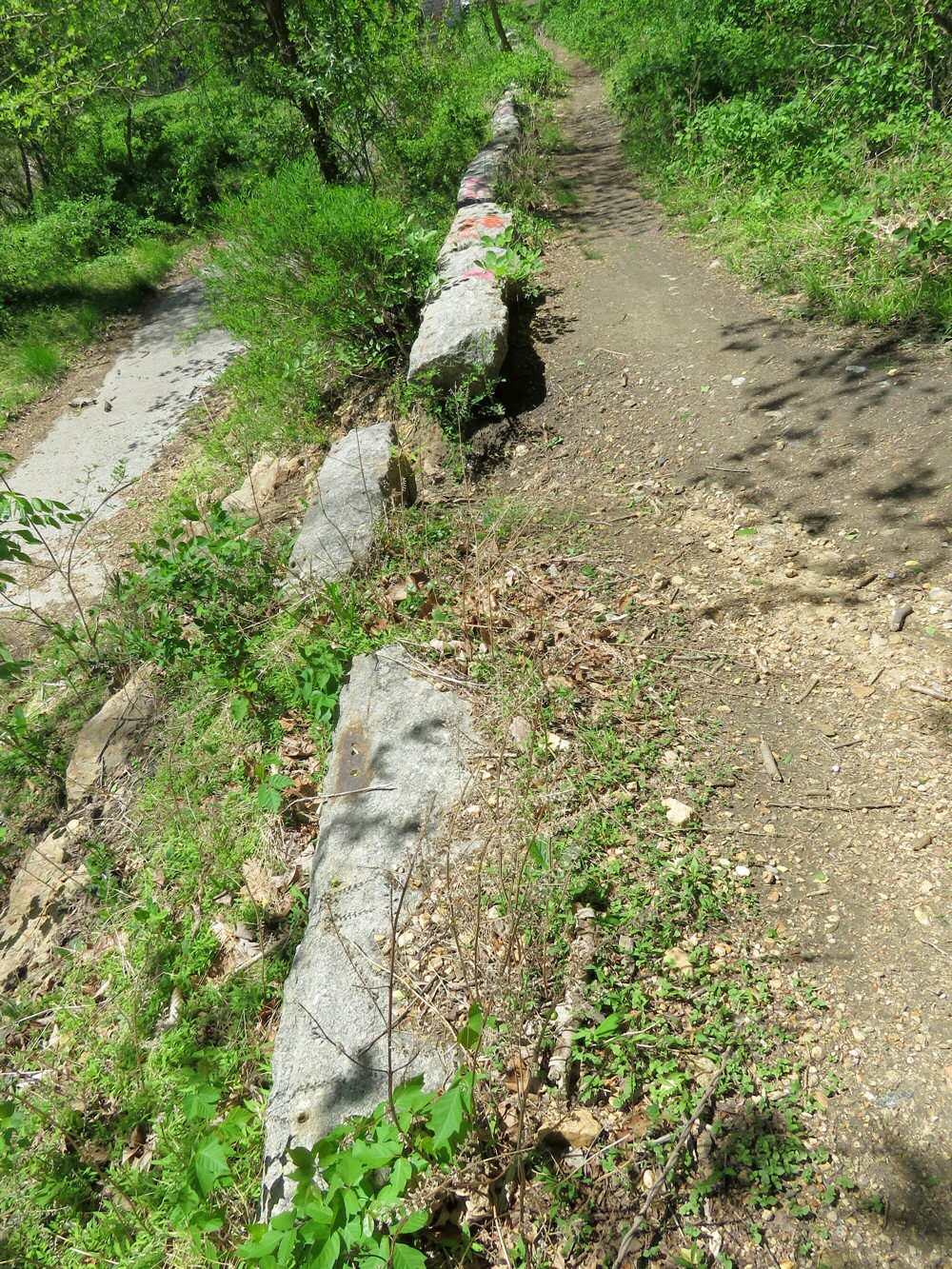
Returning from WE AVALON I follows the original B&O RoW where some of the original granite stringers have been exposed.  Back in 1830's railroad technology was still being developed and instead of wooden ties, the line used granite blocks laid end to end with the rails bolted in place.  One can still see the bolt holes, 190 years later.


I then switched over to a trail that went up and over the hill the tunnel bored through that gave me these views over the PatapscoRiver.


Heading back to my car one of the locals expressed his opinion of photographers with zoom lenses that can document their unsafe behavior.


A short while later I found myself in Garret Park, MD in the late afternoon when Amtrak Train 29, the westbound Capitol Limited, went through with Amtrak P42DC #129.


Heading to DC a few days after that I caught ACS-86 #600 at BWI, followed by my MARC train led by Bi-Level K-car #7848.


At Union Station 7k cars seemed to be in the majority, but I managed to score a 3k car heading to downtown.


At the end of the day my peak period MARC express train was being hauled by leased Amtrak ACS-86 #623.


On adjacent tracks were Acela Express trainsets with power cars #2007 and #2005.


Back at BWI to take Amtrak to Philly, I caught a southbound Acela Express, trailed by power car #2038 before my northbound Regional with ACS-86 #660 showed up.


At 30th St station I had a choice between SEPTA Silverliner IV #435 and Silverliner V #849.  I chose #849 for the railfan view. 


That ended up being a mistake as for reasons unknown, my train stopped at Suurban Station and I bailed out to catch PATCO at 15th/16th and Locust.  Here is SEPTA SL-V #726 also waiting at Suburban. 


The concourse under Dillworth Plaza has been undergoing a multi-year renovation effort and I was surprised to find it all open for service.  The dingy concrete space had been turned into a bright and clean pedestrian passageway.


I haven't managed to catch a Pemberton Industrial Track movement in years, but wile in Moorestown for a reunion I snagged NS GP38-2 #5278 heading north towards Mt. Holy.


I will conclude the set back at 30th St with another pair of Acela Express trainsets, side by side on the lower level of 30th St.  Not sure what the far set was up to as both were displaying red markers.  Power car numbers were #2019 and #2033.


That's all for this week.  Next time I will be heading off to San Francisco!