Surprisingly, for someone who is known for standing at the back of Amtrak trains and taking pictures out the rear, I had never conducted a full survey of the NEC. I had done some bits and pieces here and there, but often the high speeds combined with the double window shooting would make the pictures from my mid-range camera grainy and blurry. Also I rode the NEC so frequently that most times I was content to simply sleep because I could always get any pictures I needed whenever I wanted. Well, then Amtrak moved Business class to the last car of the train and getting rear window shots became a major headache.
Therefore, when provided the opportunity of my yearly trip to New Hampshire and a class upgrade coupon, I brought along my DSLR and stood the 3 or so hours between the Gunpowder River and New Rochelle getting whatever photos I could out the back of a northbound Regional. Because of the speed and double tinted windows the quality isn't perfect, but it is better than what I was able to take in the past under similar circumstances.
You can find the full set here, but today's Part 1 will cover from Magnolia to Trenton.
We begin at WOOD interlocking in Edgewood, MD. The brick tower was built in the 1930's and at one point had CTC control of several adjacent interlockings up through the 1980's.
Beyond WOOD there are two movable bridges, one over the Bush river and the other over the Susquehanna. Both require special procedures for opening (MoW crew to unbolt the rail), however only Bush is within interlocking limits and has scheduled openings.
Here we see PERRY tower and the southbound interior signal bridge. Amtrak was in the process of instituting Rule 562 operation between BACON and GRACE. Given that PRINCE, PERRY and GRACE interlockings are back-to-back, I am not sure what use the Rule 562 operation would be. On the Shore Line similar circumstances were kept as islands of Rule 261. Note the bagged 'C' boards on the southbound signals to display Rule 280a, Clear to Next Interlocking.
Passing Acela Express power car #2026 near Northeast, MD.
Passing SEPTA Silverliner IV #411 on a Philly run from Newark, DE as it enters DAVIS interlocking.
Between REGAN and YARD interlockings south of Wilmington, Amtrak has been trying to eliminate a 2 track bottleneck for at least the last 6 years. Here we can see the new Shellpot Branch signal southbound at REGAN, the new track finally being laid between the two interlockings and new auto-plates on the signals at YARD as this will result in that interlocking being retired.
SEPTA Silverliner V #713 laying over at Marcus Hook PA waiting to return to Philadelphia.
Note, due to a web hosting failure many of the links will not function. Please be patient as I repair the damage.
Search This Blog
Thursday, August 31, 2017
Saturday, August 26, 2017
17-08-26 PHOTOS: Baltimore Metrorail Shoppe Tour
So here we continue with Part 2 of my Baltimore transit shoppe tours sponsored by the Baltimore Chapter NRHS. In Part 1 we visited the Light Rail's North Avenue Shoppes, which were constructed ~1992 as part of what would be a pioneering light rail system, setting many of the patterns later replicated across the country. However Baltimore's other rail transit system, the Metro Subway, is a much more traditional heavy rail subway system constructed in the old style of transit that quickly went out of fashion as construction costs ballooned in the later half of the 20th century. The Metro Subway yard and shoppe complex, located in the Reisterstown section of Baltimore feels distinctly different from the Light Rail shoppe across town. At Light Rail there is a feeling of agility and dynamicism. At the Metro Subway one can feel the work rules hanging in the air. It's a great example of why heavy rail systems faded from the scene,
Anyway, you can find the full set of photos here. The Light Rail pictures are at the top followed by the Metro Subway photos.
To get to the Metro Subway Shoppes, we took mass transit. However the Metro and Light Rail lines do not have a direct connection. The best that is offered are two block long walking connections at Cultural Center / State Center and Lexington Market. Here we see Maryland LINK painted LRV #5019 dropping off tour participants at the Cultural Center station.
The Reisterstown Plaza station offers a sweeping curve west of the platform where one can get entire trainsets in the frame. A similar vantage is offered for eastbound trains at Millford Mill. The Metro runs with 4 or 6 car consists.
Here we see a diagram of the yard on the Yardmaster's console. The yard is a typical storage facility and shoppe combination, however there is a stub tail track at each end with access being provided via a number of main line connections on the north side. Long story short, you aren't getting out of the yard without at least one backup move.
We begin with the replacement truck storage area, which is currently sitting empty because truck rebuilding has been outsourced and most of the spare trucks were currently off property. The area is also equipped with a pair of lifts so that workers can get more easily to under-frame elements.
Spare motors, however, were on hand. They are of the DC variety in the 120hp range. Like the trucks, overhaul of the motors has also been outsourced to the same outfit that rebuild's WMATA's motors.
One thing the Metro Subway shoppe still rebuilds in house are the thyristor chopper motor controllers. By chopping a DC current, the apparent voltage is reduced and fine grain speed control is achievable with a solid state device. Much more efficient than cam controlled resistance drives, however still note the large heat sinks.
Heavy machinery abounds like this turret lathe.
Ground level spare DC motors (info) with the inspection plates removed to show the commutators. What's not to like about a motor system that is easily repairable with domestically sourced components!
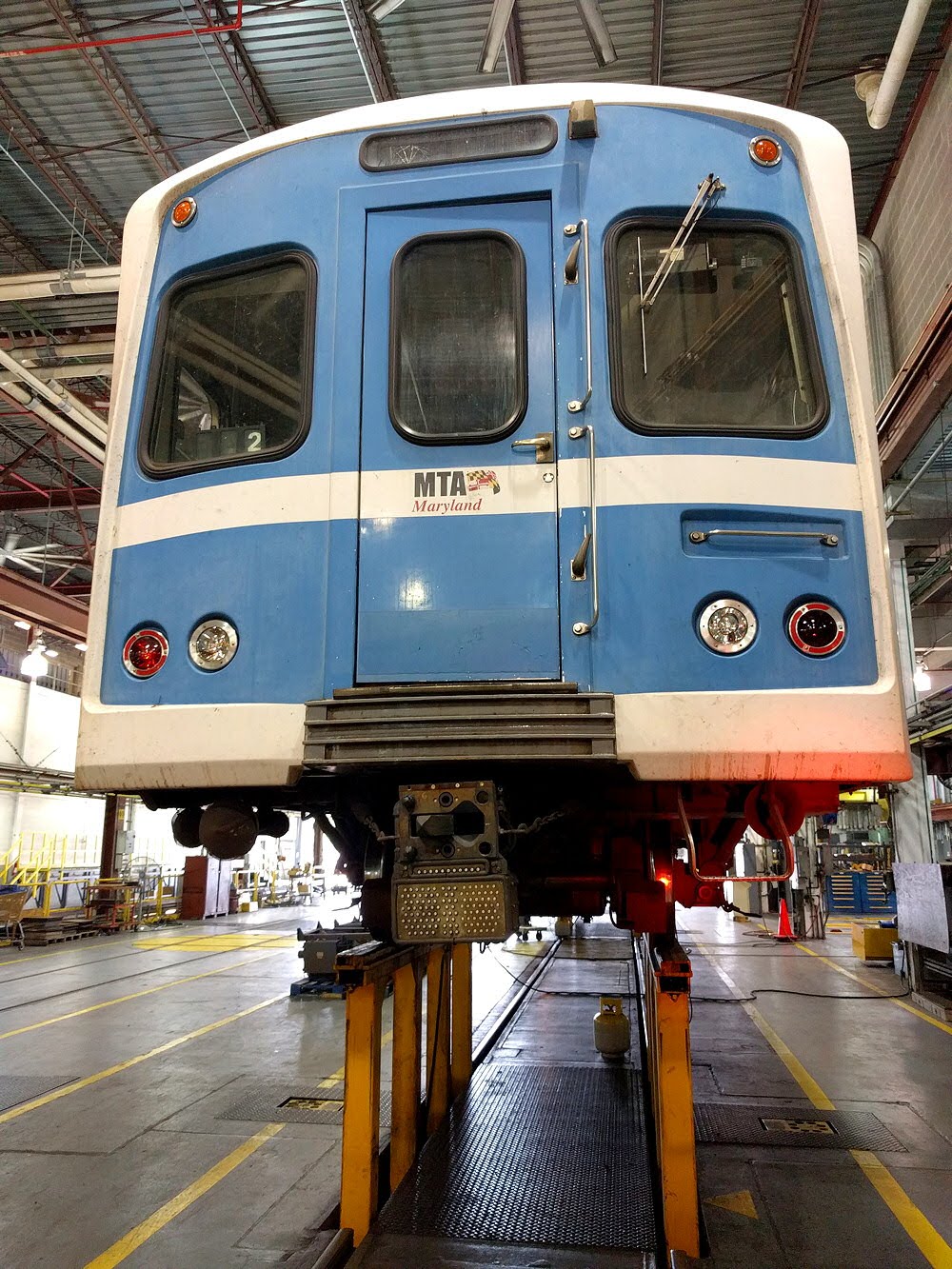
The Metro Subway has 100 Budd model Universal Transit Vehicles on the property. These were purchased in 1983 in conjunction with the Miana Metrorail. The cars are 75 feet long and are capable of 70mph operation, which is achieved for a few miles on the far western end of the line. Here we see #138 standing up on jacks for maintenance.
To get to the Metro Subway Shoppes, we took mass transit. However the Metro and Light Rail lines do not have a direct connection. The best that is offered are two block long walking connections at Cultural Center / State Center and Lexington Market. Here we see Maryland LINK painted LRV #5019 dropping off tour participants at the Cultural Center station.
The Reisterstown Plaza station offers a sweeping curve west of the platform where one can get entire trainsets in the frame. A similar vantage is offered for eastbound trains at Millford Mill. The Metro runs with 4 or 6 car consists.
Here we see a diagram of the yard on the Yardmaster's console. The yard is a typical storage facility and shoppe combination, however there is a stub tail track at each end with access being provided via a number of main line connections on the north side. Long story short, you aren't getting out of the yard without at least one backup move.
We begin with the replacement truck storage area, which is currently sitting empty because truck rebuilding has been outsourced and most of the spare trucks were currently off property. The area is also equipped with a pair of lifts so that workers can get more easily to under-frame elements.
Spare motors, however, were on hand. They are of the DC variety in the 120hp range. Like the trucks, overhaul of the motors has also been outsourced to the same outfit that rebuild's WMATA's motors.
One thing the Metro Subway shoppe still rebuilds in house are the thyristor chopper motor controllers. By chopping a DC current, the apparent voltage is reduced and fine grain speed control is achievable with a solid state device. Much more efficient than cam controlled resistance drives, however still note the large heat sinks.
Heavy machinery abounds like this turret lathe.
Ground level spare DC motors (info) with the inspection plates removed to show the commutators. What's not to like about a motor system that is easily repairable with domestically sourced components!
17-08-26 PHOTOS: Baltimore Light Rail Shoppe Tour
In August 2017 I caught wind of a Baltimore Chapter NRHS shoope tour event via Facebook. The chapter had arranged with the Maryland Transit Administration for a guided tour of both the Light Rail Shoppe off North Ave in Baltimore City and the Metro Subway Shoppe in the Reistertown section of the city. As a West Jersey Chapter NRHS member I was able to glom onto the tour in a way similar to that when I was able to accompany the Baltimore chapter on a SEPTA 1234 Market tour in 2013. Transit shoppe tours are always a blast and provide a lot of real nuts and bolts information about how various transit systems operate and what problems are always gumming up the works. A two-for-one tour such as this was a rare opportunity and something that I was sorely needing to do having been in the Baltimore area for over a decade.
The full gallery covering both tour stops can be found here, but for the sake of space this post will confine itself to the Light Rail shoppes.
Although I lived in walking distance, access to the facility was possible only by vehicle. However after getting picked up at the North Ave Light Rail stop, I was driven by a Baltimore Chapter member to the shoppe facility.
Our tour guide was a project manager for the Light Rail system and was currently working on some of their capitol improvements, most notably the rebuilding of the entire 1992 vintage LRV fleet.
After getting some special VIP day passes, we entered the shoppe where car #5034 in a Frutopia wrap had just entered while a Maryland Flag wrapped car was up on a lift in an adjacent bay.
Each LRV had three trucks, although only the end trucks are powered. Propulsion is AC and these were one of the first transit vehicles in North America with AC drive. Here we see one of the AC traction motors and a disc brake assembly, which is common to all three trucks.
Here we see a space truck, ready to be installed. The truck frames were fabricated by an outfit in Ohio and every axle had a single inboard disc brake assembly, even on the unpowered trucks.
Here we see a lineup of fresh axles, all with discs and a few with a gearbox assembly for the motor.
Like all transit shopped there was a giant lathe capable of turning axles and other cylindrical components.
Although we did not tour the dispatch office, there was a dispatch workstation located in the Yardmasters office right off the shop floor. Here we see a power dispatch screen to the left and a CTC model board on the right.
Here we see the North Ave Yard. Due to the location of the old railroad bulk transfer facility to the north the yard is single ended and movements heading north of the facility need to make a backup move in the North Ave station pocket track.
The full gallery covering both tour stops can be found here, but for the sake of space this post will confine itself to the Light Rail shoppes.
Although I lived in walking distance, access to the facility was possible only by vehicle. However after getting picked up at the North Ave Light Rail stop, I was driven by a Baltimore Chapter member to the shoppe facility.
Our tour guide was a project manager for the Light Rail system and was currently working on some of their capitol improvements, most notably the rebuilding of the entire 1992 vintage LRV fleet.
After getting some special VIP day passes, we entered the shoppe where car #5034 in a Frutopia wrap had just entered while a Maryland Flag wrapped car was up on a lift in an adjacent bay.
Each LRV had three trucks, although only the end trucks are powered. Propulsion is AC and these were one of the first transit vehicles in North America with AC drive. Here we see one of the AC traction motors and a disc brake assembly, which is common to all three trucks.
Here we see a space truck, ready to be installed. The truck frames were fabricated by an outfit in Ohio and every axle had a single inboard disc brake assembly, even on the unpowered trucks.
Here we see a lineup of fresh axles, all with discs and a few with a gearbox assembly for the motor.
Like all transit shopped there was a giant lathe capable of turning axles and other cylindrical components.
Although we did not tour the dispatch office, there was a dispatch workstation located in the Yardmasters office right off the shop floor. Here we see a power dispatch screen to the left and a CTC model board on the right.
Here we see the North Ave Yard. Due to the location of the old railroad bulk transfer facility to the north the yard is single ended and movements heading north of the facility need to make a backup move in the North Ave station pocket track.
Monday, August 21, 2017
17-08-21 PHOTOS: Eclipse Project
I kicked things off at the Haddonfield PATCO station, catching unrebuilt Vickers car #291.
Rolling out onto the Reading Viaduct on a northbound R6 train.
Front end video of my R6 train diverging over the 3 other main line tracks at 16TH ST JCT.
Passing Silverliner V #737 at Roxborough.
SEPTA #723, The Silverliner V I was riding on, at Norristown.
SEPTA Silverliner V #737 departing through KALB interlocking.
Gnarly summer squall line moving across the Delaware Valley.
While in the area I stopped by CP-NORRIS on the NS Harrisburg Line. While there a westbound freight arrived from Philadelphia with a pair of NS C44-9W's #9824 and #9064. The train was routed into Abrahms yard and stopped for the conductor to get out and hand align some switches.
Better views of the engines as they slowly enter the yard.
Saturday, July 8, 2017
17-07-08 PHOTOS: Metro Detour
So last summer someone I know from the UK needed to catch a flight out of International Airport Dulles and I suggested that we make a day out of it and visit the Udvay Hazy Center before his late afternoon flight. To somewhat complicate matters another friend who had offered to actually do the driving wanted to spend three additional hours after the Dulles trip to go and see his horse. I made a counter proposal that he just drop me off at the Wiehle-Reston Silver Line stop and I'd make my way home via the Metro and MARC Weekend Service. unfortunately things turned out to be a little more complicated than I had anticipated.
I'll start with a few photos from the Udvar Hazy center. First a Vought F4U Corsair.
The B-29 Enola Gay.
Me 163 Komet with an HWK 509 rocket engine.
A PBY-5A Catalina sitting next to the Apollo 11 spacecraft in the restoration hanger.
Upon leaving the museum I got this photo of an Air France A380 #F-HPJD landing at IAD.
Catching a waiting METRO train of the classic style at Wiehle-Reston.
Unfortunately the Blue/Orange trunk line was shut down somewhere between Roslyn and Metro Center so Silver Line trains were having to turn at Ballston Spa. This would force a transfer to an Orange Line train, but that would get me only as far as Roslyn where I would need to transfer to a Blue Line train to take me to Pentagon where I could finally get across the river on a Yellow Line train. The closure basically turned a 2 seat ride into a 5 seat ride!!
I was able to get some rear railfan window video while on the Blue line between Roslyn and Arlington Cemetery.
I'll start with a few photos from the Udvar Hazy center. First a Vought F4U Corsair.
The B-29 Enola Gay.
Me 163 Komet with an HWK 509 rocket engine.
A PBY-5A Catalina sitting next to the Apollo 11 spacecraft in the restoration hanger.
Catching a waiting METRO train of the classic style at Wiehle-Reston.
Unfortunately the Blue/Orange trunk line was shut down somewhere between Roslyn and Metro Center so Silver Line trains were having to turn at Ballston Spa. This would force a transfer to an Orange Line train, but that would get me only as far as Roslyn where I would need to transfer to a Blue Line train to take me to Pentagon where I could finally get across the river on a Yellow Line train. The closure basically turned a 2 seat ride into a 5 seat ride!!
I was able to get some rear railfan window video while on the Blue line between Roslyn and Arlington Cemetery.
Monday, July 3, 2017
17-07-03 PHOTOS: Pennsylvanian
As you have seen I have been desperately trying to document the PRR signals on the Main Line before they are replaced in over the next year or two. In the summer of 2017 I had the opportunity to ride the Pennsylvanian eastbound from Pittsburgh to Philadelphia, which would supplement my 2009 photo survey of the line in the opposite direction. I even booked Business Class to make sure I would get a view out the back. Unfortunately, despite booking on a Monday Morning, my train attracted a PV out for a short joy ride over the curve to Harrisburg and back and was denied a view of the most important part of the line :-( I did my best out the side window and I got rear shots east of Harrisburg, but all in all the trip was a bust.
If you are interested in the full set of photos I did manage to get, they are here.
The business class car was at the front of the train so I had the time and opportunity to get some pictures under the Pittsburgh train shed. Here we see Amtrak P42DC #89 on one of the two stub end tracks used by the Pennsylvanian.
The old PITT tower is visible through the trainshed columns. Built in the early 1950's, the tower housed one of the last and largest US&S Model 14 machines ever installed. Today the tower functions as a Port Authority police station with operational responsibility over the adjacent east busway that took over half of the former PRR Main Line right of way.
Here we look westward down the main station platform. Mainline track 1 is used by the Capitol Limited with a midnight westbound departure and an 5:30am eastbound departure. To the right of that is the old 3000' long Pitt controlled siding that used to store helper sets. In the 2000's, the west connection to the siding was removed leaving it as an infrequently used stub track.
Some railfans out to catch the PV movement at Latrobe.
A couple of views of Johnstown, PA. The first is a view from the Stone Bridge of the the Conemaugh River, channelized to prevent a recurrence of the deadly flood of 1889. The Stone Bridge, built in 1888, survived the flood unscathed and continues to serve in its original capacity. The second picture shows the top of the surviving PRR Johnstown Station.
Here we see the rear end of NS SD70ACU #7326. These were rebuilt SD90/43MACs purchased from Union Pacific over the last few years.
The offending private car was RPCX #2263 "Berlin", seen here rounding the horseshoe curve.
The viewing area was well patronized that day with fans seen here with PRR GP9 #7048.
Passing another train, the head end lashup included NS #6752, a former Conrail SD60I and NS #9250, an operation Lifesaver painted C44-9W.
If you are interested in the full set of photos I did manage to get, they are here.
The business class car was at the front of the train so I had the time and opportunity to get some pictures under the Pittsburgh train shed. Here we see Amtrak P42DC #89 on one of the two stub end tracks used by the Pennsylvanian.
The old PITT tower is visible through the trainshed columns. Built in the early 1950's, the tower housed one of the last and largest US&S Model 14 machines ever installed. Today the tower functions as a Port Authority police station with operational responsibility over the adjacent east busway that took over half of the former PRR Main Line right of way.
Here we look westward down the main station platform. Mainline track 1 is used by the Capitol Limited with a midnight westbound departure and an 5:30am eastbound departure. To the right of that is the old 3000' long Pitt controlled siding that used to store helper sets. In the 2000's, the west connection to the siding was removed leaving it as an infrequently used stub track.
Some railfans out to catch the PV movement at Latrobe.
A couple of views of Johnstown, PA. The first is a view from the Stone Bridge of the the Conemaugh River, channelized to prevent a recurrence of the deadly flood of 1889. The Stone Bridge, built in 1888, survived the flood unscathed and continues to serve in its original capacity. The second picture shows the top of the surviving PRR Johnstown Station.
Here we see the rear end of NS SD70ACU #7326. These were rebuilt SD90/43MACs purchased from Union Pacific over the last few years.
The offending private car was RPCX #2263 "Berlin", seen here rounding the horseshoe curve.
The viewing area was well patronized that day with fans seen here with PRR GP9 #7048.
Passing another train, the head end lashup included NS #6752, a former Conrail SD60I and NS #9250, an operation Lifesaver painted C44-9W.
Labels:
Amtrak,
interlocking,
interlocking tower,
main line,
NS,
PATCO,
position light,
PRR,
PV,
signals,
station,
survey
Subscribe to:
Posts (Atom)