Search This Blog

Thursday, June 17, 2010

10-06-17 PHOTOS: Capitol Limited Freight Spectacular - Part NS

Here is Part 2 of the westbound Capitol Limited trip I took with my father last Summer. The first part covered the former B&O route now owned by CSX between Washington, DC and Cumberland, MD. This part covers the former New York Central/Conrail Chicago Line now owned by NS between Ligonier, IN and South Bend, IN and then between Porter, IN and Chicago, IL. While I had very favorable sunlight on the first half of the trip, as the world turned the afternoon front lighting turned to morning back lighting so unfortunately almost all of these photos have less than optimal lighting and by less I mean these photos generally suck. However they aren't blurry and useless, just backlit with odd colors. I tried my best to fix the problem in post, but there was only so much I can do.

The photos cover two ranges of the Chicago Line, the first from CP-397 through to CP-437 in South Bend and the second from milepost 489 through to milepost 516 in Englewood, IL. I began where the railroad took a slight turn to the north and got the morning sun away from shining directly into the back of my train. The omitted section was where NS had already carried out a re-signaling project and I decided not to waste my time. I will attempt to pick out the most informative of the photos, but if you don't mind viewing photos with some technical difficulties I urge you all to view the complete set here.

The super-set of photos from both parts CSX and NS will be available at this link.

http://acm.jhu.edu/~sthurmovik/Railpics/10-06-17_CAPITOL_LIMITED_FREIGHT_SPECTACULAR/-Thumbnails-NS.html

We begin at CP-397 in Ligonier, Indiana. This is a facing point half-crossover on the former Conrail Chicago Line. The New York Central was a early adopter of CTC technology and its entire Albany to Chicago main line is dotted with little oddities such as half crossovers or asymmetric block lengths depending on direction. This interlocking has also seen a bit of modification including the addition of two traffic light style masts on #1 track, but the retention of the NYC era masts on #2 track, including an old bracket mast. The two traffic lights were installed at different times (one is a darth, the other is not) so either there were issues with the structural integrity of the original equipment or this interlocking is prone to derailments.

In the background we can see that the Gerber St grade crossing has been removed for rehabilitation.


The Freight Spectacular bit wasn't confined to the CSX portion of the run. Here we see NS SD70N-2 #2678 with an eastbound mixed freight train in Millersburg, IN.


Here we see a late model New York Central style signal gantry at the 418 automatic approaching Elkhart, IN. That line of darkness is a squall line that marked the leading edge of a line of severe morning thunder storms that my train was to pass through.


When it rains it pours here at the Elkhart Amtrak Station showing the mini-NYC gantry that guards the east end of CP-421 that marks the east end of Elkhart's Robert Young Yard and and the junction with the Kalamazoo Branch which crosses the outer Track 1 via a diamond to connect directly with track #2.

Based on the track alignments you can tell which was the original route and which was added later.


Bad news for the old NYC Bracket Mast at CP-423, but fortunately it is only a partial re-signaling. Robert Young yard it off to the right.


West end of the Robert Young Yard at CP-425 showing a classic NYC gantry that has had its footings reconstructed instead of being replaced by some new signal gantry. Reduce reuse recycle is what I always say.


A somewhat blurry photo taken in the rain of CP CEFX lease unit #1040 approaching Elkhart.


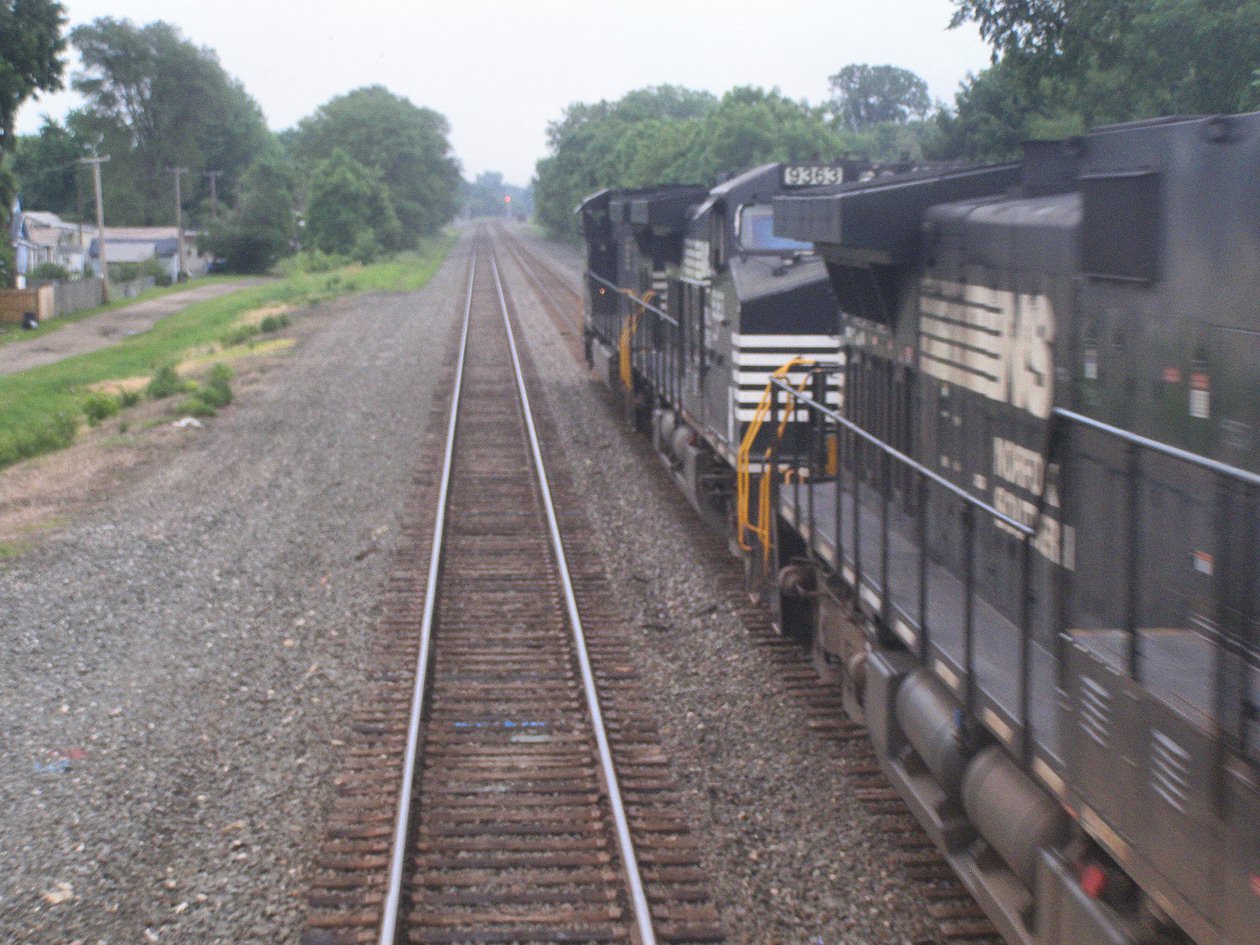
Another freight is in line to the Elkhart terminal with NS C40-9W #9363 in the lashup.

10-06-17 PHOTOS: Capitol Limited Freight Spectacular - Part CSX

Last summer I treated my father to a Amtrak trip to Chicago with sleepers booked on the Capitol Limited westbound and the cardinal eastbound with an additional night spend in the Windy Apple itself. Over the course of this trip I took probably more than 1000 photos and today I present the first part of the first set of photos. I had originally planned to present the entire westbound photo set at once, but I had so many good pics from just the CSX portion of the Capitol Limited ride that when I finished up that section it made the most sense to post it as the first part of a two part installment.

The name of the set comes from the exceptional amount of freight my train encountered on its westbound journey from Thursday afternoon to Friday morning. Despite all of the freight traffic dispatchers at both CSX and NS performed an exceptional job at keeping out train running on Clear signals and we even had an early arrival in Chicago. Today's set documents the journey over the former B&O main line between Washington and Cumberland which is today's CSX Metropolitan and Cumberland Subdivisions. My photos focus on the parts of the line that have retained their classic B&O CPL signals. My trip was taken as close to the summer solstice as possible to ensure the maximum amount of daylight for photos and by the time I stopped for the night in Cumberland it was approaching 7:30PM.

The first part of this photo set can be found here:

http://acm.jhu.edu/~sthurmovik/Railpics/10-06-17_CAPITOL_LIMITED_FREIGHT_SPECTACULAR/-Thumbnails-CSX.html

And I really encourage anyone who reads this to check it out as I had pretty good conditions for the trip and there will be many good photos that won't get a featured spot.

We begin in Baltimore with a southbound Amtrak Regional departing the station behind AEM-7 #918 under a Medium Approach signal.


Of course because the Medium Approach aspect involves flashing it requires some sort of moving picture to do it justice, which fortunately I am able to provide :-)


The Meeps were already invading Baltimore in the summer of 2010 as #24 arrives with a northbound train.


At Washington Union Station we find an instance of the very old leading the old leading the young as Amtrak SW1000R #793 tows MARC GP40-2WH #60 and MP36-2C #16.


Out on the Metropolitan Sub my train encounters old B&O stations now in MARC Brunswick Line service such as this one at Germantowne.


And classic B&O CPL signals such as these at Seneca Fill. Most of the Metropolitan sub was re-signaled in the early 90's to coincide with the expansion of MARC train service which also brought about the GP40s and single level K-cars. Fortunately CSX was still installing CPLs in B&O territory for new signal projects.


Since I now have ample access to the Point of Rocks station and interlocking complex via car I decided to capture a Westbound move from the Washington branch to the original Main Line alignment with video. Here the train makes a move from track 1 to track 1 on the Metropolitan sub, but traverses two reverse turnouts to do so as the Old Main Line routing still gets the normal speed signals.


Approaching those High Rock signals I profiled in last weeks photo essay I discovered a partially camouflaged railfan hiking the tracks. How do I know he was a railfan? He later gave himself away.


Shortly thereafter we passed the first of many freight trains. This time it was an westbound coal train with a pair of helpers on the rear the lead of which was CSX AC44CW #448.


The conductor gives me a wave as my train overtakes CSX SD50-2 #8567 as it waits at East Brunswick interlocking to enter the yard.


Monday, May 31, 2010

10-05-31 PHOTOS: C&O Canal CPLs

The C&O Canal Trail is a 184 mile long National Historic Park that runs between Washington DC and Cumberland, Maryland. It basically consists of the old C&O Canal and its towpath, but the improved surface and gentle gradient has made the park very popular with cyclists. While the subsequent B&O Railroad Main Line followed the route of the canal, it frequently diverged from the actual path of the canal, usually having the Potomac River intervening. However between Point of Rocks, MD and Harpers Ferry the railroad and canal run side by side thus turning your typical bicycle journey into a railfanning opportunity as well. In addition to the Marc/Amtrak Stations at Point of Rocks and Harpers Ferry, there is a large rail yard facility at Brunswick, MD which also serves as a MARC yard and hosts the last active interlocking tower in Maryland.

For this trip I started at Point of Rocks and biked the 12 miles to Harper's Ferry before returning. On the way out I made a stop about 1.5 miles from the start at the Milepost 70 automatic signals at HIGH ROCK and then on my return trip I took some pictures at the Brunswick MARC station (for which it is called the Brunswick Line) and then at East Brunswick interlocking at the east end of the yard.

You can find the full set of photos here which contain a lot more pictures of B&O CPL signals which some people tend to describe as "boring".

Be begin at Point of Rocks around 11am. A quick call to Julie informed me that Amtrak's Train 30, the eastbound Capitol Limited, was on time at Harpers Ferry which meant I should be expecting it soon. This information was confirmed when the dispatcher displayed a Medium Clear signal eastbound on track #1 at POINT OF ROCKS interlocking on the CSX Metropolitan Sub. Visible in the center of this photo is the Point of Rocks Station which sits in between the CSX Metropolitan Sub to Washington DC (right route)and the CSX Old Main Line Sub to Baltimore (left route). Notice that CSX's trademark speed restriction boards are up at the interlocking limits. Also note how the relay cabins are up on stilts due to the propensity of this area to flood.


I hiked a few feet up the right of way to capture t30 as it emerged from the Point of Rocks tunnel. This tunnel was single tracked with a bypass blasted around the rock outcropping way back in the B&O era for clearance reasons. I was lucky enough today to catch T30 wrong railing and thus giving me this cool tunnel shot.


Shortly after T30 had departed the scene I noticed the dispatcher has lined a straight route down the OML for some sort of freight movement. By the time I reached the High Rock automatic signals (a feat that involved crawling across a slick, semi-rotten log across stagnant C&O canal water), that first train had already gone past, however Train 30 passage had uncorked the bottle so to speak and I was gobsmacked when the automatics lit up indicating another eastbound freight train was approaching. Even better was that the track 1 mast was displaying an not-to-common Approach Slow, which uses the yellow tinted 2 o'clock orbital.


I was unsure what signal condition would cause this Approach Slow to persist for such a long period of time, but it did until CSX AC4400 #353 showed up on the head of a long coal train. That CSX had this train wait for T30s passage indicates that the company is at least making an effort to give some priority to Amtrak trains.


AC4400 #55 was the second of the lead locomotives.


The track 2 mast was displating Approach in both directions as the coal train passed by. The High Rock automatics were powered via a 440v feed on a pole line from East Brunswick.


The coal train had a pair of helpers attached including SD40-2 #8449.


Saturday, May 29, 2010

10-05-29 PHOTOS: Harrisburg Line Eastbound

A year ago on Subchat I was posting the first part of my epic PRR Main Line Main Line Survey. However as comprehensive as that survey was it only told half the story because I could only take photos in the eastward direction from my westbound train. Well shortly after i finished positing that epic survey I found myself with Chuchubob on an Amtrak Guest Rewards motivated trip on Amtrak's Harrisburg Line. The trip was to consist of three individual Amtrak trips,Philly to Middletown, Middletown to Harrisburg and Harrisburg to Philly via the Pennsylvanian. Despite the presence of Metroliner cab cars, getting a railfan view, either front or rear, on the line is rather hit and miss as cars are closed and, at least until 2010, the Pennsylvanian had a Club style business class compartment on the rear.

As a result my expectations of this trip were rather low, consisting of just a few pics out the side window and whatever I could take at Middletown and at Harrisburg. However, much to my surprise I discovered that the Pennsylvanian had recieved a full Business Class car which had been moved to the front and therefore there was an open window out the back. Not willing to pass up a gift horse I took advantage of the situation and at least carried out an eastbound survey of the PRR Main Line between Harrisburg and Philly. The weather wasn't the best and most of the pictures had to be taken through two sets of glass, but it captured the state of the line before the segment between Lancaster and Parkesburg before they were re-signaled.

Anyway this set of photos will cover Amtrak operations at Lancaster, Middletown and Harrisburg, Middletown and Hummlestown operations at Middletown and the best of the survey pics taken between Harrisburg and Philly.

You can see the entire set of photos here.

We begin with Amtrak AEM-7 #951 at Lancaster, PA. Due to single tracking ahead we had to wait for about 10-15 minutes at Lancaster and so I had some time to step off and take some photos.


CORK tower had been cut over to the new non-1920's technology interlocking. Here is a photo of the still open tower with a new style relay hut in front of it.


Here is a picture of the new coloruized position mast signals at the new CORK interlocking with a Clear signal displayed on the 2W signal.


The rear Metroliner cab car #9634 was "closed" in terms of people sitting there, but while waiting to depart Lancaster I popped back and took a picture of the cab signal display unit in the Cab Car Cab. This CSS CDU is equipped for ACSES (Amtrak's overlay PTC system) operation with a "track speed" display under the signal speed one. The signal speed is determined by cab signal codes, the track speed is determined by an internal database updated by track mounted beacons that provide TSR and train positioning information. A wider shot reveals that the Metroliner speedometer goes up to 150mph.


Because the CSS unit in the non-operating cab had not been cut out (to eliminate the need for a re-test) it was constantly freaking out as it waited for acknowledgement of the Restricting indication. I love these CDUs both because of their minimalist nature and super awesome full color position light display.


Arriving at Middletown I walked with Bob the few blocks to the Middletown and Hummelstown Railroad's yard just south of downtown Middetown. I've been there before, but I felt obligated to take pictures of the SEPTA PCC cars store there like #2104.


Of course you all know ex-SEPTA CTA L car #477 formerly used on the Rt 100, however today I got a nice shot of the inside and what was stored there. I love those classic PCC light fixtures.


Their Western Maryland painted Alco S6.


And their GE 44-ton #1.


Arriving soon after was one of that days excursion runs featuring a former DL&W MU trailer car in push mode, here having the race Street crossing flagged.


After the flagman remounted the M&H's second GE 44-ton passed by pushing on the rear.


Then it was back to the Amtrak station to take a picture of an eastbound Keystone train headed by cab car #9638. Here is a shot of it passing over the PRR road bridge over Union street that was replaced a few months later.


Sunday, May 16, 2010

10-05-16 PHOTOS: Georgia Horses

Well last week you saw the report about my trip to Georgia, well I didn't just sit around there eating pork and burning crosses because because there were horses about, both iron and the meat kind. My friend lives in Athens, GA, home of a certain football related University and through Athens runs the CSX Abbeville Sub, part of the old Seaboard Air Line freight route between Atlanta Georgia and the pot of Wilmington, NC. Despite being mostly single track the line is about 550 miles long and supports double stack operations. It sees about 10-20 trains a day and a good number of them run in the daytime.

In this trip I had two real opportunities to railfan. The first was when I went with my friend to visit the stable where she rides and performs various kinds of manual labour. The Abbeville sub runs right behind the barn and not only that the MP 511 automatic signal is located there as well. The other outing was a visit to the north end of the Fowler Junction siding in downtown Athens where where is an interlocking with some classic Seaboard signals.

You can view the entire set of photos here and this time I left in some of the non-railfan pics of the various non-Iron horses at the barn and the Anna Rudy Falls in the northern part of the state.

We will begin with the MP511 automatic (5110 eastbound, 5111 westbound). The signal is unfortunately a Darth Vader style mast and not an SAL style "elephant ear", but fortunately this was just a one off replacement and not part of some larger re-signaling effort. The signal is approach lit so that means you have a visual confirmation of an approaching train as soon as one enters the block on either side. Here the 5110 signal is displaying a Clear indication for an approaching train. Note how the new mast has been stuck onto the old base.


A few seconds later a double stack intermodal train lead by CSX C40-8 #7500 rolled through.


End of the double stack intermodal train in the previous photo.


Clear indication displayed on the 5111 signal for an approaching westbound train.


Which turned out to be a manifest freight led by ES44DC #5465. note the opposite direction signals will not illuminate until that block is occupied.


Tail end hi-cube box car on the manifest freight.


The sun was cooperating when CSX SD60 #8718 rolled through with another westbound manifest freight.


Saturday, May 15, 2010

10-05-15 PHOTOS: Georgia Scenic Route

When traveling to Georgia from the Northeast via Amtrak one has two options. You can travel directly via Train 19, Amtrak's Crescent which leaves Washington DC a little after 5PM and travels mostly overnight arriving in Georgia at about sunrise. However there is a second option that involves catching the earlier Train 79, The Carolinian, which departs WAS around 11am and travels via the RF&P, the CSX A-Line and NS H-Line before transferring to Train 19 in Greensboro, NC after a short 6 hour layover.

This route has the added benefit of having a reverse railfan window on Train 79 so you can do more than stare out the window aimlessly and on this trip I was determined to take advantage of it despite the poor light conditions and overcast skies. For those of you scared of a little layover Greensboro has a somewhat happening downtown with a variety of non-fast food eating establishments and one of the best train stations in the Region that was re-opened in 2005 to replace an Amshack that was located away from downtown opposite a freight yard.

Normally if T79 is running on time it will meet the westbound evening Piedmont train across the platform, but on this trip there was a bit of a hiccup. Around 9am a morning Piedmont train struck a low-bow trailer that had become wedged on a grade crossing causing a spectacular derailment and completely closing the H-Line. Fortunately Amtrak was able to respond by terminating that day's Train 80 at Grensboro, Bussing the passengers to Rocky Mount, NC where they would meet my Train 79 and we would perform a little swap. The northbound passengers would take Train 79's set and we would bus past the derailment site and meet Train 80's set at Greensboro that would load up and continue south to Charlotte. Since my destination for this leg of the journey was in fact Greensboro I would be able to enjoy the re-training procedure as a spectator instead of a participant.

At the end of the day my Train 79 arrived at Rocky Mount about 30 minutes late mostly due to a police action way back in DC. The buses for folks using Train 79 past Greensboro went express right from Rocky Mount and we arrived at 7:30, 30 minutes late. So on what was my first Amtrak bustitution I ended up losing a total of 0 minutes.

Anyway. most of the 300 odd photos I took on this trip were out the back of Train 79 as it traveled on the CSX RF&P and North End subdivision. They are grainy and consist mostly of signaling so I won't really bother to showcase them here, but if you are at all interested in what these main lines look like feel free to check out the Ma href="http://acm.jhu.edu/~sthurmovik/Railpics/10-05-15_GEORGIA_SENIC_ROUTE/-Thumbnails.html">entire collection here. The list is in chronological order starting in DC and cover most of the signals, interlockings and bridges except for a stretch between RO and Springfield-Franconia on the RF&P.

So, let's see what we have here. A year ago MARC's old GP40-2WH's were still queen of the roost as the deliveries of MP36's were taking place. Here is #60 at Baltimore Penn Station.


After the trip down the NEC and power change at Washington Train 79 proceeds southbound here emerging from the First Street tunnels which run under Capitol Hill.


Our train crosses the Potomac River on the Long Bridge which was built in 1903. The bridge still features its PRR catenary supports and cross spans as well as the feeder cables for what was electrified freight service into Potomac Yard. The draw span on this bridge no longer operates.


At LORTON intelrocking, where Amtrak's AutoTrain accesses its northern terminal off of the RF&P Main Line, I noticed that the northbound mast signal was displaying a Restricting aspect while the switch points were reverse.


The beefy truss bridge over the Occoquan River.


The new bridge (right) at Possum Point replaces a long irritating single track viaduct (left) that served as a bottleneck on the busy line just north of Quantico, VA. The single track bridge was installed by the cash strapped RF&P in the 1980s. The new bridge provides space for a total of 3 tracks, although only one is installed at this time.


 The AutoTrain finally shows itself at about Milepost 74 (Lorton is MP 92). I guess there wasn't much traffic on the RF&P today if the dispatcher could clear the route into the terminal so far in advance.


Following a bit behind the AutoTrain was a northbound Regional.


 Today what cost thousands of Union lives is easy, crossing the Rapahannock River on a high level concrete arch viaduct at Fredericksburg.

At the Fredericksburg station VRE trains use only track #3 to the right, while Amtrak trains can platform on either track if necessary.


The small Federicksburg yard with CSX SD40-2 #8809.


South of Fredericksburg Yard my train 79 overtook a CSX local freight consisting mostly of tank cars and lead by GP38-2S (rebuilt GP40) #6151 running on track #2.


Here is a still photo taken on the curve after the successful pass.


The local freight soon caught up with us, but we had the last laugh as we were routed ahead of it at HAMILTON interlocking. HAMILTON is one of the few interlockings using classic RF&P style signals which include full speed stacked US&S H-2 searchlight dwarf signals for reverse direction moves. The RF&P was sort of a small one trick pony railroad and had to save costs wherever it cound.


It's all here in one photo, CSX #6151, the reversed crossover, new exit signal on track #4 displaying Approach Medium and the reverse direction dwarf stack.