Search This Blog

Tuesday, November 26, 2019

19-11-27 PHOTOS: Croydon

Every year on the Wednesday before thanksgiving I head out to an NEC station with fellow rail enthusiast Chuchubob in order to catch some of the extra trains Amtrak runs to handle the Thanksgiving crowds. Typically it's just one or two extras with the regular trainsets having a few extra cars added to the consist, but it's always a fun time. Still, there exists a struggle not to have the chosen location get too repetitive. At first the chosen location was Bristol, then Morrisville, then Levittown for a few years and even Tioga thanks to a scheduling mixup. In 2019 I idly decided on giving Croydon a try and I was in no way disappointed. Not only did the station have high level platforms with great sight lines in both directions, it was also situated next to the Milepost 69 intermediate signals and a brew pub which eliminated the need to pack things in early and head to lunch. I had such a good time I will surely be back in future years. You can see the full set of 2019 photos here (mirror).

To save you having to scroll down here is a video montage of many of the trains I captured that day. Due to some technical issues I wasn't able to catch all of the trains, but I did manage to get most of them!


The Croydon parade kicks off with an eastbound Amtrak Keystone service train hauled by Amtrak ACS-86 #644 and including cab car #9632.


Next up was an inbound SEPTA R7 led by Silverliner IV #365 with #398 at the rear.

Amtrak Regional Train XXX with Amtrak ACS-86 #653.

Westbound Keystone this time with ACS-86 #661 passing under the Milepost 69.4 intermediate signals. Metroliner Cab Car #9651 was in back.

An outbound six car R7 was next on track #1 with SEPTA Silverliner IV #156 on point.


What followed was a three way meet between Amtrak Train #98, the northbound Silver Meteor, southbound Acela Express Train XXXX and southbound Regional Train XXX. Train 98 was powered by ACS-86 #639 and included 4 sleepers, a diner and a baggage car for a total of 6 Viewliners. The lead AX power car was #2028 with #2007 trailing and the Regional was being hauled by ACS-86 #619


Friday, November 22, 2019

19-11-23 PHOTOS: Reading Belt Line

The Reading Belt Line was built in 1900 to allow trains of black gold from the Anthracite regions of Eastern Pennsylvania to bypass the increasingly congested Reading yard. It was emblematic of a time when advances in industrial technology would allow the rickety 19th century rail network to get upgraded for the age of steel for those wealthy railroads that could afford it. Running from Klapperthal Jct south of the city to Belt Line Jct in the north, today it hosts the vast majority of NS through traffic on the Reading and Harrisburg Lines as they run between eastern markets and Harrisburg.

What caught my interest was the presence of surviving Conrail era signals on the line which have managed to survive several major NS re-signaling projects in recent years. Always wary of "future developments", I booked a weekend with Reading area rail enthusiast Kevin Painter to visit the Conrail signal locations as well as some other Reading area landmarks. Unfortunately the gods were not kind to me and I caught zero NS freights over the entire course of the day. You can still see all the photos I did get here (mirror).

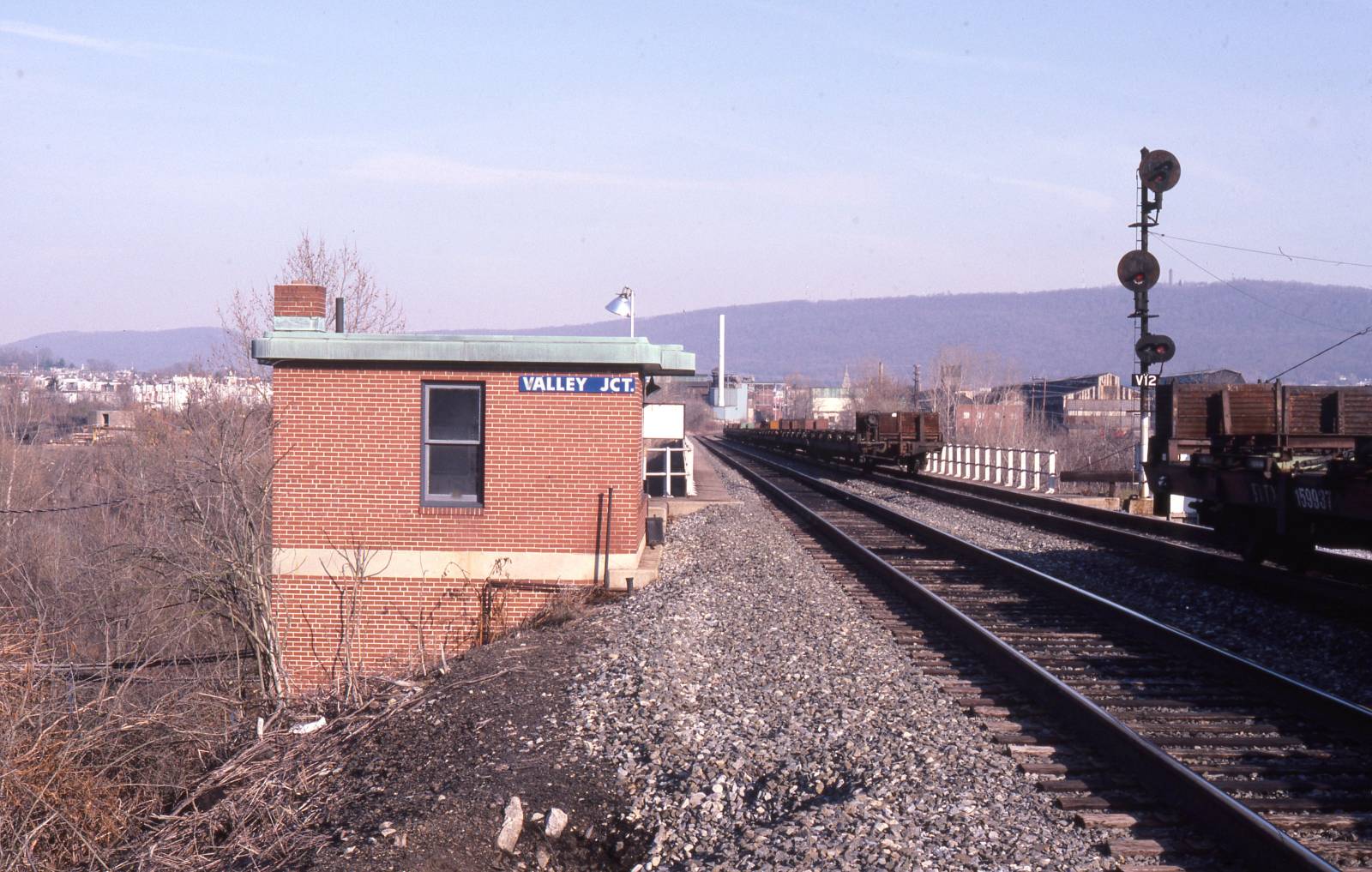
The first stop was CP-TULP where the Reading Line crosses the Tulpehocken Creek via a single track bridge. The entire bridge is within interlocking limits and the interlocking marks the division point where westbound Reading Line trains can head east to Philly or continue west to Harrisburg. First re-signaled by the Reading in the early 1950's as part of a general Reading area CTC project that concentrated control at two new towers, VALLEY JCT and OLEY, much of this territory would be end of life by the dawn of the 21st century and CP-TULP was again re-signaled by Conrail in 1998 or 99, immediately prior to the NS/CSX split. Therefore, as the interlocking hardware is essentially "new enough" it has so far avoided re-replacement. Here we see the eastbound Reading Line signal for eastbound Harrisburg Line traffic adjacent to the Conrail blue station sign.

Although Conrail was known for using "pinch points" instead of a normal double track crossover to save money, the Reading era single track bridge over the Tulpehocken Creek was the motivating factor for CP-TULP's design, not Conrail's frugality. The westbound signals feature 3 heads due to CP-TULP being back-to-back with CP-VALLEY JCT and CP-DUNKLE, necessitating the need for R/Y/G Medium Approach Medium. Although clearly an equilateral turnout, Conrail did not like the concept and designated track 2 as the diverging route.

The milepost 6 intermediate mast signals replaced a pair of Reading era bracket masts visible from the adjacent PA Route 12. The portion of the Reading Line between CP-BLANDON and CP-WYOMISSING JCT uses its own zero based mileage reflecting the history of this route as a bypass.


If there is congestion on the Belt Line or if carloads need to be handled at Reading Yard, trains may be routed via the slow road through downtown Reading. CENTER interlocking, established during the 1950's CTC project, represents the western apex of the old Reading Outer Station wye where traffic bound for Harrisburg would emerge from the Reading terminal complex. Left largely intact from the Reading days, CP-CENTER was recently re-signaled with the western switch and interlocking limits relocated to the west to save on grade crossing logic and allow for a higher speed turnout.


The eastbound signals were also made more descriptive providing for medium and full speed indications to the Pottsville Branch even though speeds on both legs of the old Outer Station wye are only 10mph.

The south leg of the Outer Station Wye is represented by CP-WALNUT. Replaced by Conrail in the late 1990's, new NS signals replaced the Conrail masts in 2018 or 2019. A major hub of activity during the days of the Reading railroad, Outer Station closed in 1969 and was destroyed by fire in 1978. In the early 2000's the city public works opened a large facility on the site and today much of the surrounding brownfield has returned to a natural state.

Looking east towards the old Franklin St station while a parade passes by on Penn St.

Sunday, November 10, 2019

19-11-10 PHOTOS: BOWIE

I have some to find that museums with few interactive elements are somewhat lacking when it comes to repeat visitations. Baring extenuating circumstances one doesn't need additional photos of the same displays year after year. As a result the last time I visited the preserved PRR interlocking tower in Bowie, Maryland was 2007. 12 years later, with opportunities to photograph classic signaling drying up, I decided to make another visit to BOWIE to take some better photos with a better camera. It was nice to see that the museum had been expanded, but NEC photography was still somewhat limited due to the tower having been moved away from the tracks. In addition to the Bowie rail history museum this set also includes photos from a random trip to DC. You can find the full set of photos here (mirror)

My DC trip was of the after work variety so I went about catching MARC at Halethorpe. As typical a southbound Regional was running ahead of the MARC local out of Baltimore with ACS-86 #645 in the lead.


Peak period express trains out of DC typically sport 9+ bi-level cars which are best handled by one of MARC's 6 HHP=8 locomotives. #4912 here was doing the honors this day with bi-level Kab Kar #7846 on the rear.


My reverse peak train to DC was somewhat shorter and led by Kab Kar #7851.

WMATA classic series train at Metro Center with #6109 on the end compared with a new 7k train at the same location.


Amtrak ACS-86 #658 in MARC service at Washington Union Station at night.

K-TOWER interlocking at night with loads of recent construction.

Southbound signals at WINANS interlocking along with the MP 103.1 automatic.

Since my last visit, BOWIE tower had its companion Western Maryland caboose replaced by a Chessie veteran. There was also a new bike path that appears to be the first step in connecting downtown Bowie to the current passenger station.

Saturday, October 26, 2019

19-10-26 PHOTOS: Viva HARRIS Tower

I've never been a huge fan of Las Vegas, however I would always get pushback from people because aside from a 4 hour stint being stranded at the Las Vegas airport, I had a pretty strict personal Vegas boycott going on. Well in October of 2019 a paid-for work related conference had me packing my bags for Sin City and I am pleased to say...that it was even WORSE than I had anticipated. Yes the city is fake and tacky and overpriced, but the rail attractions that did exist were a major pain to get to despite only being a block off The Strip. The people who frequent Vegas were just the worst and the omnipresent security made doing anything with a camera generally unpleasant. As a result of all this and more, most of this photo set (mirror) will come courtesy of a trip I took to HARRIS tower the week after. You heard it here first. Harrisburg, PA is way better than Las Vegas and I'm assuming there's a now casino there as well.

We begin in the totally not Las Vegas location of Magnolia, NJ where I caught the power from the Conrail SAO laying over while the crew was out for lunch. Like the 4 men in a jeep seen in post war Vienna, power consisted of NS GP38-2 #5302, CSX GP40-2 #6238 and a former Southern high hood GP38-2 #5226.


Rolling out of the Philadelphia Suburban Station 20th St portal en-route to 30th St Station.

Running into Amtrak Acela power car #2016 and Veterans painted ACS-86 #642 at 30th St.


My conference was at The Venetian, it was...insulting.

I stayed at the Treasure Island because I got a Priceline thing, it was...a hotel.

The TI was adjacent to SANDS AVE interlocking on the UP Cima sub. The signals were...completely uninteresting.

The Las Vegas MonoD'oh was 1 super-block off strip, so hard to get to, and super expensive. I didn't bother ponying up for a joy ride.

Friday, October 11, 2019

19-10-12 PHOTOS: Metro North Drawbridges

Since Metro North replaced all of its signaling and retired the M2/4/6's and FL-9's, it has been a pretty dull railroad. After all, how many pictures of M8's and P32AC-DMs does one need? (Hint, not that many.) However, MNRR still has a few things going for it, an an interesting electrical system with components stretching back to 1906 and a series of drawbridges with build dates going back even further. In 2019 I teamed up with a couple of local enthusiasts and we went about visiting a number of Metro North's historic New Haven line drawbridges including COB, WALK, SAGA and PECK. You can view the full set of photos here (mirror).

We start off at the COB movable bridge (SS29) in Cos Cob, CT with an Amtrak Acela Express power car #2039 passing over the span while a Metro North high rail truck sits on the out of service track #2.

Passers by often mistake this structure on the west end of the bridge for an interlocking tower, but it is actually the New Haven railroad's power dispatcher's office that controlled the entire 25hz AC power network. The New Haven system of 1914 and modified over the years uses an autotransformer architecture with 22/24kv feeders supplying 11/12kv overhead contact wires. Cos Cob was chosen as the site of the power dispatchers office because it was also the site of the power plant supplying the 25hz electrification power.

Here we see an MNRR New Haven bound train comprised of M8 cars passing by the Cos Cob power tower. The electrical switchgear mounted on the overhead gantry dates from 1914 and is still in service for catenary sectionalization. 

Here a Stamford local passes a Grand Central bound train at Cos Cob.

 
Here we have a video of a train of M8 MU cars passing through the Cos Cob Station without stopping. Even on weekend Metro North operates two service zones with locals running to Stamford and express trains to New Haven making stops after Stamford.


Here is another video of a westbound weekend Amtrak Acela Express train with power cars #2032 and #2034 passing an eastbound Stamford local at the Cos Cob station. Note the slow speed of the AX caused by the curve and SS29 COB movable bridge.


The old Cos Cob power station was shut down in 1986 and subsequently demolished and turned into a public park over the ensuing 3 decades. This park in turn provides an excellent view of the Cos Cob drawbridge, which was built in 1904 by the American Bridge Company and consists of two independent, parallel rolling bascule spans, one for each pair of tracks.

The bridge sees the most openings on the New Haven line, being immediately downstream of a marina and also has some of the least restrictive opening policies. For a while the daily departure of a party boat around 5:30pm would require an opening during the evening peak and anyone standing at the railfan window of the 5:09 New Haven super express out of GCT might get quite the scare as the tk1/3 bridge was lifted as the train passed by on the still closed track 2/4 span.


The 1906 New Haven electrification project between New York City and Stamford was the first of its kind in the world. To deal with the complexity of figuring out how to string 11kv overhead wires across a movable bridge, the New Haven Railroad just chose not to, leaving a gap in the overhead lines across the drawspan that passing trains need to coast through. The wire on both sides raises up to leave the pantograph at maximum extension, eliminating the need for the engineer to raise and lower the pans themselves.


The ban on DDT has made various railroad structures attractive to osprey and other coastal birds. As disrupting an active nest is illegal, Metro North has placed this owl puppet to try and scare the birds away so the nest can then be removed.


The SAGA movable bridge (SS52) in Westport, CT was built in 1905 and later electrified in 1918. During my visit both tracks 2 and 4 were out of service, allowing for this photo from the end of one of the double platform bridges at the adjacent Westport station.

Westport is known for its pedestrian walkway which allows one to get right up close to the action, such as this eastbound Amtrak Regional train with Amtrak ACS-86 #650.

Thursday, October 10, 2019

19-10-11 PHOTOS: Staten Island Railway

The Staten Island Railway is an odd duck to say the least. Ostensibly still an FRA railroad, it is run more like a transit system with no connection to the national network and a variety of FRA waivers. While the equipment consists of NYCTA St. Louis Car R44's, the line is equipped with Baltimore and Ohio Color Position Lights and cab signals? This strange situation has its roots stretching back to the 19th century, but today most of my interest is centered on the B&O CPL based signaling system and to a lesser degree, the R44s. I have ridden the SIR on two other occasions, the first in 2000 when I only had a film camera, the second in 2004 when I went over to see what was up with the re-signaling project. A required secondary trip for the SIR is the related Staten Island Ferry to be prepared for the requisite photos of the Statue of Liberty and downtown when you check out the full set of photos here (mirror). In addition I went out to get pictures of remaining classic interlocking towers on the IND Fulton St line.

Kicking things off south of Baltimore early in the AM, the brutalist BWI Airport Rail Station has been rebuilt as a coffee shoppe.

 
Proceeding to downtown Manhattan via the PATH, I emerged from the underground at the new Fulton Transportation center and its billion dollar view of the sky.


Taking photos of the defunct Central Railroad of New Jersey Communipaw terminal is perhaps the one rail related thing one can do on the Staten Island Ferry.

The free Staten Island Ferry is the most affordable way to get photos of the Statue of Liberty and Lower Manhattan.


Most of the 10 tracks at the St George ferry terminal are used for mid-day car storage. The 61 R44 cars, built by St. Louis Car in 1973, make up the entirety of the fleet. #400 shown here, is not the class leader as their numbering starts with #388.

The 290 NYCTA cars were retired in 2010 due to a surprise discovery of frame cracks and corrosion. With a lighter duty schedule and different maintenance regime the SIR cars were not affected and are now approaching their 50th year in service. Here numbers 392, 450 and 446 can be seen at the railroad east end of the station platform waiting their next call to service.

TOWER B was constructed by the B&O around 1952 and housed a GRS N-X type interlocking panel to control the St. George terminal and eventually the other end of the line in Tottenville. Although the 2004 CTC project consolidated dispatching functions in a new TOWER A built on the other side of the terminal, the terminal interlocking logic inside the original tower was not replaced and TOWER B still serves as a alternate control center with a replacement panel interface.

Since forward views from the SIR cars are limited to a peephole, frequently blocked by the crews, I didn't have much to do until I arrived at my destination of Huguenot. Here we can see #400 passing by the eastbound signal at WOLF interlocking, approaching the signal at POND interlocking displaying a Clear signal indication.