Search This Blog

Showing posts with label atsf. Show all posts

Saturday, January 28, 2023

23-01-29 PHOTOS: The Wave

Since the COVID pandemic my friend group and I (along with a lot of other people it seems) decided to engage in more destination type outdoor activities. As you have seen in previous posts this includes places like Alaska and various national parks. Since sitting in giant queues tends to defeat the purpose of outdoor travel, we have specifically looked to go places away from seasonal peaks, or are difficult to access or are simply obscure. One suck Journey that managed to hit all three was to experience The Wave, a natural feature near Page, Arizona that you probably know from Instagram or a computer desktop background. Limited by lottery to a maximum of 60 visitors per day, this wind eroded sandstone amphitheater is notoriously difficult to visit for anyone with a hard and fast travel itinerary. Fortunately for groups without kids and with a retiree who can hit up every iteration of the lottery, the chance of getting an off-peak permit is actually pretty good and in October of 2022 my group hit on a date near the end of January 2023. Flying into Phoenix I was also able to get some actual rail photos driving up through Flagstaff, as well as some other non-rail points of interest such as the Glen Canyon Dam. You can see the full set of photos here ( mirror ).

Visiting The Wave is much like trying to get tickets to a live taping of SNL. You don't get to pick when you go, are assigned a date and you take it or leave it. Getting a date in the January off season was more statistically likely than the in-season, but we dodged one major bullet in the form of Super Bowl 57, sponsored by Levi's. If our date had been just one or two weeks later, travel costs into Phoenix would have skyrocketed. 


For anyone looking for a place to retire, Arizona features Gila Woodpeckers, saguaro cacti and hot air balloons. 


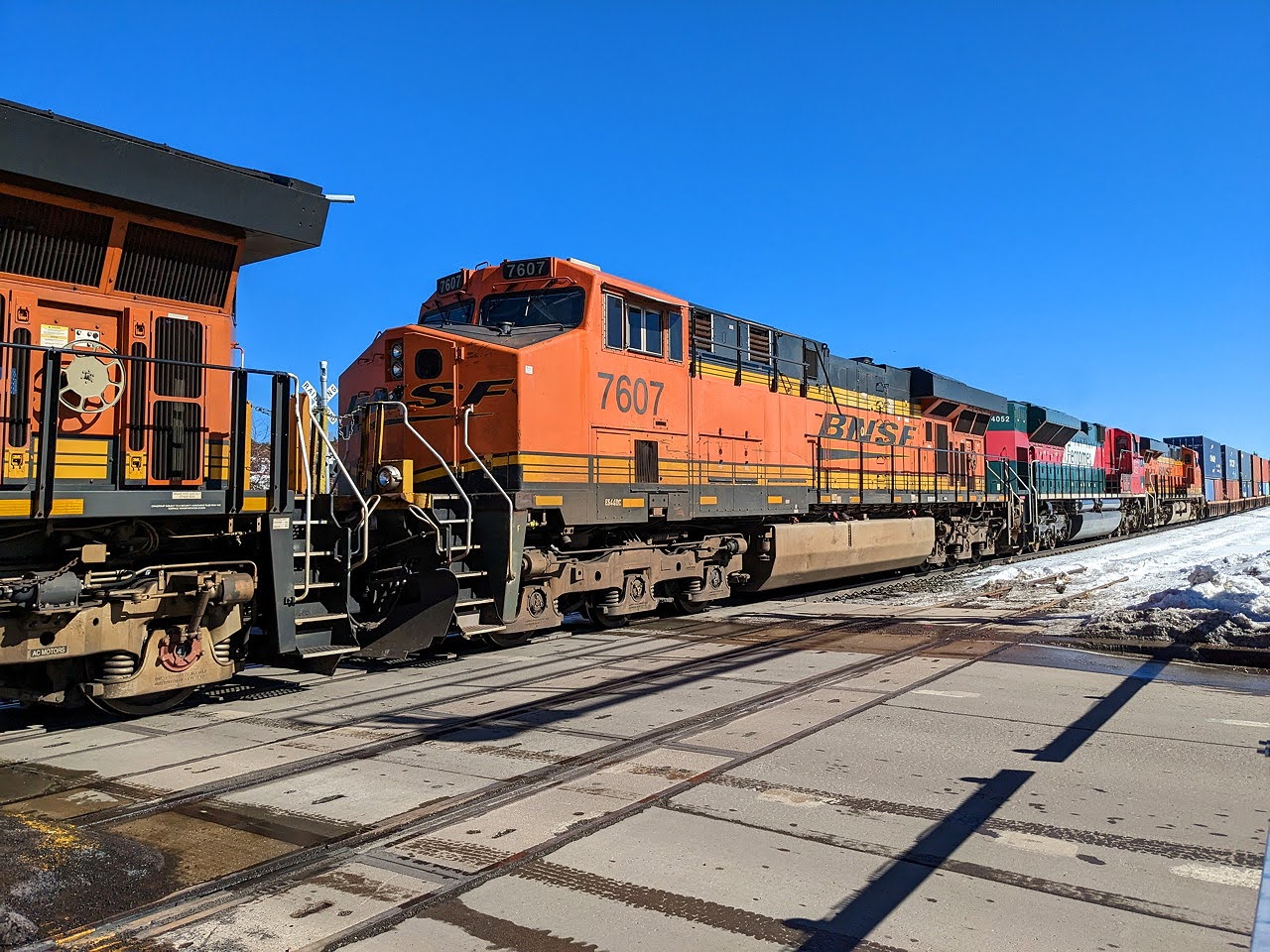
In Flagstaff the former ATSF Main Line and current Amtrak station are right in the center of town. Choosing to eat at Lumberyard Brewing allows one sufficient time to get photos of passing BNSF traffic upon activation of the San Francisco St crossing signals. The first train of that day was a westbound doublestack intermodal led by BNSF ET44AC #3788, C44-10W  #7607, Ferromex SD70ACe #4052 and ES44AC4 #8082. The Amtrak station sees the passage of the daily Southwest Chief in the early morning and evening so during the day it was all freight, all the time.


I was a little late to the party for the next two trains. The first, an eastbound autorack and manifest train, was led by ET44C4 #3994, C44-9W #5234 and ES44C4 #7038. This was followed by an eastbound intermodal with ES44C4 #4246, C44-10W #7611, ES44C4 #6901 and ES44C4 #8323.


This was followed by a westbound oil train with ES44C4 #8090, ES44C4 #6625 and C44-9W #5483 leading and two ES44C4's, #6905 and #6951, on the rear as DPUs.


A second westbound of the intermodal variety soon followed with ES44C4 #4298, C44-9W #4304 and C44-9W #4465 leading. 


Heading out of town I caught C44-9W #5191 hanging out as local power on a siding.

Friday, October 12, 2018

18-10-12 PHOTOS: Flagstaff and the Grand Canyon

Last October I booked a trip to visit the Grand Canyon in conjunction with some people I know in Phoenix. As much as one might like to try, the Grand Canyon is really not a great thing to try and day trip all the way from Phoenix considering it is close to a 4 hour drive each way. Therefore we arranged an overnight stay in Flagstaff, AZ in order to put a full day in at the park and see the entire south rim from Desert Watchtower to Grand Canyon Village. Flagstaff, like a lot of high desert towns in Arizona, is a pretty hip community and it was possible to go on an outright microbrewery crawl all within sight of the Amtrak station.

Flagstaff is located on the old Santa Fe Main Line, the premier double track line between LA and Chicago. The Station sees the daily arrival of Amtrak's Southwest Chief in both directions along with 50 or so odd BNSF through freights. While my group was in Flagstaff I was able to get some reasonable photography in and around the station area. Also included in this set are some random pics elsewhere in Arizona and photos taken while riding Phoenix's Valley Metro light rail line in Tempe. You can find the full set of photos here (mirror).

The Flagstaff Amtrak Station was built by the ATSF in 1926 and was of a style to support the local tourism industry.


Today the station primarily houses the Flagstaff visitor's center, with the Amtrak waiting area and ticket window being relegated to smaller space on the east side of the facility. The eastbound Chief is scheduled to arrive at about 4am with the westbound arriving daily around 8:30pm. 


The tourism industry resulted in a number of hotels advertising their services to arriving passengers via tall signage that remains in place today. 


Train traffic is fairly constant with grade crossings on either side of the station providing advance warning of approaching traffic. Here we see a pair of BNSF ES44C4's, #6987 and #4285, heading westbound with a double stack intermodal train first passing the old ATSF Flagstaff freight house and then the San Francisco Street crossing.


Some native rabbitbrush added a splash of color to the scene. 


ATSF painted C44-9W #691 was riding behind BNSF Tier IV ES44AC #3962 at the head of an eastbound intermodal with T4 ES44AC, #3846 and C44-10W #7620 running behind.


Friday, June 17, 2016

16-06-17a PHOTOS: Plan Brazos

In late May and June, 2016, Texas was subjected to a record setting amount of rainfall that caused the Brazos river, just west of Houston, to rise to a level of 53'. While the flooding snarled rail traffic in the area for the typical reasons like downed trees and washouts, at the former Southern Pacific Glidden Sub bridge over the Brazos River, just east of the railroad town of Rosenburg, a far more serious defect developed about 10 days prior to my. The support pier between the easternmost truss and the approach trestle was undermined by water scour and dropped down about 4 feet, rendering the bridge impassible.

Now at first I was worried that the bridge's extended outage would result in a trip ruining bustitution. However, I should have had more faith in Amtrak because when Plan A isn't available, it's time for Plan B! That's right, instead of a ruined trip I was treated to that that wonderful Amtrak event, a rare mileage detour. Instead of rolling into Houston on the Glidden Sub as I had the year before, my train would be rerouted at the famous Tower 17 south on the BNSF Galveston Sub to the town of Alvin, before then heading north on the BNSF Mykawa Sub to T&NO Jct where the line would change into the UP Houston West Best Sub that would then deliver us to Tower 26 where we would then make a backup move into the Houston Amtrak station.

You can find all the photos from this incredibly rare train movement here. Just goes to show that riding Amtrak can really turn delays into lemonade juicy railfan stories.

Movements from the eastbound Glidden Sub to the southbound Galveston Sub are not typically needed so the only direct connection available at TOWER 17 interlocking is west to north. This, and having to travel over BNSF, prompted Union Pacific to detour its freight off the Sunset Route at Flatonia, TX. On the other hand, long backup movements are just a regular part of doing business on LD Amtrak trains. Here we see a Diverging Clear signal displayed westbound at TOWER 17 for a route onto the northbound BNSF Galveston Sub.


TOWER 17 was the site of Texas's last active classic interlocking tower. The tower was closed about 10 years ago, but it and its Taylor Model 2 interlocking machine were preserved in a local railfan park.


Passing the diamond in the other direction. The multiple relay huts is due to the joint ownership and maintenance of the interlocking and its diamond crossing.


These KCS ES44AC's #4680 and #4859 distracted me sufficiently so that I missed out on more photos of TOWER 17. However, in its stead I managed to capture the local BNSF crew base.


KCS SD70ACe #4027 was providing tail end power as the unit train of covered hoppers waited in the siding for us to pass by.


Despite the 1980's vintage ATSF signaling being in relatively good knick, a replacement programme was under way because I guess anything with moving parts is bad.


Sometimes it seems that all of Texas is a highway construction zone. Here some sort of ramp or frontage road is bring added to Interstate 69.


This southbound unit grain train had passed over the diamond at TOWER 17 ahead of us, but we had the last laugh as we passed it on the Manvel siding (even limited to the freight train speed of 50mph). Unlike the popular belief, freight dispatchers do a pretty good job of routing Amtrak trains through freight traffic. Engines are BNSF ES44C4 #6803 and SD70ACe #8598.


What I assume is some sort of old feed mill in Alvin.


Because of Houston's notoriously bad air quality, genset style switchers are typically assigned here by the big Class 1 railroads. Here we see a pair of National Railway Equipment 3GS21B-DE's, #1245 and #1287, shifting cars near Alvin.


Tuesday, June 14, 2016

16-06-14 PHOTOS: San Diego Trolley

So when I fly out to Southern California I make it a point to avoid the LA Basin as even if I found something remotely redeemable in that metroplex, it's airports are not transit accessible and far from anywhere I would want to be. Therefore I utilize San Diego as my SoCal port of entry as it not only has a rich transit scene and a pleasant climate, but one can easily connect with one's choice of Amtrak long distance route out of LA via a short Surfliner ride.

This year I was conducting a do-over of my 2015 Sunset Limited trip that, due to an unfortunate placement of a private car, turned out to be a complete waste. After scheduling time to stuff fish tacos in my face and visit the beach, I still had more than enough left over to take another tour of the San Diego Trolley network and wander around downtown. I am actually no stranger to San Diego, as this would be my 4th visit since 2009, however I had still not ridden the full length of the Orange Line nor had I ridden either the Orange or Green lines since my first trip back in 2009.

You can find the full set of photos, which also include Amtrak and Coaster content, here.

Transfering from the airport bus to the Green Line trolley I spent a few minutes taking pictures at the former Santa Fe station, southern terminus of the Surfliner corridor. Amtrak handles most of its maintenance at LA, but they do keep a protect F59PHI at San Diego, just in case. This time #460 was filling the role.


Coaster cab car #2303 was at the southern end of the trainset that was currently laying over at the station providing mid-day service on the line to Oceanside. Despite Metrolink's freakout over the safety of this type of cab car, and their beefier replacements, in various types of accident, Coaster, Metrolink and ACE have no compunction against operating the type. 


Milwaukee Road private car "Montana" was also hanging out on a station track. The car lives in LA and the owners had decided on a short trip to San Diego to entertain a client.


Passengers shuffle out of Green Line LRV #4017 at Santa Fe Depot. The westward track serves both the Green Line as a station and the Orange Line as a terminal. A separate berthing area is provided for each service as Green Line trains will often pull up behind Orange Line trains to allow passengers to transfer. 


MTS LRV #3005 is seen here on the head of a train stopping at Washington St. The 11 3000 series S70 LRV's were purchased in 2004 for the construction of the Green Line. They are about 10 feet longer than the rest of the fleet and may not be able to operate on the downtown loop, restricting them to the Green Line service.


MTS LRV #4052 arrives at the Olde Towne Transportation Center, which also provides a connection with Coaster and Surfliner trains. The 65 4000 series LRV's were purchased to supplant the original U2 trams purchased from Germany in 1981.


The Green Line loops west through a valley north of the city, eventually joining with the opposite end of the Orange Line before terminating at a "towne centre" in Santee. The Green Line is the only part of the San Diego Trolley system no built on an existing right of way as is evidenced by numerous elevated sections like this one at Grantville. The route was partly motivated to serve the San Diego Chargers' stadium.


The San Diego Trolley was the country's first modern Light Rail system and line several successors, it operates under an FRA waiver to allow freight service on the original rail lines the Light Rail took over. While the freight traffic on the orange line is greatly reduced, a customer in an El Cajon industrial park still gets shipments.


Here we see MTS LRV #4039 at the Santee terminal. Since the 4000-series delivery was completed, the MTS has moved to sandwitch the older 2000-series SD100 cars in the interior of 3-car trainsets for ADA reasons. 


Sunday, June 7, 2015

15-06-07 PHOTOS: Irvine

Well it is finally time to begin my 2015 Amtrak Cross country* trip. This year I was down to the last of my priority routes, the Sunset Limited running from LA to New Orleans. Unlike the last time I was in LA to ride the Southwest Chief, this time I started the trip in Irvine, CA instead of San Diego as I had a group of friends in the OC. Also, the trip would not technically be "cross" country as I would return from NOLA via Southwest instead of Amtrak's Crescent due to the cost of that train and the lack of scenery.

Anyway the whole journey begins at the Irvine, CA Amtrak/Metrolink station and continues on to the LA Union Passenger Terminal, which I have discussed before. You can see all the photos from this set right here.

When I pulled up in my Uber I was just in time to catch a northbound Metrolink train with Rotem cab car #657 on point.


The two track station was built on the former ATSF main line to San Diego and featured an overhead walkway to reach the northbound track, on which the Metrolink train sat. Forgot about making a close connection at this station.


Metrolink MP36PH-3C #890 was providing the power.


I was in the station getting some interior photos when a southbound Surfliner train pulled in with Superliner Cab Car #9606 in the trailing position.


The former ATSF line was still outfitted with ATS, as seen here at TINKHAM interlocking, permitting 90mph speeds.


Irvine Amtrak station was constructed next to the former Marine Corps Air Base El Toro.


Sign evidence of the old ATSF.