In 2015 Amtrak reversed the orientation of most of its Eastern long distance trainsets, placing the baggage car on the rear and blocking the view out the back of the train. This ruined much of the utility of Amtrak's LD service, limiting photo opportunities to the extended station stops at crew change locations. Up through 2015 I had undertaken a twice yearly journey via Trains 79, 19 and 20 to visit a friend near Gainesville, GA, but since then I had only made the trip one additional time in 2018 with no rear view so I wasn't expecting much on this journey. However I was shocked to find that due to Covid related staff shortages baggage services were temporarily suspended on Train 79/80 allowing for an old school style rear window survey and video documentation of the former RF&P Main Line, CSX A-Line and former Southern H line too the way to Greensboro. You can find all of the still photos here ( mirror ) along with a separate video post here.
Upon departing Washington Union Station via the First Street tunnels we passed a VRE trainset in the new CP-VIRGINIA storage track with MP36PH-3C #V55.
Approaching the Long Bridge we passed the northbound Lynchburg Regional Train 174 with P42DC #180.
Passing Milepost 107 on the former RF&P Main Line, construction on the new Potomac Yards WMATA station could be seen in the background.
Passing by Marine Base Quantico the future third track was laid, but not in service. This segment of the third track extends to ARKENDALE interlocking near milepost 71.
Amtrak Regional Train 94 and CSX ES44AC #916 as distributed power south of Fredericksburg.
The new VRE Spotsylvania station and CROSSROADS interlocking. Not in service for several years, this station extends the VRE Fredericksburg Line several miles south to the location of the storage yard.
The Ashland, VA station having recently benefited from a platform refresh.
Amtrak P42DC #133, seen here at Richmond, was leading my Train 79.
CSX AC4400 #327 leading a Herzog stone train on the Richmond Belt Line.
It was going to be difficult running the 20th iteration of the SEPTA Mid-Winter Trip as the COVID 19 pandemic had only only caused massive cuts to transit schedules, but also made spending the better part of a day riding around in enclosed transit vehicles. While the two most common solutions would be to either cancel the event entirely or ignore the threat of getting sick (and passing it to others), I turned the situation into an opportunity and converted the SEPTA Mid-Winter Transit Trip into a walking tour of Philadelphia rail infrastructure. Starting at the same Market East location as usual the trip would wander around the former Reading Viaduct and City Branch before heading to 30th St Station, hiking the ARSENAL loop through University City before ending with a stroll along the Schuylkill river walk and Suburban Station approach. Although only 5 people turned out for what turned out to be a brisk 8 mile walk in surprisingly warm weather, everyone had a great time and we were able to cover a lot of interesting territory not generally available to the Mid-Winter Trip in normal years. You can view the entire set of photos here ( mirror ).
In normal years I would start at Lindenwold in order to catch one of the handful of express PATCO trains, but with the express services cancelled I just started at Woodcrest Station. My inbound train was led by PATCO #1009 with #1042 bringing up the rear.
For the folks who spend their Philly time in and around Market Street,
Convention Center or Central Business District, they might not realize
how the old Reading line to its downtown stub end terminal was just
abandoned in place in 1984 after the station closed. Subsequent
redevelopment pushed back the end of the old viaduct to just north of
the Vine Street expressway.
The Reading viaduct was ostensibly constructed around 1890, but as it
was modified over the years it developed a bit of a Ship of Theseus
feel.
The Viaduct is currently owned by the Reading Entertainment Company, the
corporate successor to the Reading Railroad after its 1970's
Bankruptcy. Reading Entertainment gets its name from a chain of 12
motion picture theaters that it owns in addition to a hodge-podge of
real estate assets. The company has been engaged in a standoff with the
city over the development of the Reading Viaduct into a linear park.
One casualty in the battle was the old Spring Garden Street Station's
northbound passenger headhouse and platforms. Neglected for years, a
local preservation group used an anti-blight law to sue Reading
Entertainment to clean up / restore the old headhouse and platforms.
Reading Entertainment choose the other option available to them,
complete demolition and clearance of the site. After a court battle the
structure in the photo was demolished in August 2021. Of course in
December 2020 there was no way to know that would happen and therefore I
only have this one photo of the building.
The real Reading Spring Garden St station building is across the tracks and has already been converted into apartments.
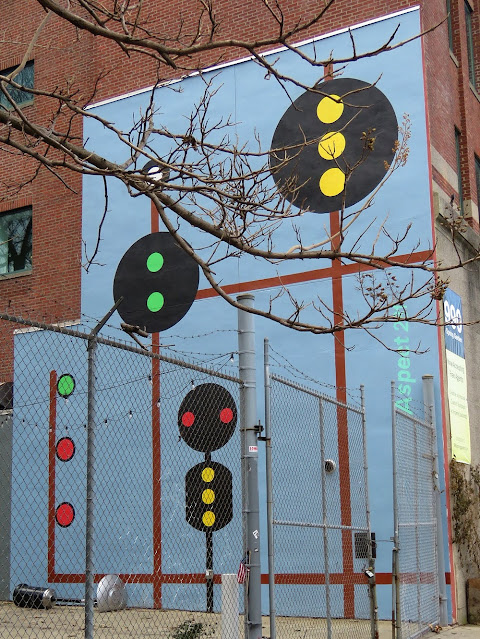
This area is seeing significant gentrification with one building
branding itself "Aspect 281" in a serious case of cultural
appropriation. Developers know that the Philly Hi-Line park is
inevitable and are getting in on the action.
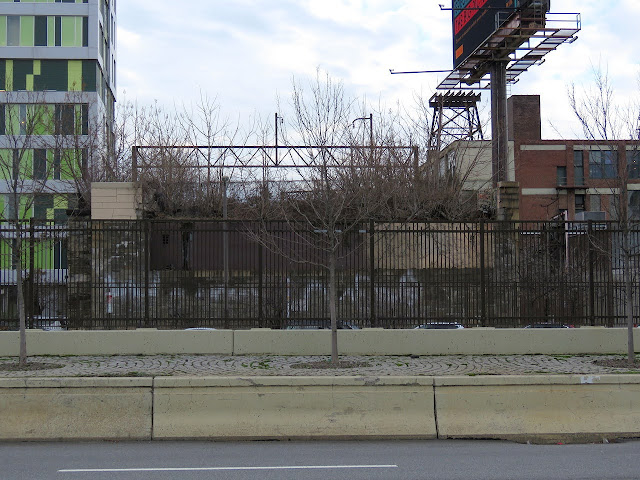
Arguably Philly's most famous closed subway station, Spring Garden on
the Broad Ridge Spur retains some of is above ground structures.
The Baltimore and Ohio railroad's Old Main Line was the first railroads constructed in the United States and also one of the first in the world with the initial segment opening for service in 1830. Located in the narrow Patapsco River valley, the impetus for the line was the fact that Baltimore had an excellent sea port, but no means to transport goods inland as the city was not located at the end of a major waterway or canal. To remedy this the B&O would act as an artificial river, first transporting goods to the C&O Canal on the Potomac River with the eventual goal of reaching all the way to the Ohio River.
The intense profit motive of making Baltimore a national port not only justified the employment of cutting edge technology, but also the use of a sub-optimal rail route in the form of the twisty, turny Patapsco River valley. Although it was an early center of manufacturing due to its hydro power resources, the rail line soon became outmoded due to numerous tight curves. By the turn of the 20th Century, the B&O was engaged in a long term effort to re-align the curves and, where necessary, build the bridges and tunnels that were not feasible in the early decades of operation. The route would eventually include 9 tunnels, a large number for an East Coast rail line (for comparison that's about as many as the entire Reading system). During 2020 I was looking for some outdoor activities so I went about visiting several of the Old Main Line tunnels, most of which were about a mile or two from the nearest Patapsco River State Park carpark. The entire river valley has been converted into a recreation area with the railroad a popular right of way for people to reach their favorite spots on the river. You can find the full set of photos here ( mirror ).
Having already visited the Ilchester Tunnel in 2019, this year's tour will start with the Union Dam Tunnel located at milepost 15 (from Baltimore's Mt Claire terminal). Built in 1902 with stone portal fronts, the 810 foot long curved tunnel travels under the US 40 arch bridge that replaced the winding Old Frederick Road.
Next along the line at Milepost 19 is the 1022 foot long Dorset tunnel,
constructed in 1906 with the same style of facing as the Union Dam
tunnel. In addition to swimmers, the park is filled with forest
puppies.
Standing between the Dorsey and Davis tunnels is one of the many plate
girder crossings of the Patapsco river, necessary to smooth out some of
the many curves. This would occasionally move the new right of way
across the river from the 1830 alignment.
The Davis tunnel, at milepost 20, is only 497 feet long, but an internal
curve prevents one from looking all the way through. It was completed
in 1906 to support a double track main line that has since been reduced
to single track leaving ample clearance and rendering the old side wall
refuges, unnecessary. Somewhat unstable ground made full brick lining a
must for all the OML tunnels.
Very little traffic was moving on the weekends, but I did happen to
catch CSX SD40-2 #8064 with an MoW train at the Marriottsville Rd
parking area. The MoW train contained both Conrail and Seaboard Coast
Line equipment.
Amtrak's Lincoln Corridor is part of an Illinois State project to create a 110mph high speed train service between St Louis and Chicago with travel times in the 3-4 hour range. Flat and straight the line's main issue are grade crossings, a single track layout with passing sidings and rural communities with a rather lax attitude towards rail safety. The following videos capture the section of the line between Joliet and Dwight, throughout the Springfield terminal area and then southern end of the line from Alton to the start of the Terminal Railroad at WR Tower. Generally note the concrete ties, anti-personnel fencing in built up areas, elaborate grade crossing protections and high/higher speed turnouts on new and extended passing sidings.
In the first pair of videos we have a rear view from the back of Amtrak Train #21, the Texas Eagle, as it runs
from the station stop at Joliet to just north of the town of Dwight,
which is a stop for Lincoln Service trains. Note METRA's recently closed UD tower, which is being converted into a
museum, and the new island platform at Joliet, as well as the entrance to UP's Global Four intermodal facility.
The last time I traveled this route back in 2005 it was somewhat of a backwater as UP had a second, more preferred line between Saint Louis and Chicago. B&O CPL signals were still present, sidings were far apart with slow entrance and exit speeds. Today over a billion dollars in state funding has completely rebuilt the line, but the 110mph speeds have yet to be achieved in regular service.
Here we see one of the slower parts of the line where it picks its way through downtown Springfield, IL, the state capitol. At about 5:10 in the video was the location of the old RIDGLEY tower, which, at the time of its closure in 2010, featured the last mechanically operated switch points in North America. The tower was demolished shortly after its closing. After the station stop the train slowly moves out of the city before running a couple of miles on NS Springfield-Hannibal District.
The southern end of the corridor past Alton (or Chicago and Alton fame) was the last to be rebuilt with WANN interlocking and it's CPLs and LENOX tower being closed only in 2018. There is still some hints of old school railroading in the layouts like the split single track mains and the outside single slip switches at WOODRIVER interlocking. Note the bright new CPLs at LENOX along with the closed tower and the NS traffic on their adjacent line.
Finally our train enters TRRA trackage at WR TOWER. The interlocking contains some poor man's single slip switches, but the tower itself was demolished decades ago.
Hope your all enjoyed this abbreviated tour of the Lincoln Corridor. Next week I'll be back with some photos on the old MoPac Texas Eagle route in the Big State of Texas.
I don't get out to Winslow Junction as much as I should, and by "as much as I should", I mean more than once a decade. WJ used to be my go to place for railfanning in South Jersey, usually on random weekends with my father. However in recent years my general unavailability combined with his decreased activity lead to Winslow Junction being that place we'll get around to visiting "next time". Well, finding myself at a severe loss for content in 2015, I decided to take a little detour from my Black Friday shopping to swing by what used to be one of the busiest rail interlockings in the entire world.
You can find the full set of photos of my trek around the old complex here.
Of course the real stars of the Southern Railroad of New Jersey are the two F7A cab units that used to work the Salem Branch between Salem, NJ and Swedesboro, NJ. They are former B&LE units and numbered 727 and 728. #728 is painted in NYO&W colors because the former SRNJ owner had a bit of a crush on the NYO&W.
#727 is painted in a CNJ heritage scheme, but after years out in the elements, some of the B&LE heritage is showing through.
The SRNJ had a couple of old GE 44-toners and NYOW painted #105 is the one that is still around.
This is what happens when you park your locomotive in a bad neighborhood. #1801 is a rare GE U18B U-Boat.
CMSL Tony doesn't have a monopoly on RDC's in South Jersey. SRNJ #7
used to belong to the NYS&W running a passenger service in Syracuse,
NY. When that railroad's eccentric owner died the service was promptly
shut down and the RDC's sold.
Former CN MLW M420 #3519 is up on the good kind of blocks, getting its front truck rebuilt.
Traction motor armature. Um...you might want to cover that.
Every so often I end up in Sunny Downtown San Jose for a conference and in my free time I find myself looking to explore the local VTA light rail system. As far as railfanning goes the VTA is pretty lackluster with bulkhead cabs and rather plain, boxy vehicles. It also has one of the cheapest signaling systems I've ever seen, but the operators are friendly and it is certainly better than nothing. Way back in 2008 on my first visit to the city in 2008 I rode the VTA out to its farthest terminus at Santa Teresa, and the green line end to end from Mountain View to Winchester. Last year I took advantage of the new express service with a side trip on the spur to Almaden. This left only the Blue Line to Alum Rock as the only part of the VTA system I had yet to ride and when presented when another conference opportunity I knew what I had to do.
You can check out all the photos from that ride plus all sorts of others from the San Jose rail system right here and of course read on for the narrated tour.
Looking to save a fare I decided to walk down to the train station from my hotel early on the first morning, catching VTA LRV #970A on the way.
What was at the San Jose Diridon Station? Caltrain, and lots of it.
Here we see MP36PH-3C #924 pushing north with a baby bullet trainset.
Gallery cab car #4001.
My ultimate goal was to catch a northbound morning express train using
gallery car equipment that I could shoot a head end video from.
Caltrain is pretty consistent about using the same equipment from day to
day and I wanted to see if any baby Bullets were going out gallery,
like the 4:45pm train I typically catch.
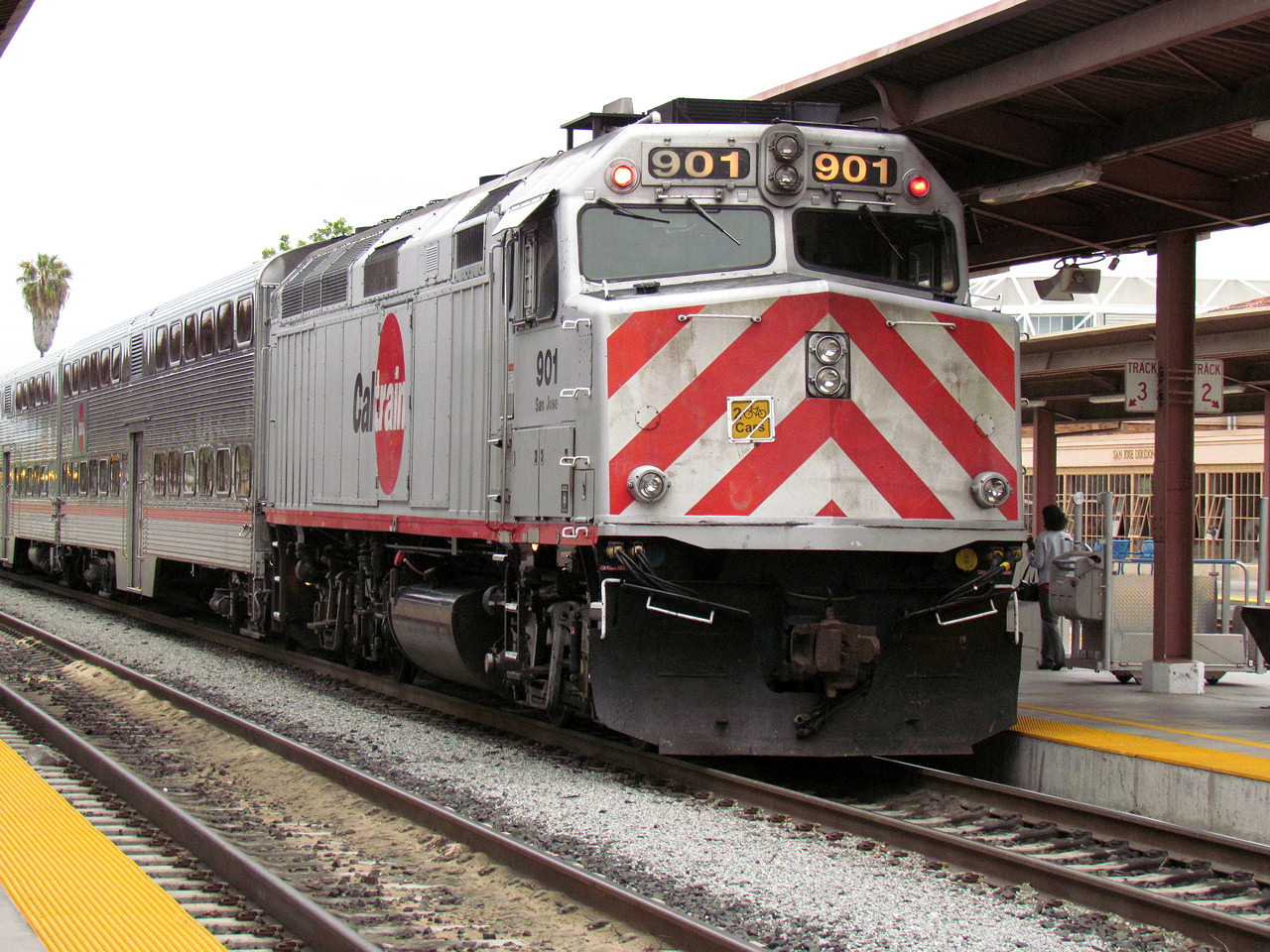
Unfortunately all the gallery car trains I saw that first morning were
limited to local trains. Here is a trio of F40PH's I saw pushing these
locals and limited service trains, #909, #919 and #901.
Here is a video montage of that first morning's action.
On day 2 I boarded VTA LRV #980A to Alum Rock.
Like I said the VTA sucks for on-train fanning soooo...here 980A is
again at Alum Rock with 959B on the rear of the 2 unit train.
Back at the end of April 4 days of rail caused a 100 year retaining wall overlooking the CSX Baltimore Terminal Sub to collapse onto the tracks. For those of you who don't watch news or otherwise live with their heads buried in the sand here is the viral video of the collapse itself.
This happened to be located not far from where I hang out and was actually one of my major train watching locations. The street had been showing subsidence problems for years with several sinkholes patched and filled by the city. Still, the problem kept getting worse and everyone in the area knew that it was just a matter of time. Anyway, of course I went and took photos of the aftermath, however I have held off on posting them because I wanted to see how things turned out to present a more complete picture of the collapse and the cleanup effort.
Also thrown into the set are some random photos taken on Balt/Wash area rail lines that didn't fit into any other set. You can see the full album of photos here
Here's how things looked a few hours after the collapse. Who's going to clean up all those cars?
Video taken the first night.
When CSX Re-signaled HUNTINGTON AVE they moved the westbound signal location from inside the tunnel mouth to a point next to the retaining wall. This is all that is left of the relay hut now.
Unlike the public sector CSX did not fuck around clearing the single
track Baltimore Belt Line. Within 48 hours they had 3 excavators
working non-stop to pile up the rocks and earth. This is the ONLY CSX
route for freight moving from south to north with the nearest detour
being through Hagarstown, MD. The Baltimore Belt Line us used by trains
carrying orange juice to New York City and hauling trash away.