In 2018, as the former PRR Main Line between Harrisburg and Pittsburgh was in the midst of a major re-signaling project, I was blocked in my efforts to get westbound facing photos from the rear of eastbound Amtrak Pennsylvanian Train 42 by a private car. In 2023, 5 years after the re-signaling project was completed, I was in the position to try again even if the route was now devoid of interesting signaling. Although cloudy weather and wildfire haze impacted the photos, I accomplished my mission of documenting the now diminished PRR Main Line between Pittsburgh and Tyrone, where the rain made additional coverage impractical. You can view the full gallery here.
Amtrak lets passengers board pretty early for the 8am departure of Train 42 from Pittsburgh Penn Station stub track #3. Power for the day was P42DC #94.
Departing the station, Train 42 passed by the old Conrail era helper base at he Pittsburgh station. Trains needing helpers over the entire west slope would have them attached here. In the mid-2000's the base was closed with the crews moved to either Cresson or Johnstown and helpers cutting off at various points along the Pittsburgh Line depending on operational expediency.
After moving to the rear of the train the first point of interest was a KCS AC4400 in the number 2 position leading a westbound train of empty oil tank cars near Manor, PA.
NS C44-9W #9700 along with a C40-10W leading a westbound intermodal near Radebaugh.
Greensburg, PA is the only station on the route with active platforms serving all main line tracks. With only a single round trip to worry about, current practice is to run both Pennsylvanians on the nominally "westbound" #2 track. Stations like Latrobe that has the capacity for a second platform, has allowed it to decay as it removes the need to correctly pre-position passengers on the correct track.
Overtaking NS ES44AC #8012 at CP-PACK.
The sun briefly peeking out as Train 42 crosses the old stone bridge at Johnstown. This structure survived the great Johnstown Flood in 1889 and continues in service to this day.
Johnstown Station's island platform only serves Track 2 and 3, although Track 3 is rarely utilized by The Pennsylvanian due to it running on a different alignment between Johnstown and CP-CONPIT that adds about 15 minutes to the trip.
Clear westbound signal on track #3 at CP-C(onemaugh). This location has far less going on than it did just 20 years ago with an complete absence of local freight/coal and helper pairs. Coal trains were some of the most in need of temporary assistance and the collapse of coal power combined with increased use of distributed power has virtually eliminated much of the hustle and bustle around helper districts.
Here is part 2 of my June 2023 combined NJT M&E / light rail trip. In part 1 I covered a round trip on the Newark City Subway, continuation to Newark Broad St and then stops at Denville and Summit before ultimately arriving at Hoboken Terminal. In part 2 I'll cover Hoboken Terminal before heading out to Tonnelle Ave on the HLBR. The full set of photos can be found here ( mirror ), just scroll down to see those photos covered in this section.
Upon arrival at Hoboken I encountered Arrow III MU #1314. Despite the M&E being largely electrified, MU's are only used on a few services such as the stop intensive Gladstone Branch locals.
Other equipment hanging out near the buffers included Comet V cab car #6063, #6035 and #6055, along with and split level cab car #7062 and Metro North Comet V cab car #6712 next to NJT Comet V cab car #6040.
Class leading NJT Comet V cab car #6000 could be found adjacent to the new track #5 end buffer that replaced a 1907 vintage buffer that was run through by a slow moving NJT train in 2016. The placement of the new stop mechanism cost about half a carlength of capacity.
The station interior was as gorgeous as ever.
The area outside the official main entrance has been named the George Warrington plaza.
NJT also installed this digital chart to cover all of the strange service patterns.
On the southern expansion platforms I found split level cab cars #7053 and #7037 along with a Metro North Comet V cab on storage track #19.
One of my bigger blind spots has been NJT's non-NEC operations in North Jersey. In fact I can count the number of trips I've taken on this part of NJT over the last 20 years on one hand. In the summer of 2023 a surprise mid-week day off from work granted me the opportunity to plan a trip that would not only visit the notable junction stations at Summit and Denville, but also ride the Newark City Subway and HBLR. This set of photos will cover NCS, Denville and Summit parts of the trip with Hoboken Terminal and HBLR to follow. You can see the full set of photos here ( mirror ).
The trip's itinerary actually involved going first to Washington to meet up with a railfan friend to use an Amtrak BOGO coupon to go to Philly. After laying over a night we would continue to North Jersey before returning back south that afternoon. The first leg of my journey was an Amtrak Regional hauled by ACS-86 #638.
After that it was a transfer to and Acela trainset with power car #2029.
We had booked cheap tickets on an early AM Keystone which required an even earlier AM PATCO connection, dutifully provided by PATCO rebuild car #1005.
Departing Philly and passing the stored Acela II sets in the Penn Coach Yard before making all the local commuter stops on the NEC.
Our Keystone train continuing on to NYC while being pushed by ACS-86 #617.
Kinky LRV #114 would be our ride out to the intermediate terminal at Branch Brooke Park.
Branch Brooke Park had been the terminus of the City Subway when it had been serviced by PCC cars before their retirement in 2001, the old PCC loop being replaced by a pocket track.
Short turning at Branch Brooke Park instead of riding to the end of the line at Grove Street afforded some additional photo opportunities such as LRV #120 departing for Penn Station and #107 arriving for the headway after that.
Quick front facing video of the inbound ride from Branch Brook to NJIT. The NCS runs along the former Morris Canal right of way.
In the winter of 2022 I finally made it out to the famous Tunkhannock Viaduct in Nicholson, PA. Although closer in proximity to me than many of the sights in central and western Pennsylvania, Scranton was just not a place I had either the ability or motivation to visit until recently when Subchat buddy Phil N moved into the area. Phil was nice enough to drive me around to both the viaduct and a variety of signal locations over the course of a day, and although I got about 1000 infrastructure photos we scored a goose egg for actual train movements. Fortunately another Subchat buddy, Kevin Painter, was able to bail me out with not only the usual tour of Reading and Northern equipment at North Reading, but also an introduction to the Colebrookdale Railroad in Boyertown, PA. You can view the lengthy set of photos here ( mirror )with the non-signal stuff all the way at the bottom.
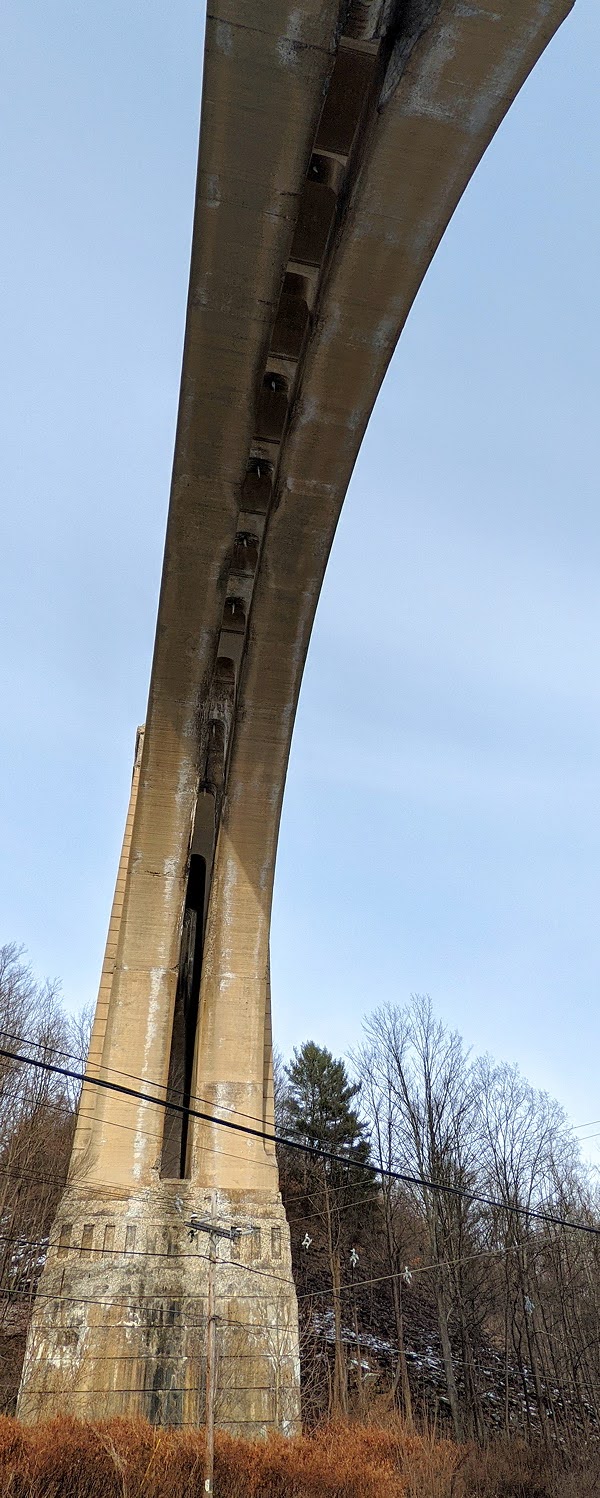
The Tunkhannock Viaduct, sometimes known as the Nicholson Viaduct or Nicholson Bridge due to the community it spans, is typically viewed as a singular achievement of railroad engineering. In actuality it was just the showpiece of a far larger project initiated by the Delaware, Lackawanna and Western Railroad in 1915. The Clark's Summit-Hallstead Cutoff (aka the Pennsylvania Cutoff or Nicholson Cutoff) was the second great construction project undertaken by the DL&W shortly before The Great War (the first being the famous Slateford cutoff in New Jersey that proceeded the PA cutoff by a few years) and replaced over 40 miles of the 1850's era alignment with a brand new, high speed and low grade main line. The viaduct, measuring 2,375 feet in length and 240 feet above the ground at its highest point, was necessary to traverse the Tunkhannock Creek at an elevation sufficient to free the railroad from having to follow the path of existing rivers just north of Scranton.
Fueled by the flush profits transporting premium home heating coal at the turn of the century, the DL&W had the financial resources to not only reconstruct its greater Pocono region main lines, but also use the era's high tech wonder material, reinforced concrete. It would be the bridge's 167,000 cubic yards of concrete that would make it such an iconic and imposing presence compared to a similar bridge of steel beams.
The bridge consists of 10 spans, 9 piers and 2 abutments, all made from reinforced concrete. At the time of construction it was the largest concrete structure in the world and is likely still one of the largest concrete bridges in the world.
Although still branded Lackawanna, the DL&W Main Line did not survive the 1960 Erie Lackawanna merger with most traffic transferring to the Erie side. The Conrail merger of 1976 saw the line pass to the Delaware and Hudson, which was able to abandon its own less efficient Scranton-Binghampton route. In the 90's the D&H was sold to Canadian Pacific before ultimately falling under the umbrella of Norfolk Southern in the 2014.
The scope of the cutoff can be seen at other points along the line where local roads have to literally tunnel through the massive embankments.
The DL&W applied its use of reinforced concrete technology to everything, including station buildings and interlocking towers. Here the station in Glenburn, PA has been repurposes as public works offices with EL caboose #C267 on display nearby.
Moving down to North Reading the next morning, Kevin and I encountered the NRFF lashup awaiting its departure with GP38-2 #2014 on the tail end behind the two NRFF painted SD50s.
Every fall I take a multi-day trip to NYC and typically I combine something on the Subway with something on the LIRR and unfortunately as of late this has meant trying to document endangered signaling and interlocking towers. This year it was VALLEY tower's turn to get my attention after previous trips to DIVIDE in Hicksville, NASSAU in Mineola and QUEENS in Queens Village. I also poked around the Jamaica terminal area thanks to a new concourse that provided some great views of the western approaches.
For this trip I left from South Jersey, making an Atlantic City Line connection to the RiverLINE, then the NEC at Trenton, subway at Penn Station to get to the LIRR at Atlantic Ave, changing trains at Jamaica to get to Valley Stream.
I then traveled to Ossining to stay with a fellow railfan who then drove me to Suffern the next day where I could catch NJT back to Trenton, connecting at Secaucas. That was a massive ordeal in and on itself so I wound up with an unanticipated hour+ long layover at Secaucas.
After getting dropped off at Cherry Hill I discovered that the NJT TGIV was sitting on the main track waiting to do some geometry inspecting.
A northbound NJT ACL train soon arrived with GP40PH-2B #4209, seen here diverging at RACE interlocking past an MoW ballast regulator.
Making the connection at the Pennsauken Transfer, my NJT train continued on past two Approach Medium signals at SAUK and JERSEY.
Since NJT NEC locals are the absolute worst, I let this train, with Comet V cab car #6050, depart Trenton and waited for the next express to New York Penn.
My train dropped me off on NYP's platform 1 where I got this shot of the far southeastern corner of the station's concrete bathtub.
A number of LIRR switchers were parked in the Morris Park deadline including SW1001 #107 and #105.
Also at the Morris Park engine terminal was LIRR DE30 #411.
DUNTON tower with a freight train on the Atlantic Branch flyover behind it.
M7 #7304 at Jamaica.
Eastbound LIRR M7 #7400 proceeding down the flyover ramp next to JAY tower. It was a cold and windy day, something the flag can attest to.
For some reason the New York and Atlantic decided to ruin some of it's GP38 locomotives by rebuilding them as PR20B's with Caterpillar road/marine use diesels. Here #300 and #301 pass through Jamaica with a string of empty high capacity gons for scrap or waste.
JAY tower seen from the new western concourse along tracks 3 and 4.
A westbound train of LIRR M3 cars with #9787 in the lead, moving through HALL interlocking.
LIRR M7 #7467 passing VALLEY tower as it diverges towards Far Rockaway.
To avoid the Hempstead Shuttle, which usually lays over on track 3 at Valley Stream, this Jamaica bound train platformed on track 4 before crossing back over to track 3 at the west end of VALLEY interlocking. Here LIRR M7 #7068 passes the track 4 pedestal signal as it takes the diverging route.
Although it was re-signaled a number of years ago, VALLEY interlocking tower is still manned and operational. The diamond is for the flat junction with the Far Rockaway branch.
If you were wondering what the 2-2E signal is displaying Clear for, the answer is an eastbound train of LIRR M3's! Better grab a towel if you are aroused by WABCO horn effects ;-)
Eastbound pedestal signals on the Babylon Branch through tracks, each with a position light module for use as a Train Order lamp.
The conductor looks out from LIRR M3 #9824 stopping at Valley Stream.