Search This Blog

Showing posts with label park. Show all posts

Thursday, June 13, 2024

24-06-14 PHOTOS: Death Valley

Las Vegas has been a regular on my travel schedule since 2019, however the metro area has a rather limited rail scene consisting of the former Desert Wind route, the Vegas Monorail and a handful of casino trams. One by one I have checked these off attractions until 2024 when I decided to look a bit further afield for new rail experiences. An easy two hour drive to the west lies Death Valley National park, and although it no longer sees any rail service, it does contain some elements of its historic rail service and 20 mule road trains. Combined with a stop by the Union Pacific yard south of town and some unrelated Northeast Corridor photos taken soon after, I had just enough content ( mirror )to fold into a post.

Starting things off near the strip, here is the Vegas Monorail's Harrah's Station and adjacent Las Vegas Wheel. Although a person at the ticket window informed me that "There ain't no monorail and there never was", I did see people using the monorail ticket vending machines, so I assume its still in operation.


Since 2019 I somehow managed to stay in the two strip hotels that ended up being closed and demolished between then and the end of 2025, the Tropicana and the Mirage. Although I was not in the Mirage this time the writing was on the wall and I made sure to get one last photo.


I took my first side trip out to the Boulder Dam, although I did not have time to do the whole visitor centre thing.


South of the strip in Arden I encountered a rather sad pair of Union Pacific SD70MAC's, #3897 and #4302. Both were looking rather tired with #3897 heavily tagged with some indication it had come in from Loa Angeles.


As I was heading out a crew showed up to take the pair out on the road, which typically consists of mineral traffic to one of the area mines or quarries.


The last significant settlement in Nevada is the city of Pahrump which has both an air ambulance base and a ranch for VW Vanagons. The dry desert air does wonders for the preservation of motor vehicles and other historic artifacts as we will continue to see.


If you want to summarize Death Valley in two photos you get the sea level sign and the live temperature tote board at Furnace Creek. The reason that these below sea level places seem to be located in hot deserts is because without high levels of evaporation, deep valleys will fill up with water until it spills over the mountains and cuts a path to the sea. For example if Lake Superior hadn't filled up with water, the low point of its basin would be 600 feet below sea level. Death Valley has the capacity to evaporate 150 inches of water per year.


Historically the valley is known for its borax production, with the product being brought to the local railhead on road trains hauled by 20 mule teams. The first two cars would carry about 5 tones of borax crystals each, followed by as 1200 gallon water tender. Although 20 mule borax is still a well known brand today, the mule operation only lasted for about 6 years until replaced by the narrow gauge Death Valley Railroad. Remains of the harmony Borax works are one of the park's many attractions as the climate preserves both wood and metal.

Saturday, January 28, 2023

23-01-29 PHOTOS: The Wave

Since the COVID pandemic my friend group and I (along with a lot of other people it seems) decided to engage in more destination type outdoor activities. As you have seen in previous posts this includes places like Alaska and various national parks. Since sitting in giant queues tends to defeat the purpose of outdoor travel, we have specifically looked to go places away from seasonal peaks, or are difficult to access or are simply obscure. One suck Journey that managed to hit all three was to experience The Wave, a natural feature near Page, Arizona that you probably know from Instagram or a computer desktop background. Limited by lottery to a maximum of 60 visitors per day, this wind eroded sandstone amphitheater is notoriously difficult to visit for anyone with a hard and fast travel itinerary. Fortunately for groups without kids and with a retiree who can hit up every iteration of the lottery, the chance of getting an off-peak permit is actually pretty good and in October of 2022 my group hit on a date near the end of January 2023. Flying into Phoenix I was also able to get some actual rail photos driving up through Flagstaff, as well as some other non-rail points of interest such as the Glen Canyon Dam. You can see the full set of photos here ( mirror ).

Visiting The Wave is much like trying to get tickets to a live taping of SNL. You don't get to pick when you go, are assigned a date and you take it or leave it. Getting a date in the January off season was more statistically likely than the in-season, but we dodged one major bullet in the form of Super Bowl 57, sponsored by Levi's. If our date had been just one or two weeks later, travel costs into Phoenix would have skyrocketed. 


For anyone looking for a place to retire, Arizona features Gila Woodpeckers, saguaro cacti and hot air balloons. 


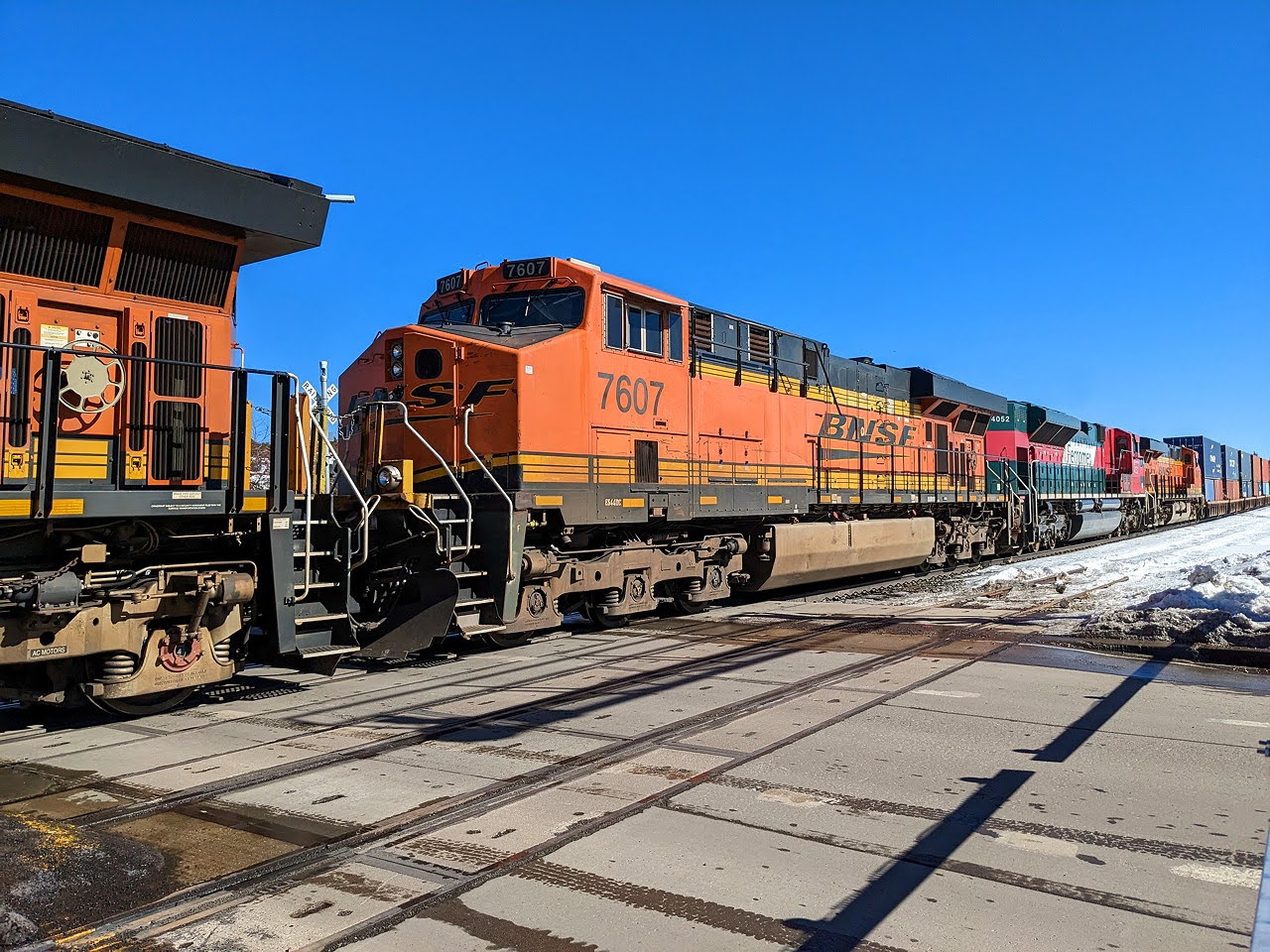
In Flagstaff the former ATSF Main Line and current Amtrak station are right in the center of town. Choosing to eat at Lumberyard Brewing allows one sufficient time to get photos of passing BNSF traffic upon activation of the San Francisco St crossing signals. The first train of that day was a westbound doublestack intermodal led by BNSF ET44AC #3788, C44-10W  #7607, Ferromex SD70ACe #4052 and ES44AC4 #8082. The Amtrak station sees the passage of the daily Southwest Chief in the early morning and evening so during the day it was all freight, all the time.


I was a little late to the party for the next two trains. The first, an eastbound autorack and manifest train, was led by ET44C4 #3994, C44-9W #5234 and ES44C4 #7038. This was followed by an eastbound intermodal with ES44C4 #4246, C44-10W #7611, ES44C4 #6901 and ES44C4 #8323.


This was followed by a westbound oil train with ES44C4 #8090, ES44C4 #6625 and C44-9W #5483 leading and two ES44C4's, #6905 and #6951, on the rear as DPUs.


A second westbound of the intermodal variety soon followed with ES44C4 #4298, C44-9W #4304 and C44-9W #4465 leading. 


Heading out of town I caught C44-9W #5191 hanging out as local power on a siding.

Wednesday, May 11, 2022

22-05-11 PHOTOS: Yosemite Searchlights

Over the last few years I have been on a bit of a National Parks kick since vacations involving cross country air travel wasn't part of my Childhood repertoire. having visited Bryce, Zion, Rocky Mountain and Great Sand Dunes in 2021, for 2022 I set up a trip to Yosemite with some West Coast friends. Despite the headline attraction, I was still able to slot in some railfan activities with a specific focus on getting photos of former Western Pacific searchlight signals near Lodi, CA and I was even able to get some BART action traveling to and front the airport in Oakland. The set of photos can be found here ( mirror ).

Starting off at Oakland I snagged this photo of an AirBART cable car on its elevated guideway. AirBART connects the Oakland Coliseum station with the Oakland Airport terminal for an additional fare. Replacing an earlier shuttle bus, the cable car system was made by ski lift manufacturer Doppelmayr.


Heading away from Oakland along the route of the BART Pittsburgh/Bay Pointe Line I encountered a mix of A type and D type stock.


Past Bay Pointe I also encountered eBART DMU #1 returning from Antioch.


Traversing the Sacramento River Delta involves a bunch of two lane roads and drawbridges. A surprising gap in California's renown system of freeways. Below are the drawbridges at Threemile Slough and the Mokelumne River.


Exiting the delta I managed to finagle a stop at the east end of the Thornton siding on the former Western Pacific Sacramento Sub. Somehow this line segment has avoided getting hit by a signal replacement program.


The searchlights are of US&S manufacture and block signals still use the split configuration for right hand placement. Hints of the WP's distinctive mint green paint can still be made out.


So yeah, I did all the Yosemite National Park activities including hiking to the top of Half Dome, but this is a rail oriented blog and you're not here for vacation slides. ;-)


Thursday, October 14, 2021

21-10-14 PHOTOS: MOAPA

The National Parks are America's Best Idea, however sometimes it can be challenging to incorporate sufficient rail content into a national parks trip. During my 2021 visit to Bryce and Zion National parks in southern Utah I was able to identify a rail related point of interest in the small Nevada town of Moapa, just a mile or so off Interstate 15. Due to various circumstances I was able to finagle a stop there on both the outbound and inbound legs of the journey from Las Vegas and despite long odds, I was ultimately rewarded for my perseverance. You can find the full set of photos here ( mirror ).


The Moapa station/siding is located on the Union pacific Caliente Sub on what used to be Amtrak's old Desert Wind route, until that service was cancelled in 1997. The siding is 384 miles from Las Angeles and I visited the northern end due to its proximity to a paved road and potential fire fuel. Although the Caliente Sub had been resignaled during the great PTC purge, the old pole line had been abandoned in place and provided some interesting visual content.


The railroad location of MOAPA is about a mile north of the town of Moapa and within spitting distance of Path 27, a 500kv HVDC power line running from Salt Lake City to the Los Angeles basin.


Because I was with non-train people I only had limited time to take some photos of the location and I was not expecting to catch a train movement. While my friend gathered wood I was treated to some A-10 Warthog ground attack aircraft flying out of nearby Nellis AFB.


Just before I was about to head out a Clear indication on the approach lit westbound mast signaled the presence of an approaching Union Pacific freight train.


It was a doublestack intermodal train led by Union Pacific SD70ACe #9048 and SD70Ms #4832 and #4543.


Friday, October 12, 2018

18-10-12 PHOTOS: Flagstaff and the Grand Canyon

Last October I booked a trip to visit the Grand Canyon in conjunction with some people I know in Phoenix. As much as one might like to try, the Grand Canyon is really not a great thing to try and day trip all the way from Phoenix considering it is close to a 4 hour drive each way. Therefore we arranged an overnight stay in Flagstaff, AZ in order to put a full day in at the park and see the entire south rim from Desert Watchtower to Grand Canyon Village. Flagstaff, like a lot of high desert towns in Arizona, is a pretty hip community and it was possible to go on an outright microbrewery crawl all within sight of the Amtrak station.

Flagstaff is located on the old Santa Fe Main Line, the premier double track line between LA and Chicago. The Station sees the daily arrival of Amtrak's Southwest Chief in both directions along with 50 or so odd BNSF through freights. While my group was in Flagstaff I was able to get some reasonable photography in and around the station area. Also included in this set are some random pics elsewhere in Arizona and photos taken while riding Phoenix's Valley Metro light rail line in Tempe. You can find the full set of photos here (mirror).

The Flagstaff Amtrak Station was built by the ATSF in 1926 and was of a style to support the local tourism industry.


Today the station primarily houses the Flagstaff visitor's center, with the Amtrak waiting area and ticket window being relegated to smaller space on the east side of the facility. The eastbound Chief is scheduled to arrive at about 4am with the westbound arriving daily around 8:30pm. 


The tourism industry resulted in a number of hotels advertising their services to arriving passengers via tall signage that remains in place today. 


Train traffic is fairly constant with grade crossings on either side of the station providing advance warning of approaching traffic. Here we see a pair of BNSF ES44C4's, #6987 and #4285, heading westbound with a double stack intermodal train first passing the old ATSF Flagstaff freight house and then the San Francisco Street crossing.


Some native rabbitbrush added a splash of color to the scene. 


ATSF painted C44-9W #691 was riding behind BNSF Tier IV ES44AC #3962 at the head of an eastbound intermodal with T4 ES44AC, #3846 and C44-10W #7620 running behind.