Search This Blog

Showing posts with label DRGW. Show all posts

Saturday, August 16, 2025

25-08-16 PHOTOS: Glenwood Springs

People might best know the town of Glenwood Springs, CO as that extra long stop on Amtrak's California Zephyr, but there's a reason for the extra long platform and the generally high level of activity. Glenwood Springs is the locus of a non-winter tourism district that aincludes an amusement park, natural scenery and actual hot springs, not the type that just keep one's wagon train from dying. Glenwood Springs is also served by the privately operated Rocky Mountaineer, which preserves the concept of railroad promoted tourism practiced by the Denver, Rio Grande and Western.  During a 2025 trip to Black Canyon of the Gunnison National Park I managed to manipulate the itinerary to include a stop at the Glenwood Springs Amtrak station in time for the arrival of westbound Zephyr Train 5. Also included in the set are additional photos of the semi-abandoned Tennessee Pass Line near Leadville. 

The Glenwood Springs station was constructed in 1904 by the DRGW. It's size and opulence was a direct function of it catering to the upper class tourism market in a similar fashion to the Great Northern station in Whitefish, Montana. At the time western railroads played a large role in promoting tourist destinations as a method to see better returns from their passenger operations that would otherwise see little travel in the sparsely populated western United States. It is currently the second least least used station in Colorado behind Denver.


The original interior has been preserved with both an active ticket office, baggage service and an interior waiting room.


The Rocky Mountaineer maintains its own private waiting room for its ultra luxury offering. Passengers can either travel between Glenwood Springs and Denver or overnight at Glenwood Springs before continuing on to Moab.


Even on days when the Mountaineer isn't running, local hotels will continue to send shuttle vans to meet Amtrak Trains 5 and 6.


Westbound Amtrak California Zephyr Train 5 was running no more than the typical hour late with a trio of P42DC's providing power.


Amtrak P42DC #37 was leading with #22 and #14 behind.
 

Saturday, December 17, 2022

22-12-17 PHOTOS: Salida

Once again I managed to find the time to explore the defunct DRG&W Tennessee Pass Line while on one of my annual trips to Colorado. I had previously visited the area in April of 2021, but as is often the case, I overlooked a couple of accessible signal locations so it came down to finding a mechanism to get my friends to drive the 5 hour round trip from our base in Evergreen. The solution came by surreptitiously arranging a "brewery tour" around the tourist/artist community of Salida, Colorado that just happened to align with the aforementioned missed railroad locations. Unfortunately out of service rail lines don't tend to feature many train movements, however I was able to pop by the Peoria RTD station to pad out the content that can be seen here ( mirror ).

Departing Amtrak's BWI Airport Rail Station Airport I spotted Southwest's New Mexico heritage unit at the new terminal A.


Salida, Colorado was the northeastern interchange point for the Denver, Rio Grande and Western's narrow gauge network. Until the 1960's, what was mostly mineral traffic would be transferred off narrow gauge, steam powered freight trains to the DRGW's Tennessee Pass main line at a yard located at the base of Tenderfoot Hill in Salida.


After the termination of narrow gauge ops, the yard at Salida continued to serve local industry including this limestone processing facility that was build adjacent to the east end of the yard.


After Union Pacific engineered an underhanded merger to gain control of the Southern Pacific and DRGW in the mid-1990's, it immediately shut down the Tennessee Pass route connecting Pueblo and Salt Lake City as it was surplus to requirements. However as the Union Pacific did not want to expose itself to competition it has held the line out of service ever since as opposed to selling or abandoning it. This has had the effect of preserving the 1960's vintage CTC signaling system such as this mast with hooded GRS Type D signals at EE SALIDA.


The proximity to town has resulted in the equipment at EE SALIDA being more exposed to infrastructure explorers, but there was been surprisingly little wanton destruction and all the glass lenses were intact.


Manipulating the rear doors on the signal made it possible to simulate a Clear main track signal indication in the eastbound direction.


View of the rusting Salida Yard looking westbound with Mt Princeton off in the distance.


The Sawatch Range overlooks the Tennessee Pass Line valley to the west.


Although I had already visited the west end of Salida yard in 2021, I took a moment to check back in and found the same old GRS model 5D switch machine amongst some higher weeds.


Unfortunately because of the booming local real estate market an enterprising vagrant had dumped out the contents of the relay hut and taken up residence.


Elevation Brewing Co off US 50 west of town was built right on the old DRGW narrow gauge RoW which now serves as a cycling path.

Thursday, March 11, 2021

21-03-11 PHOTOS: Tennessee Pass Line

Punching a rail lone through the Rockies is no easy feat. Today the preferred route is going around the mountains via the Union Pacific Main Line over Sherman Hill or the BNSF routes further north or south. If one absolutely has to go through the Rockies, the Moffat Tunnel route exists for trains traveling west of Denver. However the Moffat tunnel was completed in 1927 so what did one do before that? Well the original route through the Rockies was via the Arkansas River valley and the Tennessee pass. I have previously covered both the Moffat Tunnel and the Tennessee Pass in a previous post, but today I will take a closer look at the Tennessee Pass line on its eastern approach to the summit and what it's been up to since Union Pacific suspended service in 1997. Also included are photos off the San Luis and Rio Grande Railroad yard in Alamosa, CO before its collection of passenger were auctioned off in bankruptcy in 2021. The full set of photos can be located here ( mirror ).

Like I said in the intro, the Tennessee Pass like has been out of service since 1997 after Union Pacific saw no need for a second route between Denver and Salt Lake City. Previously the line had belonged to the Denver Rio Grande and Western, a corporate entity that also owned Southern Pacific. Union Pacific had envied a takeover of SP due to SPs ownership of the Oakland Container terminal and had gone as far to use some underhanded tactics to block the ATSF merger of the 1980s TLDR, the Rio Grand route across Colorado was an afterthought for UP and the Tennessee Pass line was removed from service, but not abandoned because it could serve as an emergency backup in case the Moffat Tunnel suffered a catastrophic failure.

Today the Tennessee Pass line is a railroad preserved in amber. Not only is it protected against re-signaling protects or PTC, but the arid mountain climate literally protects the infrastructure from rot and corrosion. Everything was left in place from the rails to the signals to the interlocking appliances. Here we see the signals at the west end of the Nathrop siding and an example of why The West is such an amazing place.


The relay hut was unsecured and although scrappers had hit the coils and the wire, the relays themselves were piled, unbroken, in a corner.


The Arkansas River defined the Rio Grand's first assault on the Rockies. The biggest problem is that trains can only access this route from Pueblo, 120 miles south of Denver.


It seems these days I can't do any railfanning without spotting a bald eagle. The bald eagle population has quadrupled since 2009.


Being into infrastructure renders "out of service" meaningless. East end of the Nathrop siding.


Don't let the Vader hoods fool you. These signals are old school GRS Type D's, not Safetran CLS-20s seen here at the east end of the Brown Canyon siding.


In the age before radio readouts, detect detectors had to use wayside indicators like this blue strobe light at the Milepost 2218 intermediate signals,.


The line was also a superb reservoir of General Railway Signal Model 5D point machines. The 5D can be differentiated from the later 5H by the presence of a braking clutch box on the motor.


Salida, Colorado is one of the larger communities on the Tennessee Pass. The town celebrates its heritage with a large white S on an adjacent mountain in addition to a former DRGW caboose. Salida was the base for most of the DRG&W's narrow Gauge operations that served small mining communities throughout the Colorado Rockies.

Sunday, November 8, 2020

20-11-08 PHOTOS: Winter Park

After visiting the eastern portal of the Moffatt Tunnel back in July 2020, upon my next visit to Colorado I made plans to visit the western portal which just happens to be located at the site of the Winter Park Resort rail station, western terminus of the famed Denver Ski Train, where some luck and timing allowed me to catch the westbound run of Amtrak's California Zephyr. Later that weekend I had some extra time to visit the new Denver RTD commuter rail stations at 41st-Fox and Denver International Airport. These and other Denver related photos can be seen upon visiting the entire gallery located here ( mirror ).

The Winter Park Resort station has served as the terminus of the Denver Ski Train since the days of the Denver, Rio Grande and Western Railroad. After issues with insurance and the Great Recession caused an extended hiatus between 2008 and 2014, the Ski train officially returned as an annual Amtrak sponsored event in 2017. Demand was such that a fresh platform was constructed at the Winter Park Resort terminus to better support the ridership. Fun fact, this is the highest point on the Amtrak network at 9300 feet.


The reason for the Ski Train's popularity is the proximity to the ski lifts at the Winter Park resort and the limited highway capacity dictated by the mountainous terrain. If the Berthoud Pass or I-70 are blocked or congested the only alternate routes in the winter are a 190 trip via South Park or a whopping 260 mile detour via Fort Collins.


As a plus, the station platform is located directly adjacent to the western portal of the Stephen Moffatt Tunnel. While not as involved as the eastern portal with its crazy fan plant, it is still treated with the same marquee label and dates. At 6.2 miles in length it is not the longest tunnel in North America, but it is pretty important cutting many miles off the previous Tennessee Pass route and delivering water to the City of Denver.


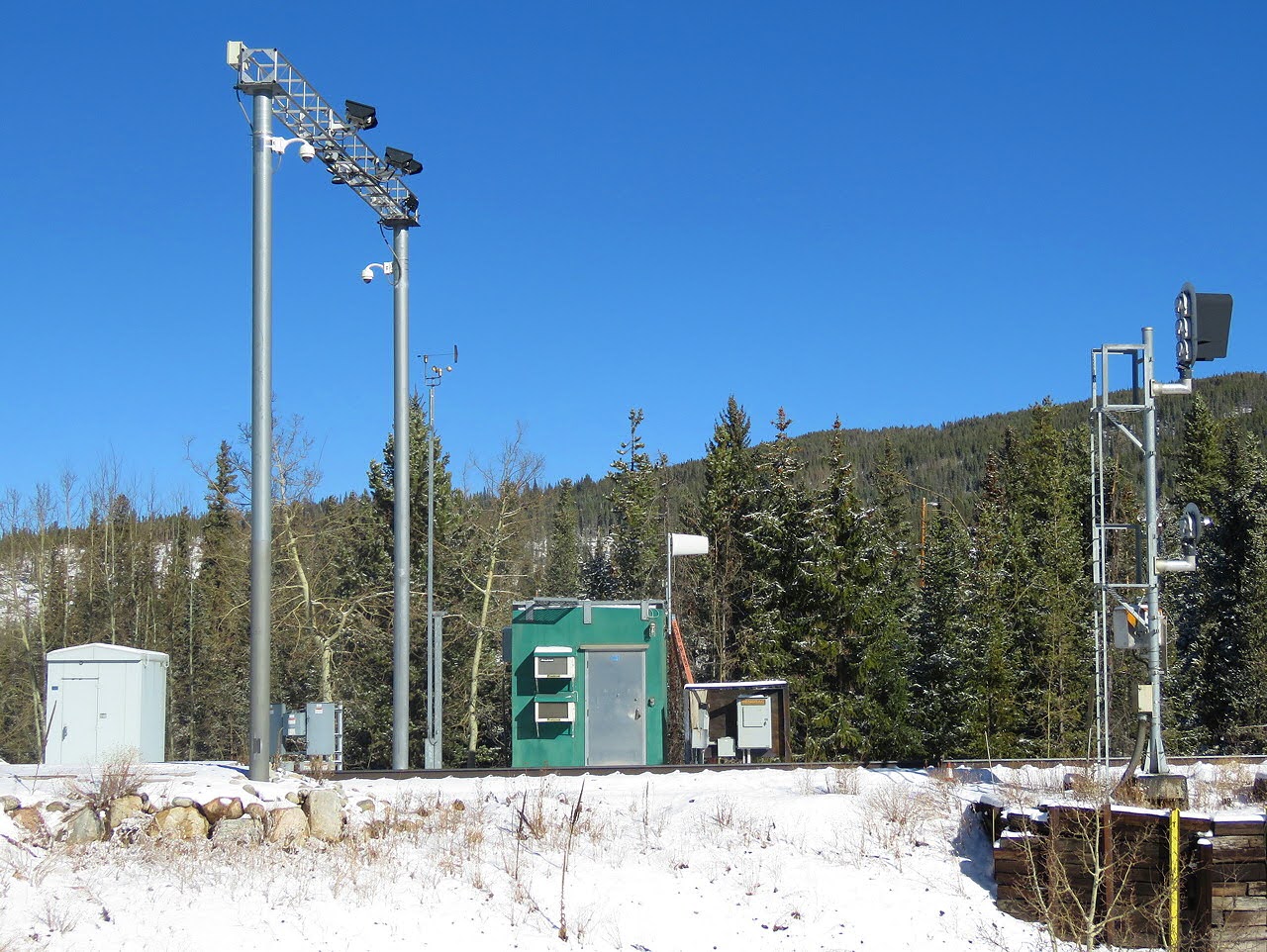
The western portal area is equipped with anti-intruder sensors and a repeater signal for the East End of the Winter Park siding.


The approaching Amtrak Train 5 could be heard from quite a distance back in the tunnel and took a white to emerge despite the 40mph track speed.


The Covid shortened consist was powered by Amtrak P42DC's #69, #133 and surprise 3rd engine #62.

Saturday, July 25, 2020

20-07-25 PHOTOS: Continetal Divide

The Continental Divide sounds like an intimidating barrier to transcontinental travel, however on some rail lines such as the Southern Pacific's Sunset route the crossing is so sedate that it's not even marked. The Great Northern offers a bit more drama, but was still able to get over the top out in the open at an altitude not much higher than Denver. Colorado however is where the Continental Divide in the form of the Rocky Mountains lives up to the stereotype, creating a massive barrier to east-west travel. While most of the Brand Name railroads built their routes to the north or the south, the Denver, Rio Grande and Western decided to go through the Rockies, not around them and this ultimately took the form of two distinct route. The first ran northwest from Pueblo to the headwaters of the Colorado river over the Tennessee Pass. Unfortunately this meant a 180 mile detour for trains trying to get west from Denver so in 1922 the State government funded a project to tunnel through the Rockies on a more direct route. On my summer 2020 trip out to Denver I visited both of these crossings and you can find the complete set of photos here ( mirror ).

The Moffat Tunnel was built between 1923 and 1928 and runs 6.2 miles underground between a point west of Tolland, CO and the resort community of Winter Park. Due to the length of the tunnel forced ventilation is a requirement, even with comparatively less polluting diesel locomotives. As the comparatively populated Winter Park would object to a constant haze of locomotive exhaust, the fan plant was located on the east side of the mountain seven miles down a dirt road from the nearest state highway.


Unlike the East, large portions of Colorado is public land and therefore the East Portal is a popular trailhead with ample parking, day or night.


The Moffat Tunnel route had actually been first cut by the Denver and Salt Lake Railway, that used an extreme switchback route over the Rollins Pass that ultimately proved unsustainable. This still eased the way for the Moffat Tunnel project that just had to bypass the bit over the Rolls Pass. Today some of the cabins used by the tunnel work crews are still standing and were recently made a state historic landmark.

The original tunnel headhouse consisted of two parts, a pressure door and two large squirrel cage blowers with the gatehouse structure supporting the door and the two boxy towers behind it the blowers. The door would prevent blower air from just rushing in/out the eastern end.


In 1988 the Rio Grande purchased the Southern Pacific with the resulting combination being purchased by Union Pacific in 1996, who operates the tunnel to this day. With the UP's original main line through Wyoming to Ogden, UT offering lower grades and more capacity, the former DRGW route now sees a much reduced amount of traffic with most road freights terminating in Grand Junction, CO leaving Amtrak as the primary user of the line in its original purpose as a shortcut to Salt Lake City and beyond.


The Moffat Tunnel itself was built by the public improvement district and leased to the railroad. Bronze plaques at the east portal attest to the principles involved.


The original fan plant was upgraded to modern standards some time in the 1980's with an entirely new plant built directly behind the first. A new door system was installed and the squirrel cage blowers were replaced by axial turbine units. To avoid polluting Winter Park the fans suck air towards the east end with large exhaust horns attached to the comparatively small electrically driven fans. There are two primary fans located on either side of the tunnel extension.


As giant fans are long lead items, a spare fan motor is on site in case of a failure.


A third fan is available to blow air from the east in the face of slow moving eastbound trains that might become bound in their own exhaust plume. Line speed is 40mph compared with 25mph in the similarly operated Cascade tunnel.


Direct drive diesel backups are provided for each fan.


A 10 foot wide pilot tunnel used in construction of the main bore was repurposed into a pipe to transport water from the Colorado River headwaters on the western side of the Continental Divide to the City of Denver on the eastern side. The water can be seen her exiting the mountain next to the rail line.


The fan plant requires a substantial amount of electric power which is supplied to this substation.


I timed my visit to coincide with the afternoon passage of Amtrak Train 6, the eastbound California Zephyr from San Francisco. Power on the head end consisted of P42'sDC #17 and #167. At 9239 feet in elevation the Moffat tunnel is the highest point on the Amtrak network as well as one of the highest main line passenger routes in the world.