Search This Blog

Friday, May 25, 2018

18-05-25 PHOTOS: AR UN

The high point of a mountain railroad has historically been a very busy place often with sidings and loop tracks that enable helpers to uncouple on the fly and then head back down the mountain to help another train ascend. At the PRR's high point, she summit tunnels at Gallitzin, PA, 2173 feet above sea level, is typically where all the photos are taken, however the real guts of the operation are about a half mile to the west where the dual interlockings of AR and UN are located. Connected by a loop track dating from the days of steam and manually controlled from an interlocking tower until 1994, the AR-UN complex still seems a bit frozen in time, with position lights and pneumatic point machines, although both are now slated for replacement.

I was able to visit the AR-UN complex as part of a Memorial Day road trip to Clarion, PA. The trip also involved a stop at CP-GRAY and the automatic signals at Tipton, completing my documentation efforts started back in the previous December, at those two locations. Also included in this 800 photo set are some summertime photos of the Tunnel-Bridge-Tunnel complex on the former L&MS Western Pennsylvania Main Line at Clarion.


AR (Allegheny Ridge) tower is located along the current eastbound Track #1 about a half a mile west of the New Portage tunnel that was originally built for the Pennsylvania canal system. Currently only the center track #2 is signaled for bi-directional operation, but the full mast signal being installed indicates that Rule 261 will be coming to all three tracks. The 4 main tracks west of CP-AR narrow to a single track via an equilateral switch so that doublestacks and other dimensional loads can fit through the tunnel. Up into the Conrail era this route would accommodate two tracks through the tunnel.


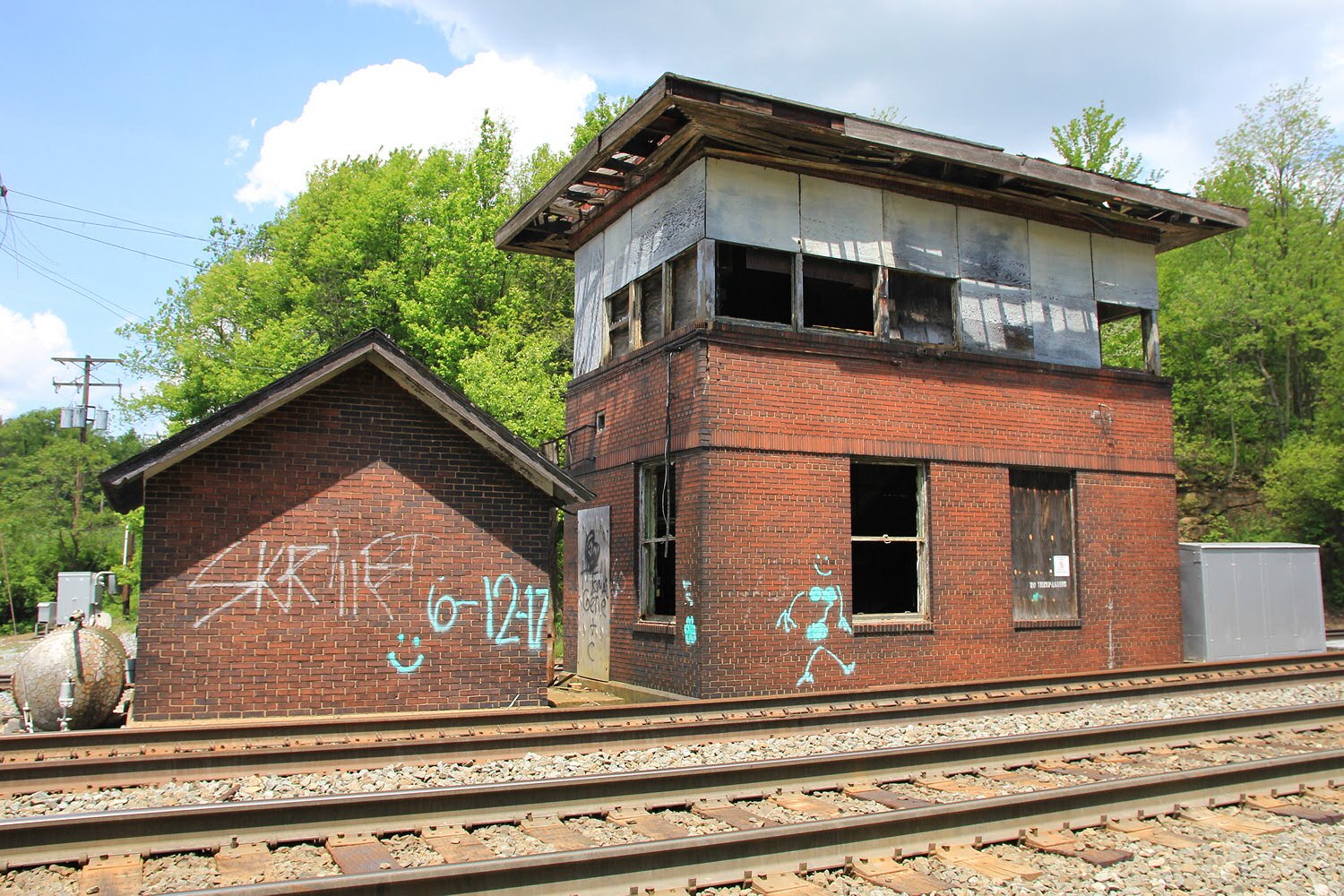
The World War 2 vintage AR tower actually consolidated the work of 4 previous towers into one modern brick structure. In addition to AR interlocking it also handled UN interlockings covering tracks 2 and 3 (formerly tracks 3 and 4) on the other side of the loop, SF interlocking east of the tunnels at the junction of the Muleshoe Curve route and BF interlocking, providing crossovers further east of SF. AR tower was built with a flat roof, but was retrofitted with an angled roof in the Conrail era to prevent leaks. The outbuilding used to house the compressor plant for the pneumatic switches and currently supports 100hz signal power generation. The tower was closed in 1994 along with MG, MO and SO as part of a Conrail re-signaling effort.

The eastbound signal bridge governs traffic on Tracks 0, 1 and 2 along with a dump siding. Although there are 3 designated main tracks, 0 is in essence a siding that runs just 2 miles between CP-MO and CP-AR. This incarnation of Track #2 also only runs between CP-MO and CP-AR and forces what are normally tracks 2 and 3 to number++ between CP-UN and CP-MO. A clear signal is being displayed for the next eastbound train on main track #1. Also note that the signals for both tracks #1 and #2 can display a Clear indication over the equilateral turnout. The new 4-track signal bridge won't change much, except the low speed turnouts off 0 and the dump siding will have high color light signals that can both display Slow Clear. 


AR tower as seen from the west with the #1 switch in the foreground.


Rear view of AR tower showing the old compressor house and a vintage pole line pole that has been left standing.


Possibly as a wartime economy measure, AR tower was fitted with 2 smaller US&S Model 14 interlocking machines, instead of one large one. The near machine, #2, worked SF and BF interlockings while machine #1 handled AR and UN.


The Model 14's were largely intact and open for inspection, just like the big on at the HARRIS tower museum. Unfortunately their condition was much more rusty :-\


Saturday, May 5, 2018

18-05-05 PHOTOS: Baltimore Swansong

Since 2003 I have been living part time in Baltimore City about a half block away from the CSX Baltimore Terminal Sub, aka B&O Baltimore Belt Line, aka the site of the first main line railroad electrification in the world, aka the place where the street collapsed in 2014. When I first arrived in the area I always had my scanner on and upon hearing approaching trains activate the MP 92.0 detector or call the eastbound signal at HUNTINGDON AVE i would sprint to the wall overlooking the track and get my photos.

Like the Blues Brothers said, the trains came so frequently that eventually I just stopped noticing them and although I would still keep an ear out for an approaching movement, I became a must more passive watcher (especially after my local B&O CPL was removed in 2012). However as I neared my data of departure I started a push to once again "fan my local" and that is pretty much what this photo set contains. The content was captured at the cut between North Charles and St Paul Sts, right at the westbound dwarf signal for the HUNTINGDON AVE interlocking.

You can find the full set of photos here and I'll be placing all of the video clips at the bottom of the post without regard to the order they were taken in relation to the still photos.

First I want to share a little something about the Charles Cut. It has been suffering chronic drainage problems that multiple scoop and cleans and even the complete rebuild after the 2014 collapse have failed to resolve. At this point CSX seems to have given up. Track speed is only 35mph and few trains even move that fast.


First off we see CSX ES44AC #809 and AC4400 #214 exiting and entering the tunnels with a train of autoracks.


Next up we have a westbound train descending the grade with AC4400's #203 and #468 on point. Behind them is a remote control set with SD40-3 #6537 and GP38-2 #2531 that may have been helping or was just in tow.


In the consist were some of the most pristine RailBox (TBOX) box cars I have ever seen.


At some point I caught a rail train hauled by a pair of elderly C40-8W's, including #7731. The silent passing of GE -8W's has caught me by surprise. On one hand I should probably be out more to document any sort of historic engine. On the other hand I've always hated GE's and they pretty much look like the newer ones. At least #7731 here was still in it's older school CSX paint scheme.


The two old -8's were pulling a welded rail train that clearly didn't need hotshot power.


Now we're getting into some proper history. FRA regulations specify a maximum age of 40 years for freight cars, with waivers extending that a bit in some cases. However MoW stock is exempt, so while the Chessie cat has vanished from the main lines via repaints and attrition, it survives on the engineering trains.


Some more detail shots of the rail laying equipment.


Monday, April 23, 2018

18-04-23 PHOTOS: St Denis

I can get rather desperate for content in the spring. It's cold and wet and grey so I jut don't get out as much as I should. In 2018 I made an effort to squeeze sufficient content out of some local railfan sites and the St. Denis MARC station seemed to fit the bill. not only was it a commuter rail station with commuter rail service, it was at the junction of the CSX Capitol Sub, Baltimore Terminal Sub and Old Main Line Sub.

With daylight time back in effect I could catch about three passenger movements within a single one hour window. Also included in this set was a trip to the old HX tower about a mile east of St. Denis, some photos around DC Union Station and some photos and video from the Baltimore Belt Line. You can find the full set of photos here.

The MARC Camden Line doesn't have a lot of service and the St. Denis station in particular has even less. Of the six peak direction trains, only 3 stop at St Denis with all of the reverse peak bypassing the stop as well. Arriving before the first train of the day returned from DC I only saw one car in the lot when typically most MARC stations are overflowing into the adjacent residential areas. One big reason is the close proximity of the faster Penn Line Halethorpe station that likely siphons off anyone with a vehicle.


The eastbound shelter dates back a ways to the B&O / MD Dot days of the 70's and 80's, while the westbound platform features a newer bus style shelter. Before the adjacent ST DENIS interlocking was placed in service in 2006, the westbound platform was a low island located between the Old Main Line track and Capitol Sub track 1. Now the train simply platforms at the duckboards to conduct the limited passenger operations.


ST DENIS interlocking was constructed in 2006 as a replacement for the older HALETHOPRE interlocking about a mile to the east. This lengthened the storage area for inbound trains to the southern Baltimore Terminal yard complex that branches off at WEST BALTIMORE interlocking. Here we see an Approach Medium indication displayed for an eastbound train on Track #2.


A non-stopping westbound train then arrives with MARC multi-level cab car #8049 on point and MP36PH-3C #28 and SC44 #85 providing power. At this point the SC44 Charger locomotives were still undergoing testing and had to be paired with the existing locomotive stock.


View of the train as it rounds the sharp curve west of the station. Just out of sight the OML will split from the Capitol Sub just east of the Thomas Viaduct.


The first train back from DC arrived with a single SC44, #83, on the front. It stopped and discharged a few passengers.


Alighting passengers must wait for the train to depart before crossing the tracks via the duckboards to get to the small parking area on the westbound side.


Here we see single level MARC cab car #7762 passing the subdivision post between the Capitol and Baltimore Terminal subdivisions.


CSX #ES44 #973 and AC4400 #11 ran light through ST DENIS interlocking after detaching from a coal train. The engines will now run back to to some yard for servicing. Note the Restricting signal indication for the light engines and a Medium Approach Medium signal for what turned out to be an approaching freight on Track #2.


Saturday, March 31, 2018

18-03-31 PHOTOS: Perryman

With Amtrak making waves about eliminating intermediate signals along the NEC I am scheduling some trips to cover such an eventuality. One such signaling location is at Milepost 69 in Perryman, MD just south of Aberdeen. It happens to be adjacent to the Perryman Substation, which was built in 1935 as part of the Wilmington to Washington electrification project and provides an additional photography subject. You can find the full set of photos covering both these subjects here.

The Milepost 69 signals support three bi-directional tracks numbered 2, 3 and 4 from east to west. They were previously converted to LED lamps along with the BUSH interlocking high speed turnout project around 2010.


The Perryman Substation is a typical PRR intermediate substation with two 25hz transformers that step down 138kv transmission voltage to 12kv for the overhead wires.


The substation was built to accommodate 5 of the transformers, although only 2 were ever installed. The transformers are relatively new, having been installed around 2005, and have a capacity between 10 and 25 MAh.


The substation is fed by two 138Kv, split phase transmission lines. Although referred to in literature as a single phase system, the two transmission wires are offset 180o in phase, which provides the 138Kv figure. This trick allowed the PRR to save on costs and complexity as each wire is only at 69kv with respect to the ground. Although each transformer is typically fed through a single transmission line, it is possible to use field switches to feed either transformer from either transmission line as well as cross tying the two transmission lines together.


As another cost saving measure the PRR decided to place all of it's circuit breakers on the 12kv side of the substation with 138kv field breakers present only at Perryville, Zoo and Thorndale. High voltage faults will usually involve isolation of the complete electric region followed by the manipulation of HT field switches, such as those pictured above, under unloaded conditions.


In this side view we can see the configuration of the substation with the second 138kv transformer and the bank of 12kv breakers.


A progress tree erected within the fence line of the substation had been taken over by a mated pair of Osprey. These maritime raptors enjoy a diet completely composed of fish and appear to have a permanent chip on their shoulders.


Note the size of the talons which are perfect for snagging fish...or murdering you.


The pair was in the process of constructing a nest, much to the chagrin of every other bird in the area who were actively harassing the Osprey for the entire time I was there. Just goes to show that humans are not the only species to practice racially motivated housing bias.


Saturday, March 3, 2018

18-03-04 PHOTOS: Buffalo Line North

As NS re-signaling efforts continue to wipe away large amounts of PRR heritage, I embarked on a mission to document the signaling on the NS Buffalo Line between Harrisburg and Lock Haven. Part one of this mission, between Harrisburg and Northumberland, was completed in the summer of 2017. Part 2 would cover the remaining signals between Williamsport and Lock Haven, specifically the Linden wye, CP-PINE, the two-track signal bridges and whatever was left over at CP-LANE and Lock Haven. Along the way I was also able to catch some power from NS and various local short lines.

You can view the entire set of photos here.

We begin back at Sunbury where in the previous trip we had neglected to visit an old Reading railroad signal bridge that once governed eastbound traffic at SF interlocking. Today the gantry spans a parking lot.


Adjacent to the signal bridge is the former Reading Railroad passenger station, which is now a law office.


In the former PRR Northumberland Yard NS SD60I #6754 and SD40-2 #613 were waiting to take out the next manifest freight to Harrisburg or Allentown.


The North Shore railroad runs on the north shore of the Susquehanna River's eastern branch and rents yard space in the former PRR Northumberland complex. Here we can see North Shore SW1500's #1942 and #2238.


The Linden Wye on the Buffalo Line west of Williamsport is bounded by CP-SOUTH LINDEN, CP-LINDEN and CP-RIVER. Here we see CP-SOUTH LINDEN with a new mast signal already in place. An earlier layout is evidenced by the long distance between the northbound home signal and the switch is protects. The re-signaling effort will contract the interlocking limits.


There is also evidence of both the old layout and the the use of pneumatic point machines by this rusting US&S A-5 unit and the out of service air line.


Originally serving two tracks, today the PRR signal bridge at CP-LINDEN supports a single signal.


There is another disused air plant, which was taken out of service sometime after 2006.


The Buffalo Line was an early CTC experiment for the PRR, which purchased custom relay huts, each with a keystone above the entry. Here the hut for CP-LINDEN is seen next to its replacements.


The Buffalo Line CTC project is also know for it's use of PRR pedestal signals with red lenses on the upper head diverging route signals.


CP-RIVER is located just north of the Susquehanna River bridge that connects to the various industrial tracks that serve Williamsport Proper. Although the Main Line, Rockville to Buffalo, runs through South Williamsport, the PRR had a line directly serving the city and also connecting to the Elmira Branch.


The signal used to be located at the far end of the bridge, but NS has already taken the trouble to relocate it and shrink the interlocking limits.


Another feature of the Linden Wye are automatic PRR dwarf exit signals on the tight eastern leg. Without a route lined at the next interlocking they default to Slow Approach. These are also to be eliminated.