Search This Blog

Saturday, May 8, 2021

21-05-08 PHOTOS: Airport Run

Since visitors who why in tend to fly back out, a week after picking up someone from JFK airport I was involved with dropping the same individual off at JFK airport for their return flight to the west coast. With three people on hand, paying the AirTrain penalty was not particularly appealing so I suggested taking Uber to the Rockaway ferry terminal to take the scenic route to Manhattan. After dinner I proceeded back south via NJT, RiverLINE, PATCO and Amtrak. The full set of photos can be found here ( mirror ).

The Rockaway Ferry was started in 2012 as a way to connect the peninsula to downtown after Hurricane Sandy took out the A Train causeway over Jamaica Bay. With subsidized fares, a scenic route and $3 beers, the Rockaway Ferry quickly became one of the best deals in the city and since my friend had never been to New York City before I figured it would be a fun tourist activity.


Unfortunately the weather was a bit cold and grey and they weren't selling any beer on board, but we still had a great time.


Although our destination was Central Park we decided to connect with the A train at Chambers by walking down to the Battery and then up past Wall St.


The expensive PATH headhouse and Fulton TC oculus were both still a thing.


Catching an R46 A-train at Chambers with #6070 in the lead and then a video of it leaving 59th St.


Saturday, May 1, 2021

21-05-01 PHOTOS: Moynihan Train Hall and TWA Hotel

A lot of people were talking about that new Moynihan train hall so when presented with a need to pick someone up from JFK Airport I decided to make a side trip one block to the west to see what all the fuss was about. Once I was in the mood for retro travel experiences I also killed some time in the new TWA Hotel built in the old TWA Flight Center structure. The full set of photos can be found here ( mirror ).

Starting off at BWI Airport Rail Station with Amtrak ACS-86 #654 leading Train 20, the northbound Crescent at speed on the center track through the BWI Airport Rail Station. The lack of LD service to BWI is a bit of an annoyance after I moved out of the city.


This was followed by my northbound Regional arriving with Amtrak ACS-86 #610 in the lead.


SEPTA Silverliners IV #433 and #440 at 30th St Station.


Here we have east and westbound PATCO trains arriving simultaneously at 8th and MARKET.


PATCO Rebuild #1071 at Haddonfield.


RiverLINE LRV #3518 southbound at Bordentown.


Amtrak ACS-86 #656 pushing a Keystone set out of Trenton.


SEPTA Push-pull set at Trenton with cab car #2408 and ACS-86 #906.


The east facade of the Farley Post Office building was still under renovation, but branding for the Moynihan Train Hall had been applied.


Inside, the Moynihan Train Hall was very nice, but still pretty empty as COVID was still holding back travel.


Friday, April 23, 2021

21-04-24 PHOTOS: Devon and Wayne

The next point of focus on my PRR Main Line tour are the stations of Devon and Wayne, 16 and 14 miles from Suburban Station respectively. Each location plays host to a classic PRR signal bridge still in a 1940's vintage configuration along with all of the other Main Line accoutrements such as victorian station buildings, a 4 track main line with 1915 overhead catenary and a mix of SEPTA and Amtrak services. You can find the full gallery of photos here ( mirror ).

The Devon station is typical of those seen on the Main Line, an ornate Victorian building made from high quality materials like brownstone. The railroad turned the towns along it into bastions of wealth that could use the new transportation artery to escape the dirty urban hellscape and live in more natural settings.


A little ways down from the station are the Milepost 16 intermediate signals mounted on an old 19th century truss road bridge. Here an inbound SEPTA R5 local passes by the signal location with Silverliners IV #325 leading and #166 on the rear.


The Main Line is still in its 1940's configuration with three single direction (ABS Rule 2510 tracks (#'s 1, 2 and 4) and one bi-directional (Rule 261) track (#3). The line is run by manned interlocking towers with the dispatcher keeping track of movements via paper train sheets. Here Amtrak Train #43, the westbound Pennsylvanian, passes under the Milepost 16 automatic signals with P42DC #117 in the lead. The track #1 signal is still displaying Stop and Proceed after the passage of the previous SEPTA train.


A barely missed a meet between the westbound Train 43 and an eastbound Keystone train fronted by Metroliner Cab Car #9635 and propelled by ACS-86 #646. Just after the keystone passes the Milepost 16 signal on track #1 finally changes from Stop and Proceed to Approach.

Saturday, April 17, 2021

21-04-17 PHOTOS: Seabrook

In the past year or two as Covid has curtailed some of the opportunities I had for travel and urban transit, I had to look closer to home to find interesting railroad content. One of the low hanging fruit has been MARC commuter rail stations in my area, specifically those on the Penn Line (Amtrak NEC) that has both all day and weekend service compared with the Camden Line (B&O) that does not. Today's station is the first one located outside the Capitol Beltway in Seabrook, Maryland. You can find the full set of photos here ( mirror ).


Located fairly close to the New Carrollton DC Metro terminal, Seabrook is skipped by many weekday trains and has no weekend service in order to save a few minutes for other Penn Line travelers.


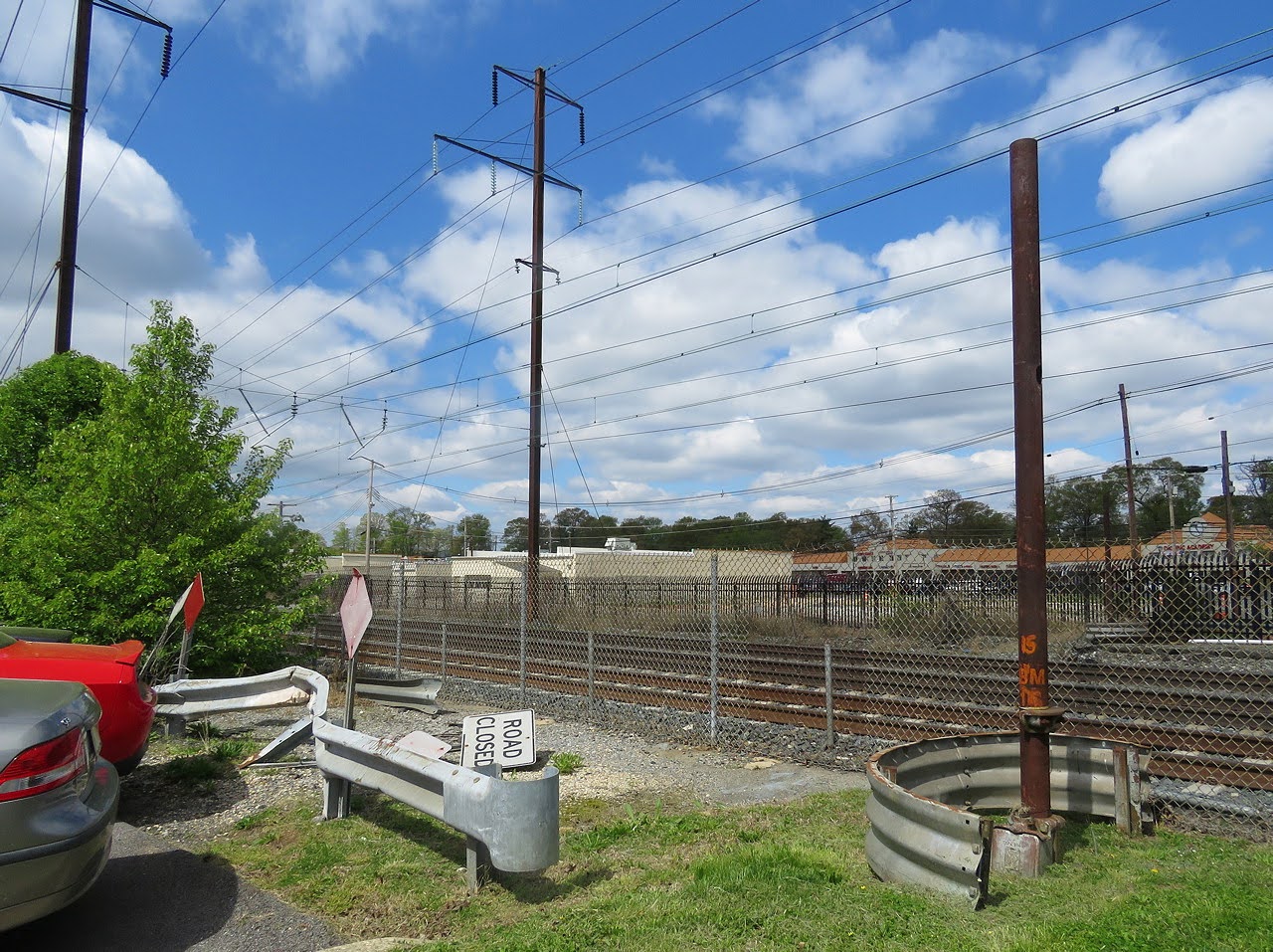
Seabrook was the location of one of the last 4 grade crossings on the PRR portion of the NEC. Eliminated as part of the NEC Improvement Project of the 1980's, remains of the Seabrook Road crossing are still evident including one of the masts for the crossing flashers.


The station is also situated about a quarter mile south of the milepost 124 intermediate signal location and dragging equipment detector. Both of these were installed as part of the NECIP, however the old PRR era signal bridge can be seen spanning the station platforms.


The first pair of trains to show up was a northbound Amtrak Regional hauled by ACS-86 #610 and a southbound weekend MARC local pushed by M36PH-3C #13. I managed to capture the meet in the video below.


Unlike more contemporary stations, MARC was not afraid to use ramps and an underpass for accessibility. This saves on the cost and visual footprint of overhead walkways with elevators.

Friday, March 26, 2021

21-03-26 PHOTOS: Hudson Line Cleanup

For many years I have been taking trips to the New York Capitol Region around Albany as I have good friends that either went to school there or have family there. Typically I would take Amtrak's Empire Service to and from as I would have access to a vehicle at the far end to carry out the various cultural and outdoor activities that we had planned. However in recent years this vehicle access went away and while a rental filled the gap in 2019 and 2020, the COVID pandemic in the spring of 2021 made rail travel somewhat less attractive and my friend and I decided to drive up instead. The silver lining was that I would be able to visit a couple of signal locations on Amtrak's Hudson Line that were in danger of replacement by the creeping re-signaling project, specifically ones I had missed on my two previous Hudson Line signal documentation trips based out of Westchester country. You can find the full set of these photos here ( mirror ).

As all of the signaling worth seeing is north of Poughkeepsie, I would take the Thurway to US 44 and cross the Hudson via the Mid-Hudson Bridge. Of course this would require a stop at the Walkway Over The Hudson and despite the rather meh weather, I managed to score a photo of an northbound train of autoracks on the former Conrail River Line hauled by a single CSX AC4400, #474.


The fact that a single unit can manage such a long train belies the relative low weight density of motor vehicles compared to other freight.


The Hudson Valley Rail Trail, running over the old Bridge Line to Maybrook Yard, has parked an ex-PRR N5 caboose at the west end of the Hudson Walkway, despite the fact that the line was a major New Haven route.


North of the Amtrak/Metro North division post at CP-75 in Poughkeepsie, traditional New Yok Central / Conrail signaling is still in service with many classic signal bridges over what used to be a 4-track right of way. The Milepost 83 automatic signal is co-located with the Conrail, Staatsburg, New York defect detector and a grade crossing. Linespeed here is 95mph, but in the pre-PTC days it was not uncommon for engineers to get a little bit more with the fastest speed I observed on the detector readout being 103mph.


I was on hand for the appearance of a northbound Empire Service train led by Amtrak P32AC-DM #706.


Sunday, March 21, 2021

21-03-21 PHOTOS: BROWN Berlin

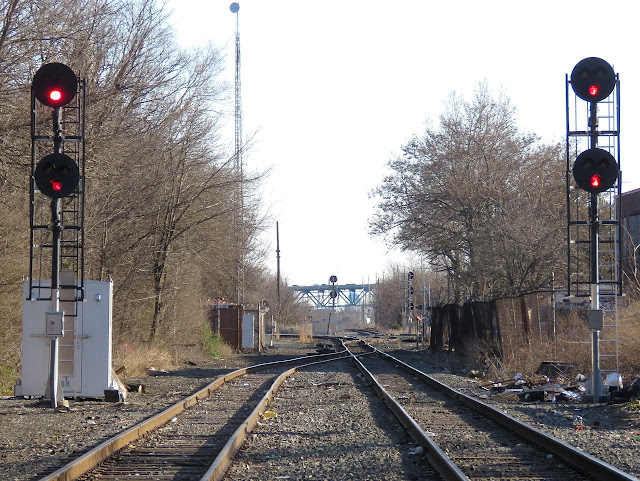
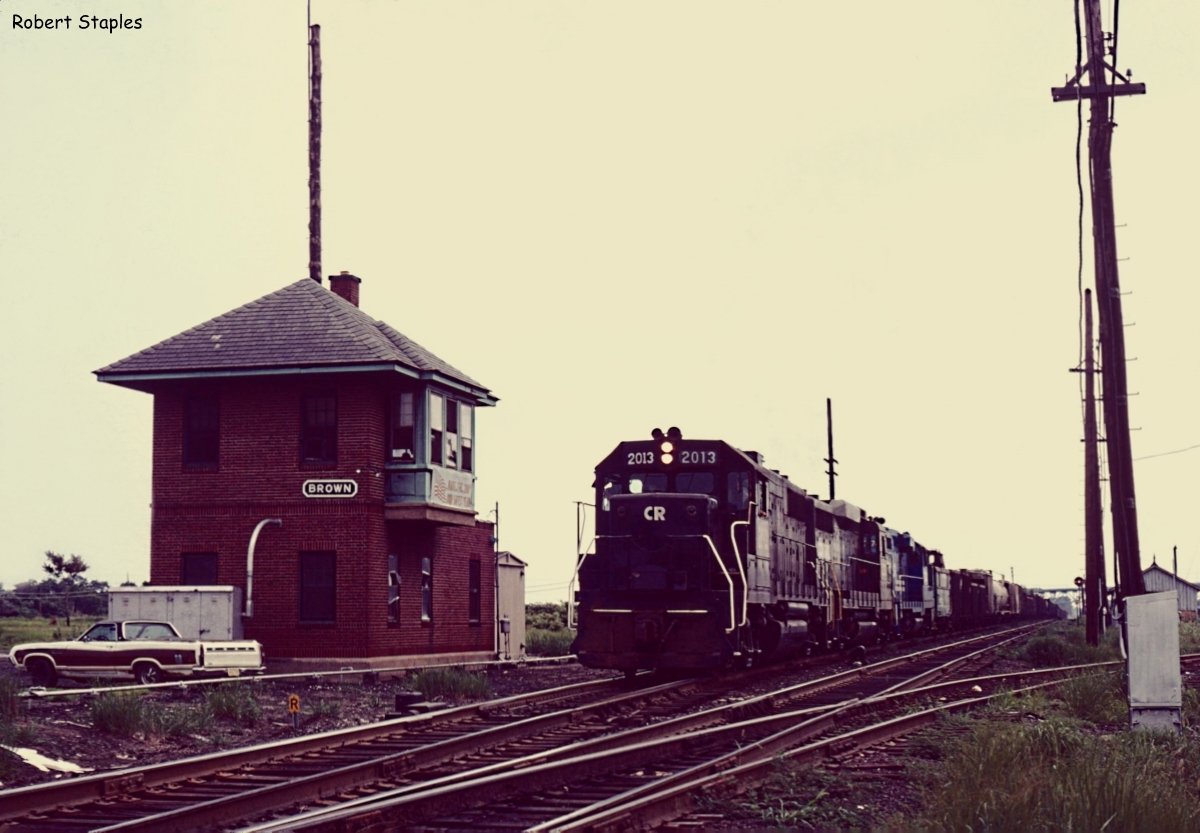
Rebuilt in 1934 to help join the former PRR and Reading networks in South Jersey after the PRSL merger, BROWN interlocking was located at the crossing of the former Reading owned Atlantic City Railroad and the PRR owned West Jersey and Seashore Railroad main lines in Camden, NJ. Controlled by BROWN tower until the 1980's, the interlocking was drastically simplified under Conrail, although the PRR style position light signals remained until 2002. Even with Conrail signals in place, increases in South Jersey freight traffic brought about a second re-building with new signals and a new interlocked connection to the former Reading Bulson St yard around 2018.


The area can be generously described as rough, but it is an interesting location when one is lucky enough to catch a train, which I was not. Unfortunately the southbound PRR signal bridge was removed about 15 years ago, but the footings can be seen behind the southbound mast signals.


The Berlin, NJ train station was built for the PRR controlled Camden and Atlantic in 1856 and served as a stop on later PRSL and NJDoT train services to Atlantic City until 1983. Today the station building houses a historical society.


When When NJT restored Atlantic City Line service, the old Berlin station stop was moved to a large Park-and-Ride facility about a mile south of town in the town of Atco. Unfortunately the expected Park-n-Ride traffic never emerged and lightly used trains, like this southbound with Comet V cab car #6050 and GP40PH-2B #4215, now pass by the Berlin station without stopping.


Originally a high speed double track main line, the the NJT ACL was restored as a single track line with a number of short, 1 mile passing sidings. The Lucas siding is one of two between Winslow Jct and Lindenwold and show off the very rural nature of the line despite being only about 15 miles from Center City Philadelphia.


Despite NJT's best efforts to discourage such actions, use of the railroad right of way for personal wheeled transport is pretty common.


With protracted Covid headways I had plenty of time to set up for and catch the next northbound train with NJT GP40PH-2B #4209 and Comet V cab car #6008


Thursday, March 11, 2021

21-03-11 PHOTOS: Tennessee Pass Line

Punching a rail lone through the Rockies is no easy feat. Today the preferred route is going around the mountains via the Union Pacific Main Line over Sherman Hill or the BNSF routes further north or south. If one absolutely has to go through the Rockies, the Moffat Tunnel route exists for trains traveling west of Denver. However the Moffat tunnel was completed in 1927 so what did one do before that? Well the original route through the Rockies was via the Arkansas River valley and the Tennessee pass. I have previously covered both the Moffat Tunnel and the Tennessee Pass in a previous post, but today I will take a closer look at the Tennessee Pass line on its eastern approach to the summit and what it's been up to since Union Pacific suspended service in 1997. Also included are photos off the San Luis and Rio Grande Railroad yard in Alamosa, CO before its collection of passenger were auctioned off in bankruptcy in 2021. The full set of photos can be located here ( mirror ).

Like I said in the intro, the Tennessee Pass like has been out of service since 1997 after Union Pacific saw no need for a second route between Denver and Salt Lake City. Previously the line had belonged to the Denver Rio Grande and Western, a corporate entity that also owned Southern Pacific. Union Pacific had envied a takeover of SP due to SPs ownership of the Oakland Container terminal and had gone as far to use some underhanded tactics to block the ATSF merger of the 1980s TLDR, the Rio Grand route across Colorado was an afterthought for UP and the Tennessee Pass line was removed from service, but not abandoned because it could serve as an emergency backup in case the Moffat Tunnel suffered a catastrophic failure.

Today the Tennessee Pass line is a railroad preserved in amber. Not only is it protected against re-signaling protects or PTC, but the arid mountain climate literally protects the infrastructure from rot and corrosion. Everything was left in place from the rails to the signals to the interlocking appliances. Here we see the signals at the west end of the Nathrop siding and an example of why The West is such an amazing place.


The relay hut was unsecured and although scrappers had hit the coils and the wire, the relays themselves were piled, unbroken, in a corner.


The Arkansas River defined the Rio Grand's first assault on the Rockies. The biggest problem is that trains can only access this route from Pueblo, 120 miles south of Denver.


It seems these days I can't do any railfanning without spotting a bald eagle. The bald eagle population has quadrupled since 2009.


Being into infrastructure renders "out of service" meaningless. East end of the Nathrop siding.


Don't let the Vader hoods fool you. These signals are old school GRS Type D's, not Safetran CLS-20s seen here at the east end of the Brown Canyon siding.


In the age before radio readouts, detect detectors had to use wayside indicators like this blue strobe light at the Milepost 2218 intermediate signals,.


The line was also a superb reservoir of General Railway Signal Model 5D point machines. The 5D can be differentiated from the later 5H by the presence of a braking clutch box on the motor.


Salida, Colorado is one of the larger communities on the Tennessee Pass. The town celebrates its heritage with a large white S on an adjacent mountain in addition to a former DRGW caboose. Salida was the base for most of the DRG&W's narrow Gauge operations that served small mining communities throughout the Colorado Rockies.