Search This Blog

Friday, October 12, 2018

18-10-12 PHOTOS: Flagstaff and the Grand Canyon

Last October I booked a trip to visit the Grand Canyon in conjunction with some people I know in Phoenix. As much as one might like to try, the Grand Canyon is really not a great thing to try and day trip all the way from Phoenix considering it is close to a 4 hour drive each way. Therefore we arranged an overnight stay in Flagstaff, AZ in order to put a full day in at the park and see the entire south rim from Desert Watchtower to Grand Canyon Village. Flagstaff, like a lot of high desert towns in Arizona, is a pretty hip community and it was possible to go on an outright microbrewery crawl all within sight of the Amtrak station.

Flagstaff is located on the old Santa Fe Main Line, the premier double track line between LA and Chicago. The Station sees the daily arrival of Amtrak's Southwest Chief in both directions along with 50 or so odd BNSF through freights. While my group was in Flagstaff I was able to get some reasonable photography in and around the station area. Also included in this set are some random pics elsewhere in Arizona and photos taken while riding Phoenix's Valley Metro light rail line in Tempe. You can find the full set of photos here (mirror).

The Flagstaff Amtrak Station was built by the ATSF in 1926 and was of a style to support the local tourism industry.


Today the station primarily houses the Flagstaff visitor's center, with the Amtrak waiting area and ticket window being relegated to smaller space on the east side of the facility. The eastbound Chief is scheduled to arrive at about 4am with the westbound arriving daily around 8:30pm. 


The tourism industry resulted in a number of hotels advertising their services to arriving passengers via tall signage that remains in place today. 


Train traffic is fairly constant with grade crossings on either side of the station providing advance warning of approaching traffic. Here we see a pair of BNSF ES44C4's, #6987 and #4285, heading westbound with a double stack intermodal train first passing the old ATSF Flagstaff freight house and then the San Francisco Street crossing.


Some native rabbitbrush added a splash of color to the scene. 


ATSF painted C44-9W #691 was riding behind BNSF Tier IV ES44AC #3962 at the head of an eastbound intermodal with T4 ES44AC, #3846 and C44-10W #7620 running behind.


Friday, October 5, 2018

18-10-05 PHOTOS: CONPIT and TROBE

October was a busy month with back-to-back trips to Western Pennsylvania. The first covered the PRR Main Line between Altoona and Conpit Junction and the second had me swinging by the well known railfan locations at Latrobe and Derry, PA. In my previous post I covered the West Slope portion of the trip between Gallitzin and South Fork, moving the Conpit Junction photos to this post with the Latrobe and Derry photos taken a week later as they present a more logical grouping. CP-CONPIT is the westernmost end of the three track segment of the PRR Main Line that starts at Tyrone, PA, about 10 miles east of Altoona. At CP-CONPIT the Pittsburgh and Conemaugh Lines and diverge and take different routes to Pittsburgh, with the Conemaugh Line being the longer yet lower grade option as it follows the Conemaugh River to the Allegheny River at Kiski. Meanwhile the Pittsburgh Line continues directly to Pittsburgh overland via the cities of Latrobe and Greensburg. CP-CONPIT takes the form of a full 3-track crossover, but sees more than a typical crossover's share of shuffling as different types of trains take different routes.

CP-TROBE is located at the site of the old KR tower that controlled a crossover and the side platform Latrobe passenger station. A history of the tower can be found here, but the interlocking was initially completely removed by Conrail in favor of DR interlocking at Derry, before being restored as part of the late 70's CTC project. Latrobe itself is the home of Arnold Palmer, Mister Rodgers and Rolling Rock Beer. Derry, PA is a well known Railfan location due to a small railroad museum and a position light signal bridge that used to be the westbound home signal for DR interlocking.

You can find the set of Conpit photos of the bottom of this gallery (mirror) and the Latrobe/Derry photos here (mirror).

We kick off with the same two GE engines I had caught earlier in the afternoon at Summerhill, a brand new NS ET44AC #3671 and a decrepit CSX C40-8W #7826. They are powering a westbound manifest train over the long crossover from Pittsburgh Line #3 track to Pittsburgh Line #2 track as that train is being routed directly to Pittsburgh.


The Conemaugh Line between CP-CONPIT ahd CP-KISKI was the site of the PRR's experiment of a cab signal system without wayside signals and as a result it features Rule 280a "Clear to Next Interlocking" lamps on all westward signals to accomidate cab signal failures. Here we see the original PRR vintage 8W signal displaying a Clear indication for a westbound train. 


The westbound train in question was a doublestack intermodal led by NS C44-9W #9242 and C40-8W #8366.


This was soon followed by an eastbound with a 5-engine lashup on the front that consisted of NS C44-9W #9227, Flordia East Coast SD70M-2 #106, NS C44-10W #7526, NS GP38-2 #5662 amd NS SD40-2 #3462.


Monday, October 1, 2018

18-10-01 PHOTOS: West Slope

The second day of my Fall 2018 PRR Main Line trip started at Altoona and would cover the West Slope between there and South Fork with stops at The Brickyard, Horseshoe Curve, Gallitzin, Cresson, Cassandra, Portage and Summerhill. All of these places are well known railfan hot spots and rail enthusiasm is even a local tourism industry with multiple beds and breakfasts and even a stretch of PA Route 53 signed as a railfan byway. At each of these locations I documented the endangered PRR style position light signals, but due to traffic levels on the main line I also caught a healthy mix of NS freight including four(!) "specialty" units and two rare instances of foreign power.

You can view all the 1300 or so photos here or here.

The day started at the railfan bridge over what used to be CP-SLOPE. The fog was pretty thick, which would limit infrastructure photos, but since this area had been re-signaled in 2012 there wasn't too much I personally was interested in. While most railfanning involves a lot of futile waiting or chasing down trains with the help of a scanner, the old PRR Main Line has sufficient traffic that even a brief stopover makes catching something likely. In this case an eastbound intermodal train rolled out of the fog led by NS C44-9W #9841 and UP SD70M #4500.


ALTO tower was still standing in downtown Altoona. Although owned by the nearby Railroader's Museum, the wooden structure is unoccupied at at a high risk for arson. 


From Altoona my friend and I drove about a mile up the line to a location known as Brickyard as it was at the site of an historic brickyard. Although the former PRR Position Light signal bridge was replaced by an NS style cantilever in 2012, it is still a popular location due to a grade crossing and a defect detector. We were just in time to catch an eastbound merchandise train descending the East Slope on track #1 and in an amazing feat of good luck, the NS SD70ACe "Barcode" unit #1111 was first under the signal, followed by a significantly less interesting Tier IV ES44AC #3612.


On the rear of the long train were two SD40E (former SD50) helper packs, with two units each, NS #6324, #6329, #6302 and #6327.


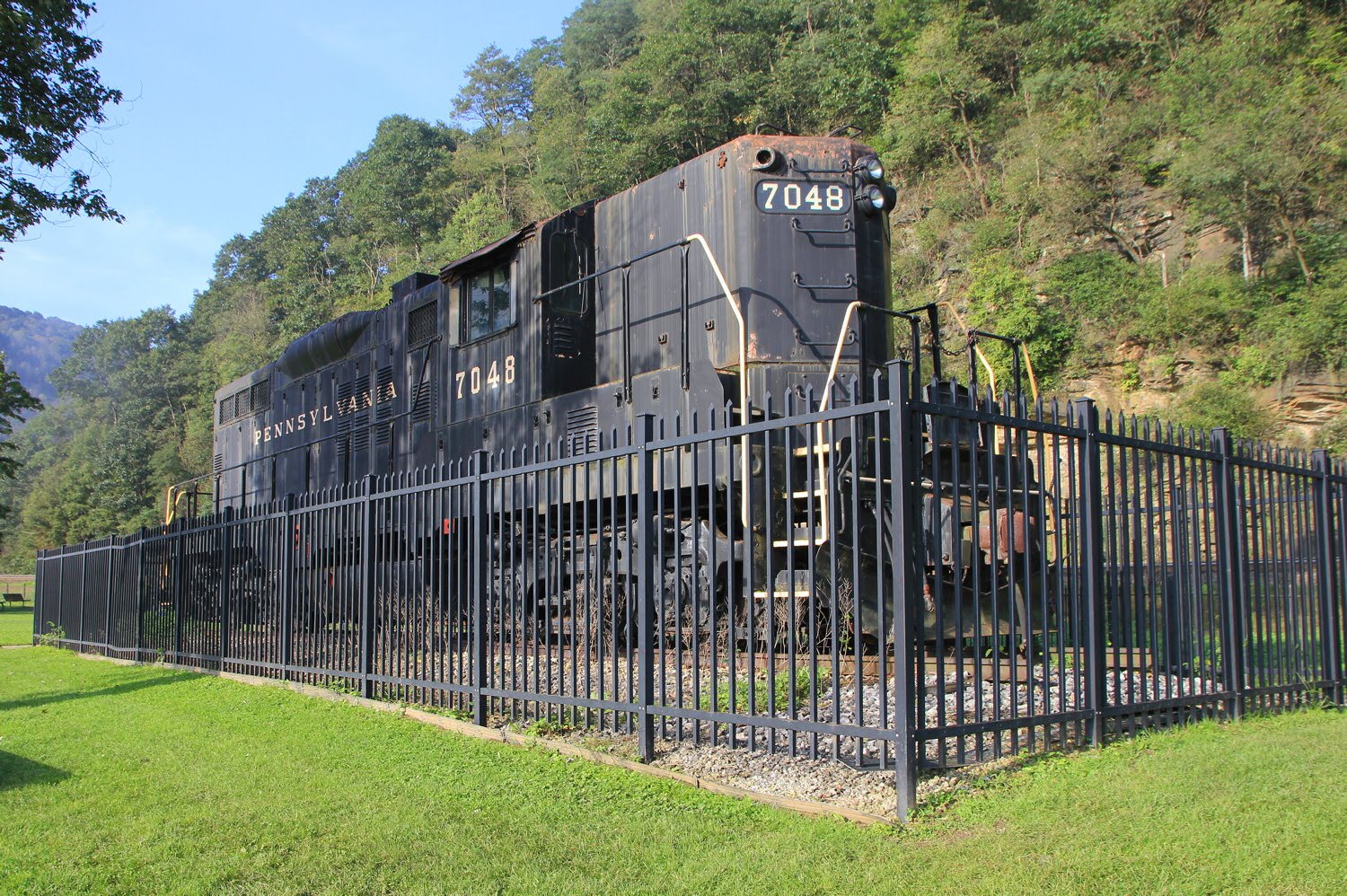
The fog lifted on the uphill drive west to the famed Horseshoe Curve where I grabbed this obligatory photo of PRR GP9 #7048 that is on display at the park there. 


Although Pittsburgh Line traffic does come in waves, I was not to be disappointed as a westbound doublestack train soon appeared headed by NS Wabash SD70Ace heritage unit #1070 with mechanically heritage C40-8W #8350 running behind.


Assisting from behind was a sibling pair of SD40E helpers #6331 and #6330.


About 5 minutes later an eastbound oil train descended the grade on track #1 with Central of Georgia heritage unit ES44AC #8101 followed by sister NS ES44AC #8106.


Sunday, September 30, 2018

18-09-30 PHOTOS: Rockhill Trolley Museum

So while this photo set is labeled as "Rockhill Trolley Museum" it is actually Part 1 of another PRR Main Line signal documentation project targeting the West Slope between Altoona and CP-CONPIT. This was a two day road trip and my partner in the activity wanted to stop by the trolley museum as it was literally on the way. The Rockhill Trolley museum sourced most of it's collection from central Pennsylvania cities like Johnstown, but is also a destination for Philadelphia area equipment as Philly lacks its own dedicated streetcar museum.

Because the trolley museum generated much of the non-signal content in this set I just decided to use it for the headline. Anyway, since we didn't have all day to spend at the museum I am sure there is a lot of stuff I missed, however that means this set also includes NS action on the PRR Main Line west of Huntingdon including locations such as Allison Road, Fostoria and Altoona's Rose Yard. You can find the full set of photos here (or here).

We begin with Newark City Subway PRR car #6 sitting on the storage track adjacent to the main museum building. I believe that this was the heritage painted car on the NCS and did not need to be re-painted by the museum. Somewhere I have a film photograph of this car operating on the NSC days before the line closed in 2001.


Car #311 is a former Johnstown car in a wonderful orange livery similar to that used in Baltimore. The thing on the front that looks like a bicycle rack is actually a pedestrian safety device that scoops up wayward jay walkers before they can be mangled by the running gear.


Hiding between buildings is a 1936 art deco Philadelphia Bridge Line car. Fortunately this beautiful class of rapid transit car is well represented in preservation.


Car #172 is an immigrant from the tram system in Porto, Portugal. 


This relatively modern fellow is a Siemens–Duewag U2 from the San Diego Trolley. As more of the older Light Rail systems approach their 40-year anniversaries there will be more and more of a need to preserve their equipment. The U2 design, dating from 1965, is likely still able to be maintained with basic tools, but increasingly computer controlled vehicles may actually be less preservable than their analogue counterparts. Anyway, here car #1019 sits at the Orbisonia Station where museum visitors purchase their passes. The San Diego transportation agency away a number of U2's to museums in exchange for PCCs and PCC components in order to create a historic streetcar operation in downtown San Diego. 


Heading out on the museum's "main line" we find a stretch of dual gauge track that is shared with the adjacent East Broad Top Railroad. The EBT is a preserved narrow gauge coal hauling railroad that operated until 2013 before going on hiatus when the family that owned it grew tired of subsidizing the losses. The Rockhill Museum uses the former EBT Shade Gap branch and support for the 3 foot gauge track is needed as the museum was built around the EBT's turning wye. Also note that the Rockhill Museum operates on standard gauge despite generally preserving Pennsylvania streetcars built to the 5' 2.25" Pennsylvania Trolley Gauge. 


Approaching the Shade Gap station with cars #172 and #163 already waiting to return.


Sunday, September 9, 2018

18-09-09 PHOTOS: Boston Backwards

Traveling to Boston typically involves a return and a surplus of Amtrak class upgrade coupons means that I was positioned in the rear car of a Regional allowing me to survey the Shore Line between Boston and a point in Rhode Island where the low light and high speeds made good photography impossible. Also included in this set are some Downeaster photos and a brief trip I took on the Orange Line for the purpose of killing an extended layover in Boston. You can find the full gallery of photos here or on Google.

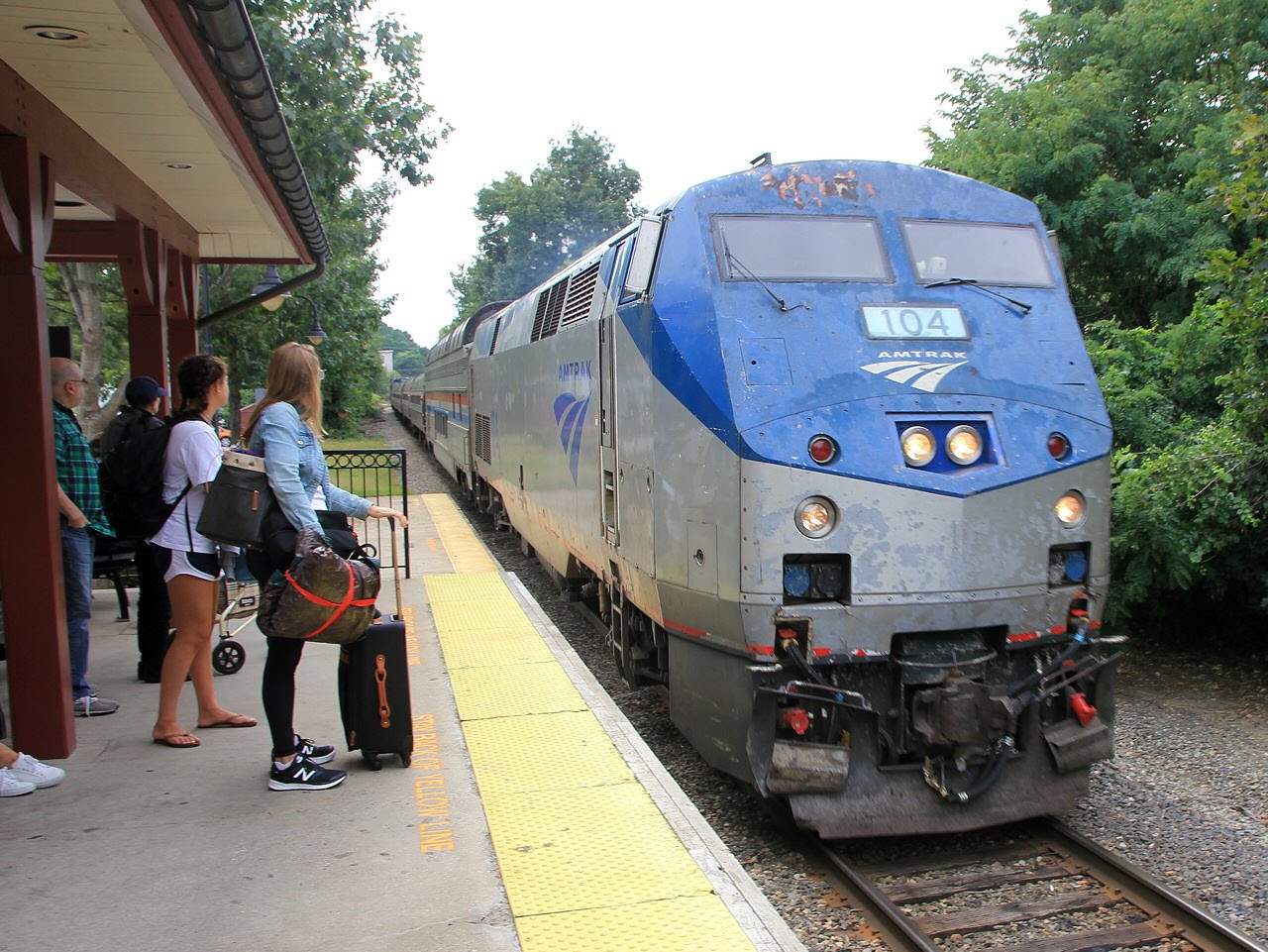
We begin at the Exeter station waiting for my southbound Downeaster train. While I waited the northbound train appeared with a rather shabby looking Amtrak P42DC #104 in the lead and Amtrak Great Dome car #10031 trailing behind. Through 2018 the New Englande Passenger Rail Authority would pay to have this car added to the Downeaster as a leaf season extra, however it's future availability is in doubt due to Amtrak cost cutting :-(


Cabbage car #90220 was on the rear.


As the passing siding was only a few miles to the north the southbound Downeaster soon arrived with Amtrak P42DC #120. 


Due to work on the Lowell Line, my train was diverted down the Reading Line, affording this view of the Amelia Earhart Dam.


MBTA GP40MC #1120 at North Station.


MBTA 1200-series Orange Line car #1260 at Wellington. These cars are in desperate need of replacement, although the Chinese cars purchased for the task will likelt be little better even upon delivery. 


Friday, September 7, 2018

18-09-07 PHOTOS: New Haven Line - Part 2

While the Amtrak Shore Line between New Haven and Boston is a bit more interesting than the Metro North segment of the former NYNH&H Main Line to Boston, it's easy to forget that the trip between New Haven and Boston still takes around three hours and on many past journeys I have started out taking photos from the rear of the train only to get tired and loose interest some time around the Rhode Island border. Well this time upon departing New Haven I took a break and resumed taking photos at or around Westerly. Unfortunately I had to content with a rain front that suspended photo operations around Providence, but I continued through to Boston.

Also included in this set are photos of my cross town transfer to a Downeaster train at North Station.

Starting at New Haven I caught repainted GP40-2H #6698 in Springfield commuter servicewaiting at an adjacent platform.


Amtrak P40DC #833 has seen better days as it now works out of New Haven toting Shore Line East trains between here and New London.  In a callback to the perpetually bankrupt New Haven, #833 is in dire need of a paint job.


Amtrak ACS-86 #662 was in the motor storage yard while P42DC #4 drifted by lite for some upcoming power change.


I came back on the line as my Regional was passing Westerly and the high speed crossovers at HIGH STREET interlocking.


The Kingston, RI station has been expanded with an island platform an a third track to accomidate future MBTA service. A new interlocking named LIBERTY was also installed west of the station so that the new third track did not have to be stub end.