Search This Blog

Friday, September 7, 2018

18-09-07 PHOTOS: New Haven Line - Part 1

The New Haven Line is dull. The signals are dull, the catenary is dull and even with the M2/4/6's the trains were dull too. I used to ride Amtrak over the line a lot and the best use of the time was to sleep or catch up on some reading. I had previously recorded video over the line between New Rochelle and New Haven, but I had never seriously tried to do a photo survey because, like I said, the whole damn line is dull.

Well with my videos all captured I really needed some content and so on my annual Labour Day-ish trip to Boston I brought along some cameras and lenses to shoot out the back of an northbound Amtrak Regional en route to Boston. This would be paired with some Amtrak NEC and Hellgate line photos along with some Shore Line photos east of New London. Part 1 covers everything up to, but excluding New Haven and Part 2 will cover New Haven through Boston and beyond. You can find the full set of photos here or on Google.

Waiting at BWI for my Regional, a southbound MARC commuter train rolled in with Kab Car #7850 and HHP-8 #4912. MARC was trying to retire the HHP-8's after Amtrak threatened to withdraw support, however they soon discovered that their monster length peak trains were no match even for the intended HHP-8 replacement, diesel SC44s. Therefore MARC got the HHP-8's refurbished.


MARC MP36PH-3C #28 with a solid train of bi-levels awaits its departure from the Perryville, MD station early in the AM.


Since my last Boston trip in 2017 HAROLD interlocking has been completely re-signaled with new scissors crossovers installed east of the main plant. All of this is to support the boondoggle East Side Access project, which is ultimately intended to reduce congestion on the (7) train.


Here we have a GoPro video documenting the Amtrak Hellgate Line between F Interlocking in Sunnyside and SS22 in New Rochelle. This pretty much completes my NEC GoPro series between Gunpow and Boston.


A trio of P&W C40-8W's, including #4050, sit on the freight track east of Oak Point yard. After the takeover, short line conglomerate Genesee & Wyoming wasted no time in re-painting the P&W fleet in perhaps the only paint scheme that less attractive than the old red and brown.


Passing an inbound Metro North local train of M8's just east of the Mamaroneck station.


MoW work underway on track #2 at Harrison.


Passing another westbound train of M8's east of Rye.


Cos Cob movable bridge and it's famous catenary break.


Saturday, September 1, 2018

18-09-01 PHOTOS: Milepost 121

As plans for the re-signaling of the PRR Main Line drew near, I realized there was some low hanging fruit, distance wise at least, that I had yet to tackle.  Therefore over Labour Day weekend I headed back up to the Harrisburg area to shoot the Milepost 121 signal bridge that served as the eastbound distant to CP-CANNON.  Unfortunately there wasn't much train action during my expedition so I fleshed out the trip with a visit to CP-ROCKVILLE and the HARRIS tower museum.  You can find all of the signal and train photos here and on Google Photos.

As I mentioned, the Milepost 121 signals are located in view of the US 15 bridge over the Juniata River north of Duncannon, PA. The PRR signal bridge dates from the 1920's or 30's while the position light signals were reconfigured in the 1980's.


CP-ROCKVILLE is located on the opposite bank of the Susquehanna River and encompasses the east end of the Rockville Bridge. The present day relay shed was built adjacent to the old PRR Rockville tower.


NS ES44AC #8008 and NS SD70ACe #1166 showed up with a westbound TOFC intermodal train.


Included in the mix were some potentially new intermodal container road trailers.


From there I drove to the Rockville Bridge wye crossing just in time to catch a local freight heading up the Buffalo Line with NS SD40-2's #3347 and #3423


Although this part of the junction was technically part of CP-WYE on the Buffalo Line, replacement signals were still going up. With PTC and operating practices in general there is less of an appetite to signal trains around low speed routes at junctions and the dwarfs will be replaced by high signals displaying "full" Clear. 


Saturday, August 25, 2018

18-08-25 PHOTOS: OAK

Amtrak OAK Interlocking is located behind a mobile home park directly off US 40 between Aberdeen and Havre de Grace, MD. Due to an earlier re-signaling effort that took place between Amtrak GRACE and BACON interlockings north of OAK, I thought it might be a good idea to document things a bit so I wouldn't be forced to later. In addition to the Amtrak action I caught at OAK, I have also included a bunch of Baltimore area transit that I used commuting to a conference downtown. You can view the photo gallery here or on Google photos.

OAK is located at Milepost 63 on the Philadelphia to Washington line. It is directly south of GRACE interlocking and works in conjunction with PERRY interlocking. For this the layout consists of a single trailing point crossover from track 3 to track 4. There is also a connection off track 2 for the Havre de Grace industrial track. OAK used to mark the southern end of a 4-track segment between there and GRACE where freights and whatnot could wait to cross the 2-track Susquehanna River bridge and, more often than not. proceed up the Port Road to Enola yard. Today the NEC is three tracks through OAK, but the presence of a labeled 1S signal, a dead 2S signal on the southbound gantry and 19 switch hint at the former layout.

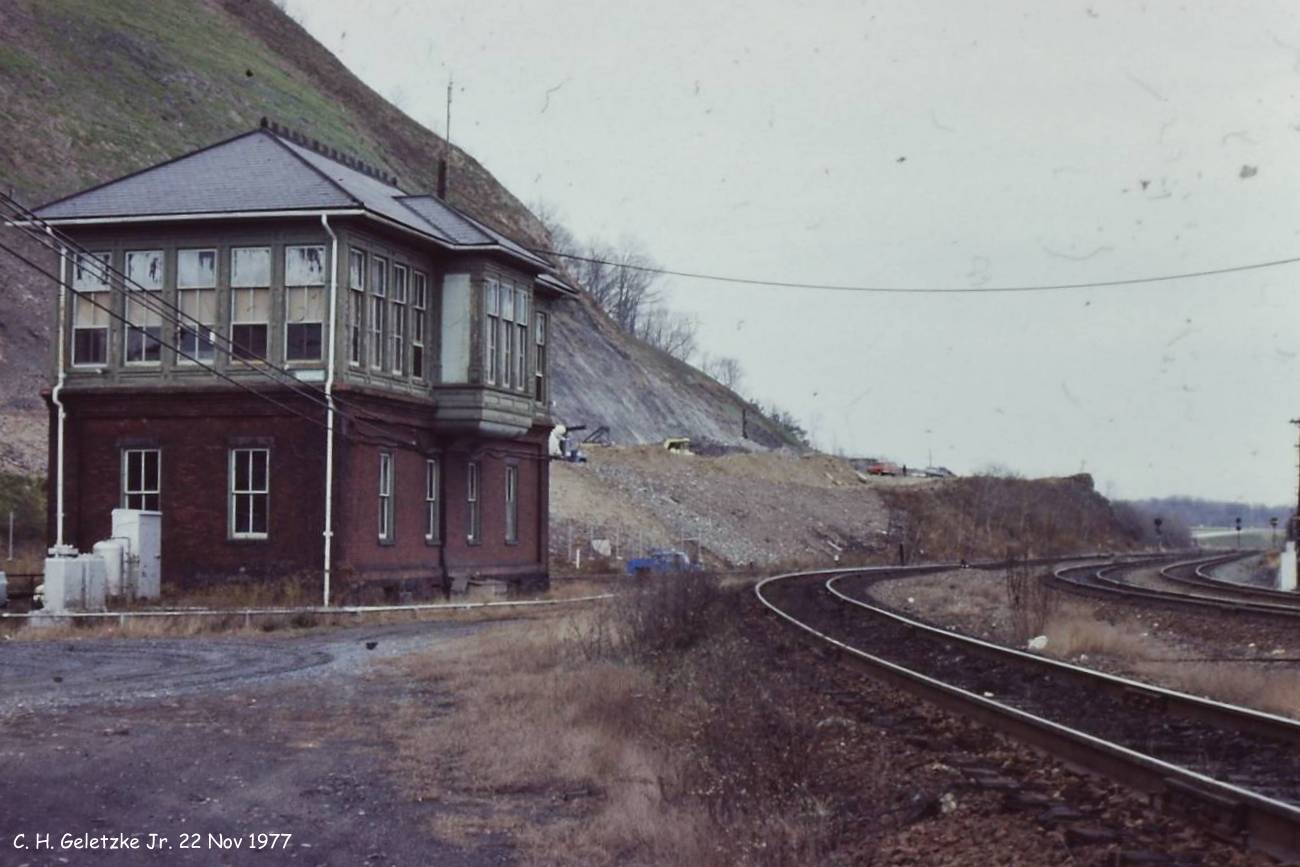
The single #43 turnout remains operated by US&S A-5 pneumatic point machines. The 19 switch to the industrial track was converted to electric in the early 2000's. Here we see the southward air compressor plant and a pneumatic valve for the 43A points.


Here we see northbound Acela Express power car #2024 passing by the old OAK relay house. OAK was originally controlled from a CTC style machine in PERRY tower along with other area interlockings like GRACE, PRINCE and a number on the Port Road. The Penn Central vintage interlocking sign is one of just a handful left in service.


Passing the northbound Acela (just visible in the background) was a southbound Regional led by ACS-86 #606. Sometimes southbound Regionals are pulled into the center track #3 between GRACE and OAK to allow Acela Express trains to overtake them on track #4. 


This strange building turned out to be an MoW tool house. Upon closer inspection, Penn Central paint could still be identified. 


Saturday, August 11, 2018

18-08-11 PHOTOS: PHOENIX

My emergency trips to document classic signaling wasn't restricted to the former Pennsylvania Railroad territory. The former Reading Railroad main line, already re-signaled by Conrail in the 1980's, was facing another round of replacement that would eliminate the Rule 251 ABS operation along with the remaining small target searchlight signals. The route between Philadelphia and Reading actually doesn't have many interlockings as traditional Rule 251 lines tend to prefer non-interlocked hand throw crossovers as a way to reduce costs back when digital logic not cheap. Last August I made time to visit CP-PHOENIX across the river from Norristown, PA. Also included are some MFL and Route 100 photos, which can all be found here or on Google.

CP-PHOENIX, as configured by the Reading and later Conrail, stretched the length of the Black Rock Tunnel that cuts off a long bend in the Schuylkill River. Originally a two-track tunnel, Black Rock was single tracked by the Reading with a turnout at both ends to allow higher cars. A similar process was carried out at the Flat Rock tunnel closer towards Philadelphia. The west side had its signals replaced around 2005, but the east side still featured Conrail vintage signals up through it's replacement in 2018. Behind the westbound signals one can see the old PRR Schuylkill Branch bridge, now used as a rail trail.


To the east of the French Creek bridge is the old Phoenixville Station. Back in the Reading heyday the Main Line here was actually 4 tracks, shrinking down to two for the tunnel. Out of sight behind the trees is the new CP-PHOENIX that will replace the existing long double Y interlocking with a pair of shorter interlockings bracketing a 2 mile long section of single track. 


The new interlocking on the west side of the tunnel will be CP-CROMBY, seen here with the new masts in place. The old Track #2, that used to run all the way to the mouth of the tunnel, will be converted into a storage siding with a hand operated switch at the east end. I suspect that part of the reason for the change is the general inaccessibility of the old CP-PHOENIX's west end by MoW vehicles as the switch was situated in the middle of a bridge over the Schuylkill River.


CP-CROMBY is named for the old PECO Cromby Generating station, a coal fired power plant that closed in 2011 and saw deliveries accomplished via a hand operated switch off track #2 and a hand throw crossover.


The Reading is described as a Coal Age Empire, having a dominant position in the market for Anthracite Coal , which was widely used for home heating both in the United States and Europe. This allowed the Reading to construct an impressive physical plant for a railroad with an end-to-end length of only 200 miles and that only served one major market. Much of the route between Philadelphia and Reading consisted of 4 or more main line tracks, and even the parts that were still two track, like this bridge over Mingo Creek, had room for expansion to four.


The 301W automatic signal protecting the hand throw crossover would be another casualty of the re-signaling project.


Cutting to CP-NORRIS I caught NS SD70ACU #7262 leading a merchandise freight into Abrahms Yard where local traffic would be set out or picked up. 


In a major stroke of luck, the second unit was former Conrail SD80MAC #7202. With only about 30 units producted, these 5000hp monsters actually proved more successful than their planned 6000hp replacements due to the failure of EMD's new "1010H" engine. #7202 was actually built as an SD90MAC, but given a 4300hp 710G engine, upgradable to the 1010H once the kinks were worked out. (Psst, they never were.) 


Sunday, July 22, 2018

18-07-22 PHOTOS: Georgia Trip 2018 - Part 2 Northbound

In Part 2 of my 2018 Georgia trip I will cover the northbound leg of the trip between Gainesville, GA and Washington, DC. Of course the same situation with a rear positioned baggage car applies and I pretty much had nothing to do for the actual train trip itself. However there was a good number of NS units waiting at the Gainesville, GA station and the DC power change is always interesting. You can find the full gallery of photos here or on Google.

We start with NS SD40-2 #6166 sitting on the local power track in front of the Gainesville, GA station.


It was coupled to NS #3471, a former lease company SD40-2


A freight train was parked on Main Track #2 with seemingly nowhere to go, even though a signal was displayed for it at MIDLANd interlocking. NS SD70M-2 #2653 was in the trailing position in the lashup.


NS ET44AC #3662 was also in the lashup, having been previously spotted in a lineup of light power earlier in the week.


At the head of the train was NS C44-9W #9786.


Eventually, due to Amtrak Train #20's increasing lateness, the freight went ahead, taking the signal at MIDLAND interlocking and perhaps moving onto the eventual section of single track two miles to the south.


Inside the NS half of the old Southern RR station building we see that the injury/safety board is being updated.


Eventually Train #20 showed up where I had a sleeper accommodation booked all the way to Baltimore. With the sleeping cars now on the end I was prepared to walk all the way down to where they would platform, however the conductor had me wait for all the coach passengers to get processed so the train could pull ahead for a second stop. I'm all for service, but I am also for not delaying the train :-(


Amtrak Train #20 was running too late for me to get dinner, but I was able to enjoy breakfast in a new Viewliner II dining car.


Not really much to take photos of out the side window save for the renovated VIRGINIA tower in Washington, DC, which I heard might become some sort of small boutique pub.


As is typical when Train 20 is delayed there were suddenly multiple Amtrak trains on the lower level of Washington Union Station awaiting power changes. Here we see ACS-86 #649 waiting to couple onto my northbound Crescent while a southbound Virginia Regional sits on the adjacent track.


Thursday, July 19, 2018

18-07-19 PHOTOS: Georgia Trip 2018 - Part 1 Southbound

Between 2009 and 2015 I would make two trips a year via Amtrak to visit a friend in Georgia via Train 79, 19 and 20.  I would be able to take photos ad video from the rear of the trains providing a valuable source of content and documenting the transition from the Seaboard era signals to modern replacements.  Then both life and Amtrak intervened to both pause the trips and cover the rear facing windows with baggage cars.  Three years later my friend was good to go, but Amtrak was steadfast in its new policy changing a pleasant ride into a boring slog through the south.

Here in Part One I cover the southbound leg with what photos I could take at stations and out the side of the train.  This is padded out with some video and additional photos from a mythical mosiaculture exhibition at the Atlanta Botanical Gardens. You can view the full gallery here or on Google Photos here.


We kick off with northbound Amtrak Acela power car #2033 at the BWI Airport Rail Station.


Shortly after Amtrak Train 92, the Northbound Silver Meteor, blasts through BWI Rail Station at track speed with ACS-86 #635 at the front.


ACELA power car #2029 was later spotted on the upper level from the lower level at Washington Union Station.


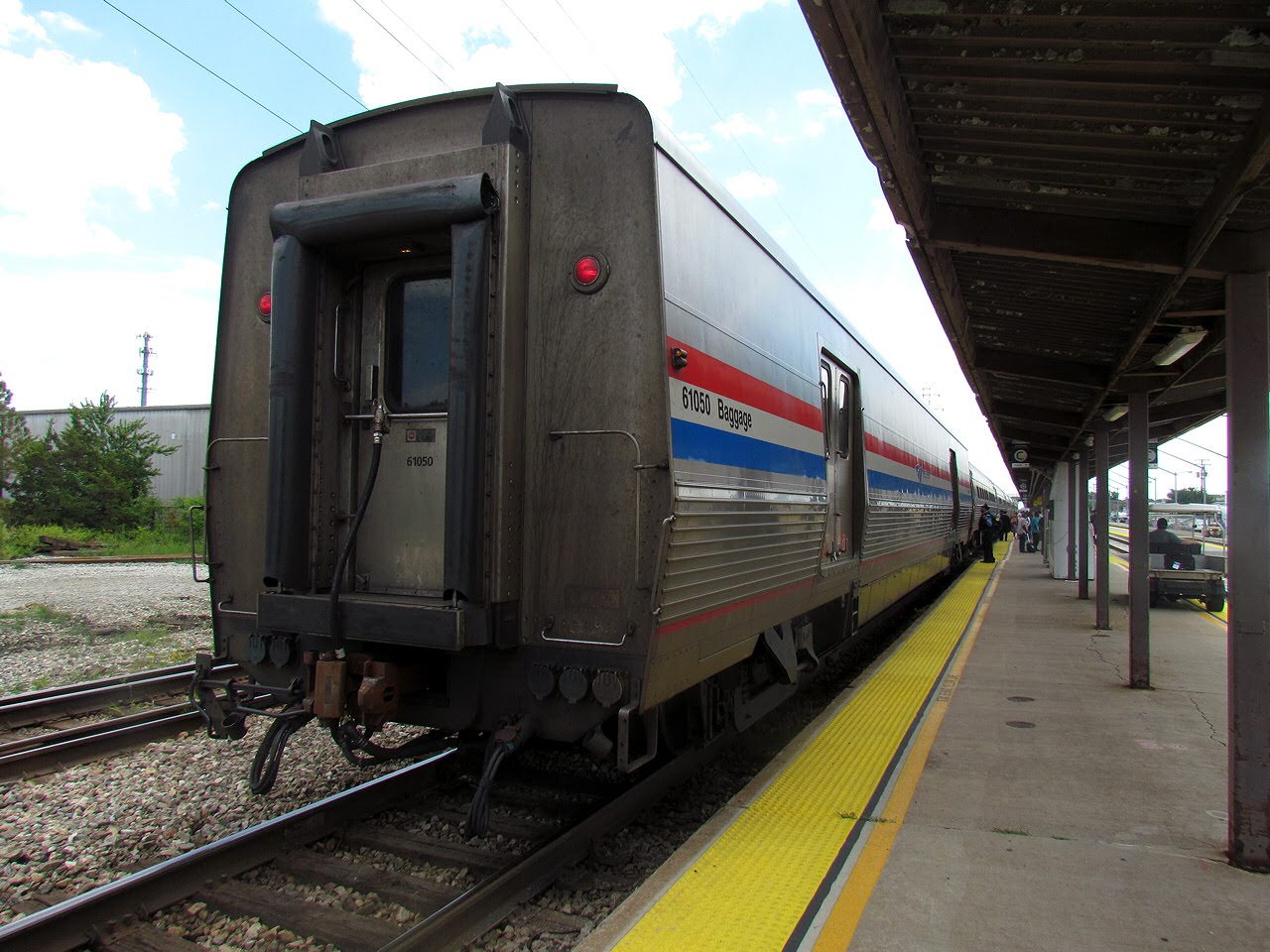
As Viewliner Baggage Car #61050 was tacked on the the rear of the train, there wasn't much I could do until the train got to Richmond.


Since I had last traveled on the route in 2015, GREENDALE interlocking at Staples Mill Road had been re-configured and a new interlocking had been added to reduce congestion in and out of the station. Previously trains would wind up stuck on the main line waiting for a platform spot. The new layout creates a short siding track where southbound Amtrak trains can wait off the main line as well as parallel crossovers so one Amtrak train can depart northward as another enters southward.


Acca Yard had also been heavily reconfigured as most traffic now bypasses the yard. The old AY and NORTH ACCA interlocking layouts had dated from the RF&P days when all through freights had to stop at Acca for a power change. With the former "passenger bypass" track being expanded to continue the two main through tracks the meat of the old AY interlocking, seen here next to CSX C44-10W #5322 and GP38-2 #2788, had been mostly ripped out.


Not much to take photos of until the Atlantic Coast Line yard at Rocky Mount, NC where SD40-3 #4324 and AC4400 #5114 were hanging out on the southern yard lead.


Perhaps the biggest change since my last trip was the new Raleigh, NC passenger station. The old, single, low level platform was replaced by a new high level island platform, seen here with Amtrak P42DC #67 waiting on a signal at BOYLAN interlocking.


Here you can see the difference between the old and new station buildings. The old station appears to be at risk for demolition.


As is typical my Train #79 was running late and we slightly delayed the new Piedmont Service Train #78 with F59PH #1984 at Greensboro.