Search This Blog

Monday, August 18, 2014

14-08-18 PHOTOS: Cascade Corridor - Part 1

2014 was a special year because I took not one, but two big Amtrak trips, the second of which was a unique opportunity to ride the Coast Starlight on a trip from Seattle to San Diego. Unfortunately there was a small problem with Union Pacific track work that would result in a bustitution between Portland and Eugene, Oregon, however this turned out to be a blessing in disguise as our trainset that departed Seattle wound up lacking a Pacific Parlor Car...an amenity that I came to appreciate in the second half of the trip. Still, despite the lack of Parlor Car I had great fun as you can see below.

You can see the full set of photos from Seattle to Portland here. Part 1 will cover the line from Seattle to Olympia.

After departing King St station we passed under the retractable roof of Seattle's Safeco field, home of the Mariners.


The yard for both Amtrak and Sounder passenger equipment is located south of the Stadiums. Here we see Sounder F59PHI #904 waiting for the return to service.


Sounder F59PHI #903 and a large number of P42's laying over at the Seattle engine terminal.


Union Pacific GP38-2's #606 and #667 hanging out at Argo Yard. UP operates to Seattle from Portland on BNSF trackage rights.


BN painted GP39-2 #2723 with a short train south of Argo Yard.


A light engine move with BN painted GP38-2 #2075 and BNSF GP39-2R #2918 waiting for us to cross over ahead of it at TUKWILA interlocking.


The new Tukwila Sounder station was built built with a third track upgrade in mind.


The old Northern Pacific station at Kent, WA is just a few blocks south of the new one.


A large lineup of GE road units at Auburn Yard including CP ES44AC #8841.


Sunday, August 17, 2014

14-08-17 PHOTOS: Seattle Reunion

Last August I was planning to attend a computer security conference in San Diego. I had already completed that year's coast-to-coast Amtrak trip and was basically looking forward to some fun in the sun eating fish tacos, but then a travel buddy suggested that we could use this as an opportunity to take the Coast Starlight. Checking the airfare I determined that it would only cost 2$ more to fly out to Seattle and then back from San Diego so after that a call to Amtrak Guest Rewards set up the sleeping accommodation and I was off to collect another leg of Amtrak's national rail network.

I had been to Seattle once before in 2011 prior to my Empire Builder trip and found it to be a wonderful city (seeing as how I went during the 3-week long Sunny season). This trip would present me with far less time due to the Starlight's morning departure, but I would still have about a day to see some old school friends and ride around on transit. I also was able to see the completed King Street Station, which had just been beginning its refurbishment when I was there 3 years ago.

The complete photoset is right here

Flying in via Southwest I took this photo of Mt. Ranier, which will one day erupt and destroy the SeaTac area.


Sound Transit light rail LRV #141A wrapped to promote a concert series at the Tukwila Station. The line to the airport travels a distance that rivals most commuter rail systems.


Here is a video of SoundTransit LRV's #152 and #120 departing the Tukwila train station towards Seattle.


I had no reason to ride the Mono-D'oh, but I was near the Westlake terminal which is surrounded by trolleybus wire.


Here we see BNSF C44-9W #5261 sitting north of Olympic Park. The waterfront was packed with people and access control due to...sigh...Hempfest. I would have tried getting closer to the engine here, but my friend was refused entry because he had a 5 ounce glass bottle of artisan olive oil. Cannabis was fine, but small glass bottle? That's too much. 


Dinner at Ivar's Salmon Shack provided me with excellent views of the University Ave Bridge and Lake Union.


The University Ave bascule drawbridge is notable for supporting a trolleybus line and its associated overhead lines.


One of the control cabins on the bridge. Note the original traffic control signals embedded in the concrete structure.


South end control tower with the trolley wire structure.


I had gotten a good rate at a place called Hotel Seattle. Well, I quickly discovered that you get what you pay for. Despite being downtown the entire building was ratty with infrastructure that had been last refreshed in the 1970's...or before. One silver lining was the creaky old elevator with the clockwork noises that indicated relay logic. After poking around I made my way into the control room where I found this.


Car leveling was handled by this analogue of the elevator shaft, which I guess saves on wiring physical contacts for the car to trigger directly.


I had a friend in the elevator to run it down to the lobby and back while I took some video. The elevator was a Montgomery product.


From the hotel it was on to King Street station to catch the Starlight's 9am departure. Commuter trains were also coming and going like F59PHI #906 on the front of soon to depart Tacoma train.


Saturday, August 16, 2014

14-08-16 PHOTOS: JD Tower

CSX has been on a tear ripping out its classic B&O signaling all up and down the East Coast and for the last 4 years or so I have been trying to stay out ahead of the wrecking crew documenting the setup as well as I can. One of the last CPL locations on the Capitol Sub between Baltimore and Washington is JD TOWER, in Hyattsville, MD, at the point where the Alexandria Extension wyes off from the Capitol Sub proper. The Extension is used by CSX trains heading up from the south via the RF&P route.

The current signals were put into service in 1992 when the tower that stood there was closed. More on the history of the tower can be found at this website here. As far as I can tell these were some of the last B&O CPLs installed new by CSX before they began to change over to color lights. For example when VIADUCT JUNCTION tower was closed in 1994 it received color lights.

Until about 10 years ago most railroads would have left the CPLs with their entirely modern masts and gantry structures in place, but since then labor costs have changed resulting in it being cheaper to install and test brand new hardware in parallel than to cut things over and then test it.

Anyway, this isn't one of my long and involved signaling posts because JD TOWER is also a fairly well known railfan hotspot since it serves as a nexus for both east-west and north-south CSX traffic. I'm going to post most of the train photos here, but if you care about the signaling you can find those photos here.

I'm actually going to begin things with an aside. I went on another signal photo trip to ELISMERE JCT in Delaware back in July.

A Clear signal on the eastbound bracket mast was soon followed by a mixed freight train lead by AC6000 #689.


Following behind was SD70MAC #4771 and C40-8W #7866.


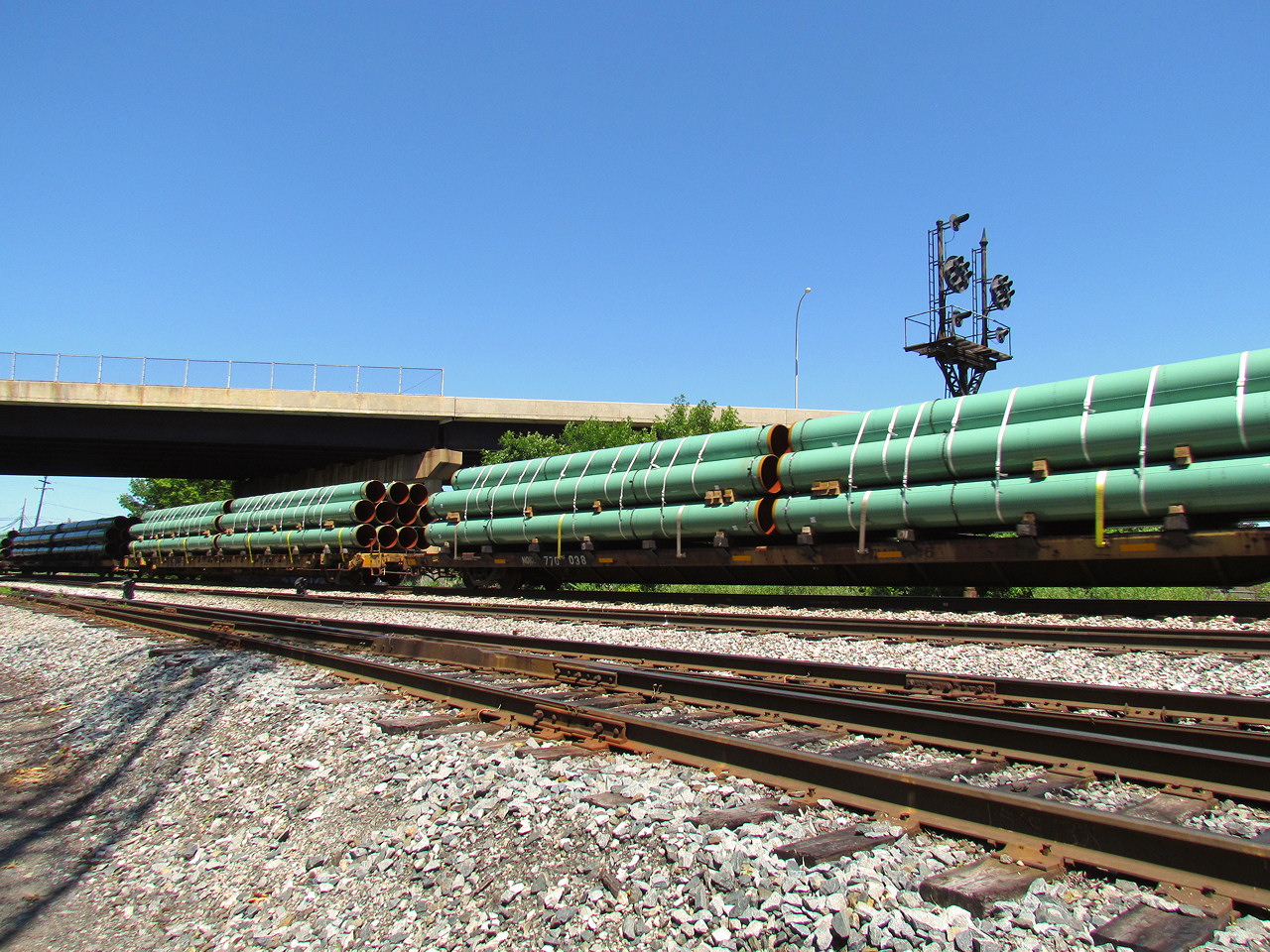
Whole lot of pipeline going on.


Ok, getting back to JD Tower we catch a westbound freight train with ES44AC locomotives #730 and #834 passing the eastbound CPL masts and then passing through the Hyattsville defect detector.


The entire wye used to be controlled from the JD Tower, but today only the west leg of the wye and crossover is part of JD TOWER interlocking.


New signal masts were waiting to be installed. 


The wye is also be reconstructed with a double track project on the Alexandria. Here the new crossovers can be seen with CSX SD40-2 #8856 in front of a ballast train. 


CSX installed a new temporary CPL mast on the Alexandria Extension as the old mast was in the way of the second track RoW. This mast and the apex of the wye is also part of JD TOWER interlocking.


The east leg of the wye is now known as RIVERDALE interlocking. When I arrived I noticed a Medium Clear signal on the eastbound cantilever for a movement off the wye.


 Eventually a trio of C40-10W's (#5228, #5408 and #5392) arrived with a long intermodal train. Yes, that IS another railfan hiding in the weeds.


Same three units knocking down the signal.


Wednesday, August 13, 2014

14-08-18a PHOTOS: Eugene Oregon

So some weeks before my Coast Starlight trip kicked off we got one of those Amtrak e-mails explaining how there would be a surprise service modification in the form of a Bustitution between Portland and Eugene due to a UP maintenance blitz on the Brooklyn Sub. Now I have experienced this type of Bus Bridge before and it actually didn't cost much time since buses, running direct without stops, can usually make better time than the train.

I'll get into the details of the bus ride as I get into the photo part of the post, but suffice ti say we made it to Eugene and got rolling again on our new Train 11 where I was able to document at least some of the former Southern Pacific line to San Francisco. You can see the full set of photos here.

We begin with our original Train 11 trainset waiting under the canopies at Portland Union Station with Amtrak P42DC #167 and Heritage baggage car #1721. This trainset would proceed to wye before picking up the group of northbound passengers.


Amtrak "Mae West" Talgo cab car #7911 was sitting at the head of the Cascades trainset that was waiting for the next northbound departure. Not only is it ugly, I doubt it will substantially enhance the safety of the passengers and crew if the train hits anything more than a compact car. Also is it just me or is this transit look extra long?


Starlight passengers wait for their bus or train inside.


Despite the "corridor" type service, the Portland station still features a non-electronic train board behind the ticket window.


You heard the tower...GO BY TRAIN!


View of the station as my bus departed northward across the Willamette River. You can see a better panorama here.


Although it took about 30-45 minutes for our bus to get out of Portland, the 2 hour express run to Eugene still has us less than an hour behind schedule. Note the Southern Pacific style station signs with the terminal mileage.


There the new Train 11 trainset was waiting, having arrived earlier that day with the northbound passengers. 


This train was equipped with a Pacific Parlor Car, #39972 "Nappa Valley", which turned out to be a huge plus. 


In recent months Amtrak had taken to substituting the second P42 for a P32-8WH, but for this trip we were treated to Surfliner F59PHI #461!!! The leading P42DC was #123.


Saturday, August 9, 2014

/14-08-09 PHOTOS: Norristown

Over the last 10 years SEPTA has been systematically re-signaling its entire Reading side which up through 2005 was still using hardware that was effectivly unaltered from the days of the Reading. Today the project is almost finished with the last line still waiting to get upgraded being SEPTA's black sheep, the lowly old Norristown Line. Once known for being the slowest commuter rail line in the country the Norristown Line has been seeing a bit more investment in recent years with new rail, slightly faster speeds and station upgrades. The re-signaling project will bring bi-directional operation, a new midpoint CTC crossover and cab signals. Because the Norristown area has a number of Reading era interlockings in easy walking distance from at least three SEPTA stations I decided to head out there to document them. Don't worry, there was a lot of non-signaling things out there as well so keep reading :-P You can find the full set of photos here. Heading out onto the Reading viaduct we encounter the Phase Break indicators where Amtrak supplied power is replaced by SEPTA supplied power.


Dropping down off the viaduct to duck under the Philadelphia Connecting Railroad we pass through the North Broad station. In case you couldn't tell I was riding out to Norristown on a Silverliner V.


Video of our train crossing the three other Main Line tracks to reach the Norristown Line at 16Th ST JCT.


 SEPTA East Falls station.


Former SEPTA Shawmont station. This is one of the oldest surviving railroad stations in the United States, dating from 1834.


The new crossover interlocking is named RIVER and is located just east of the Miquon Station.


FORD interlocking, where freight trains off the NS Morrisville Line head through to the Harrisburg Line, has also been upgraded with the addition of crossovers.


New SEPTA KALB interlocking relay hut with the renovated Norristown substation behind it.


Entering the Elm St terminal, the old Reading era mast signal had been replaced with a dwarf.


SEPTA Silverliner V's #717 and #881 at Elm Street.


SEPTA Main Street station. Norristown has surprisingly good commuter rail service.


SEPTA BRIDGE interlocking is named after the concrete arc bridge carrying the PRR Schuylkill Branch over the Stony Creek. Today the PRR RoW carries a bike trail.


Remains of the old FORD interlocking.


The trainset I rode out on returning to Philadelphia with SL-V #882 in the lead.