Search This Blog

Thursday, June 20, 2013

13-06-20 PHOTOS: New Mexico Main Line

Welcome to the third part of my third cross country Amtrak rail adventure, this time featuring the Southwest Chief. In Part two I was traveling eastbound on the former ATSF double track transcontinental main line as my train blasted across Arizona at speeds upwards of 90mph. Here we begin again in Gallup New Mexico and will continue on to Dalies, NM where the Chief turns off the main line and onto the largely single track Raton pass route.

You can find all the photos from this and the previous set here and if you'd like more information on the BNSF Gallup Subdivision here

Starting off west of Gallup the right of way splits for some reason as we climb up to the Continental Divide. Here is a doublestack train on track #1 as seen from track #2.


Tree and a dump track with scenery. Nearby BNSF crews were repairing fence lines to keep cows off the track.


A second stack train headed west on track #1.


Here we see the Continental Divide at Campbell Pass, 7270 feet about sea level. While higher than the 5200 foot crossing on the Great Northern Hi-Line and not in a tunnel like the DRG&W Mofat route, the ATSF crossing is rather tame with no epic scenery and not even a sign to mark the occasion. Even more bizarre is that this isn't the high point on the line with two additional higher 7000+ foot crossings on the Raton Pass route.


Just east of the summit the tracks rejoin and we find C44-10W #7351 heading westbound towards and Approach Limited signal to cross back over behind our train at Gonzales interlocking.


Fellow C44-10W #7323 was on the rear pushing at Thoreau.


The Thoreau wye was being used as a transloading facility for non-conventional oil.


The tracks split again before we pass by some local color.


Autoracks and stacks seem way over on track 1 from track 2.


This corridor supported all forms of transportation from the ATSF railroad, to Interstate 40 and NM State Highway 122 to a dude on horseback.


At this point we star to pass eastbound intermodal trains on track #2 the first of which is lead by C44-10W #7865.


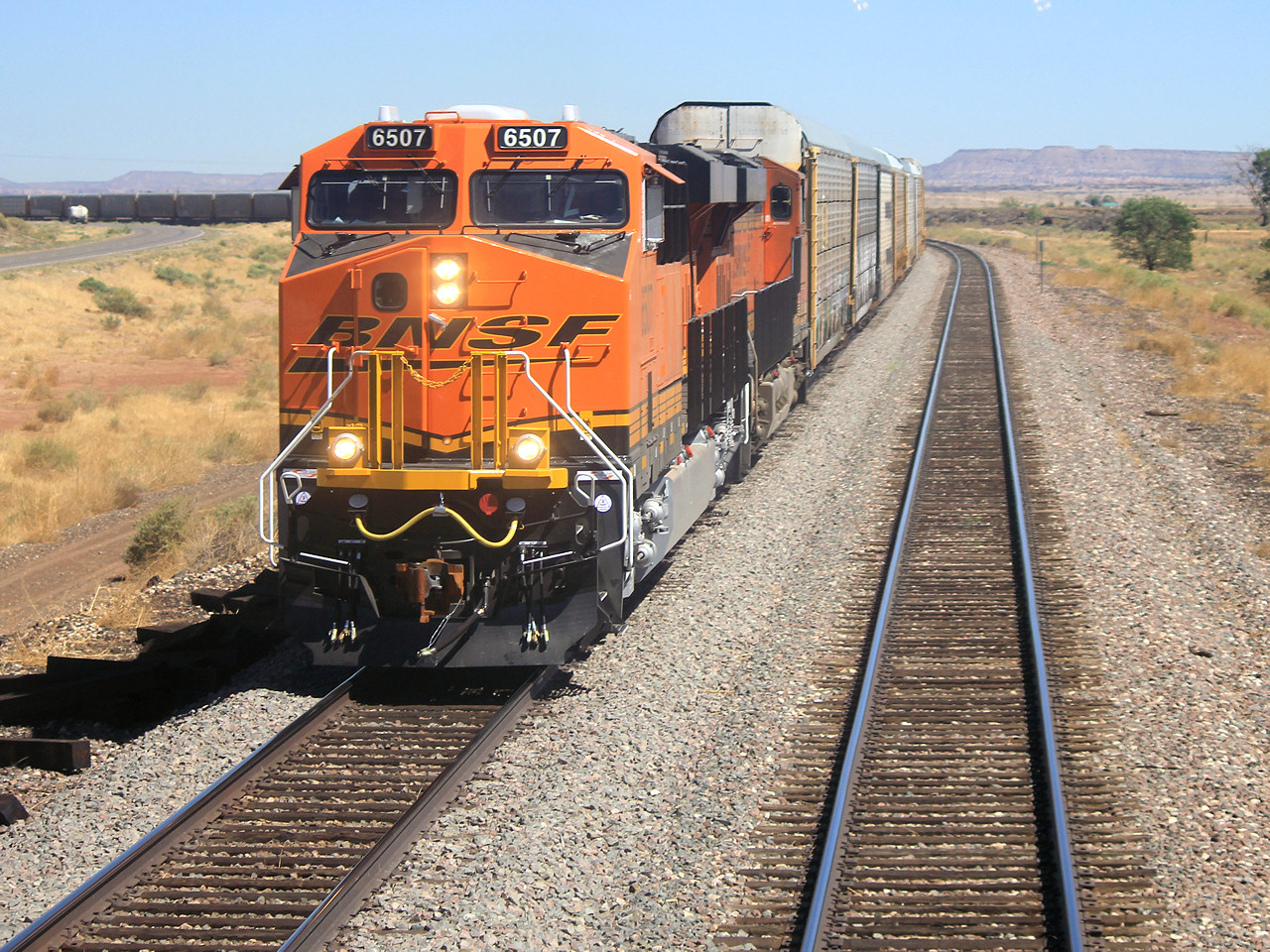
Next up in the Conga line is #6507 leading a string of autoracks. #6507 is the lead unit of the large ~2012 order of GE ES44C4's and was purchased singly to test out the 6 axle, 4 motor concept. 


Here's another new ES44C4 #6560 with doublestacks at Grants, NM.


13-06-20 PHOTOS: Arizona ATSF

Well its part two of my third annual Amtrak Epic Cross Country Journey and this time after a refreshing night's sleep in the sleeper I awaken at the crack of dawn to find myself just east of Flagstaff Arizona. My train, the eastbound Southwest Chief, was running about an hour late, which was a good thing since my traveling companion really wanted to have his picture taken in Winslow, Arizona because some song told him to apparently.

Anyway the Southwest Chief follows the route of the former ATSF Super Chief and Regular Chief trains from LA to Chicago. Between LA and Dailes, NM this route is quite unlike the typical western main line with its single track and passing sidings. The ATSF clearly had its shit together when it built a two track main line from mid-west to west.

This set is a long one covering parts of the Seligman and most of the Gallup Subdivisions and those of you who enjoy railroad signals and mesas you can find the entire set of 700 or so photos right here.

Starting things off heading out of East Flagstaff was a double stack intermodal train waiting for us to clear up. Included in the lashup was C44-10W #7329.


Providing yard power for a nearby Purina plant was ATSF painted GP38 #2229.


The intermodals were parked nose to tail on approach to Flagstaff.


 ES44C4 #6958 was assisting the second train on the rear.


Third train in line was headed up by ES44C4 #6885 and C44-10W #7309 with a general consist.


Unfortunately this part of the line had recently been resignaled and lost its classic ATSF searchlights. Despite 2-mile signal blocks 4-block signaling was in effect. The former ATSF main line is FRA track Class 5 enabled for 70mph freight train amd 90mph passenger operations. 


Starting west of EAST DARLING interlocking Intermittent Inductive Automatic Train Stop was in service for eastbound trains allowing them to travel at 90mph. The silver induction shoes can be seen outside of the running rails here at West Diablo Canyon Interlocking located on the edge of its namesake Canyon. Oh East Diablo Canyon, why can't you be more like West Diablo Canyon. 


East of Dennison there was an odd split track arrangement low grade thing going on seen here with a westbound stack train. This is actually only about 10 miles from that famous meteor crater.


Waiting for a highball at Winslow, AZ.


Wednesday, June 19, 2013

13-06-19 PHOTOS: San Bernardino

Well its finally time for the main event, my trip across the great American west on Amtrak Train 4, the Southwest Chief. The Chief still follows the same route as the old Santa Fe Super Chief so that means we head south out of LA Union Station along the LA River before turning east on what is now the BNSF San Bernardino Sub which heads through Fullerton and Riverside before reaching San Bernardino at the foot of the Cajon Pass.

I was looking forward to this first part because a good part of the line was equipped with searchlight signals which had been modernized in the 1990's as you can see in this 2010 daytime survey of the route out to Riverside. Unfortunately it seems that BNSF has been bitten by the same money wasting bug that has befallen CSX and even tho the hardware had decades of additional life left in it who would want to miss an opportunity to throw up more Darth Vader signals.

The other problem this set faced was that due to the nearly hour late departure from LA I was subjected to catastrophic backlighting between the turn onto the San Bernardino Sub and Fullerton. I did manage to get a lot of good photos despite the difficulties and you can see them all here.

We begin having just departed from LA near the end of the evening rush hour. Across the LA River was Metrolink F59PH #870 heading out on the Riverside Line and while our trail will also go to Riverside the Metrolink Riverisde Line runs via the Union Pacific routing while Train 4 sticks to the original ATSF routing.


#870 does a good job pacing us seen here just before it curves off down its own route at CP-9th St.


Passing by the closed HOBART tower again.


A turn to the south reduces the backlighting and shows off the ongoing triple tracking project at the LOS NIETOS diamond crossing.


Just east of the SANTA FE SPRINGS interlocking is a westbound intermodal train with C40-9W #4510 and ES44C4 #6865 waiting for us to cross over and clear up.


A structural fire raging off in the distance my train passes the only searchlight signal remaining on the line just west of the Fullerton Station.


The San Bernardino Sub had no fewer than three shooflies set up for the purposes of grade crossing elimination projects, each in various stages of completion. Here we see half of Placentia Ave crossing at grade and half already moved into an underpass.


The modern searchlight signals were back in force starting at ESPERANZA interlocking with a clear signal on Track #3.


With stored doublestack wells on the siding a westbound mixed freight passes by on the opposite main track with Santa Fe painted GP60M #118 in the #2 slot.


The western roads are big believers in helpers distributed power and ES44C4 #7031 was bringing up the rear.


The setting sun behind a highway overpass at MP 25.1.


13-06-19 PHOTOS: LAUPT

Anyone who knows me knows that I have a rather strong dislike of Los Angeles. The city makes absolutely no sense. It's plopped down in an arbitrary location without distinct geographic features, it failed to unify its region under a single governmental structure so what you think is part of LA isn't really part of LA, it gets insufficient rain, insufficient snow its downtown is pointless, its construction goes out instead of up, its mass transit is pathetic, there's no planning, traffic is a mess, it shakes a lot and occasionally catches fire. As a result the city has been added to my blacklist and I will not visit it for any reason.

However there is an exception that we might now call the Edward Snowdon loophole in that if I do not leave the airport or train station I have not actually officially entered Los Angeles proper so in that case I can travel from San Diego to Chicago with a change of trains in LA. In this set you will see photos I took from a Pacific Surfliner train traveling to Los Angeles and then photos I took around the station property itself.

You can find all these photos right here

The 90mph ride up from San Diego in Pacific Business Class was quite enjoyable. Here is a video from the side of the train as we ran just a few hundred feet from the Pacific Ocean somewhere around San Clemente. What shocked me was how busy the beaches were at 2pm on a Wenesday Afternoon. Doesn't anybody in California work for a living? Fucking hippies.


I was surprised when I discovered that the stadium for the Oakland A's of Anaheim was accessible by commuter rail. Shame its about 30 miles away from what should be the downtown population center. Oh wait, this is LA, there are no population "centers". Also they named a team after Anaheim? What the fuck sort of branding is that?! That's like having the East Rutherford Football Giants or Newark Nets. Nobody likes Anaheim. Disney built his whole separate world so that people could get away from it. Anyway, I guess the existence of a stadium means that the LA Clippers of Baseball aren't just some fictional construct for a movie franchise.


I caught a pair of GP60M's, ATSF #155 and BNSF #116, sitting in Hobart Yard. The ATSF was the only purchaser of the GP60M wide nosed model of GP60 with a total of 63 units. The GP60 was the most powerful 4-axle power that EMD ever made with 3800hp and was intended for hot intermodal trains on routes with less demanding grades or tonnages. Roughly equivalent to the GE B40-8, both classes sold lightly as the railroad demand for service differentiated road power dried up.


The now closed HOBART tower stands at the west end of Hobart yard where another line crossed the 3-track former ATSF main.


Heading west the freight lines head toward the Alameda Corridor while the passenger trains fly up and over both them and the LA River. Across the river is the Metrolink Riverside Line which runs to Riverside via the Union Pacific alignment, as opposed to the ATSF alignment. Here is an outbound Riverside Line train with Metrolink F59PH #864 on point.


It appears that all of those monstrousness new Rotem cab cars have been delivered because I didn't see a single one of the old GO-type cars running at the head of a train. Here is #653 running on the west bank of the LA River.


Waiting hear the large junction opposite LAUPT is UP ES44AC #7719 waits for Metrolink traffic to clear up.


The now closed MISSION tower with another Metrolink train approaching to the North. MISSION interlocking was the gateway to the LAUPT trunk line with connections to all the major railroads in the area.


Built at the same time as MISSION, TERMINAL TOWER was closed in a mid-1990's re-signaling project.


Cab car #6906 on my Surfliner train at the LAUPT platform. 


LA Union Station was built in 1939 and is considered to be the last great American passenger rail station before the era of Air Travel made such stations unnecessary. Here is the outside of the station showing the ticket hall and passenger drop off lane. Note how that even in the 30's the station catered to the automobile. Oh, don't think this is a Staples Mill Road situation either. This is about as downtown as one gets in LA. Don't believe me? Take it up with Joe Friday.


Main entrance into the station.


LA Metro Gold Line train on the flyover south of the station. While flirting with Heavy Rail subways briefly in the 80's and 90's, LA decided to adopt light rail as its preferred transit solution, albeit with some heavy rail features like full length high level boarding.


It's getting into the peak of rush hour here and traffic is set outbound on 5 of the 6 trunk tracks. Rotem cab car #653 brings up the rear of a departing Metrolink train.


Tuesday, June 18, 2013

13-06-18 PHOTOS: Ride to the Border

As far as I am aware there is exactly one rail transit system where one can ride to an international border and that's the San Diego Trolley's Blue Line. Because Los Angeles is on my black list of cities with poor urban planning that I will never set foot in, this year's cross country Amtrak trip began with a 24 hour stay in San Diego where the weathermen have the easiest job in the universe. Seeing as I have been to San Diego before this time it would not only be something different, but also somewhat symbolic to begin my cross country journey from the San Ysidro International Transportation Center, connecting to Amtrak's Surfliner Service at the Sanfa Fe Depot before finally catching Amtrak's Southwest Chief at the LAUPT.

As always the weather was NICE and despite having to take a bus in from the Airport, San Diego is bustling with both light and heavy rail transportation ranging from the aforementioned trolley to Amtrak and Coaster passenger services and a healthy dose of BNSF serving the local post and industry. I also paid a visit to the USS Midway (CV-41), which is docked downtown as a floating museum, but those photos will have to wait for another time.

You can find all the photos right here.

After getting off the airport bus I found Amtrak F59PHI #450 seemingly bad ordered at the ATSF Depot. It remained there the next day with the blue flags in place so something was clearly wrong with it.


Behind #450 is the the Cyrus K Holliday, which had made the run down to San Diego with a bunch of mid-whigs which were discussing some future station improvements. The car was made for the president of the Soo Line railroad and named after a former official of the Santa Fe railroad.


There is usually a coaster trainset laying over at the santa Fe depot and today was no different with Bomber cab car #2003 on the south end. 


During the peak periods Coaster trainsets head in from the yard south of the city. Here is F40PH-2 #2101 crossing Broadway into the platform area.


Wrapped Bomber Cab Car #2310 promoting unnecessary medical spending.


The former ATSF main line between LA (Fulelrton) and San Diego has split ownership between Metrolink and San Diego county. Due to it being a primarily passenger route it is still equipped with Intermittent Inductive Automatic Train Stop between MP179 and 249 allowing 90mph operation. All leading locomotives and cab cars must be equipped with an IIATS pickup receiver. All the adjustment screws are because the receiver must pass within 1.5 inches of the track mounted shoes.


Since the SDT re-arranged its routes a few years ago moving the major transfer point from Old Towne to the more logical ATSF depot now Green Line trains travel through all the way to 12th and Imperial with Orange Line trains terminating at the station. Blue Line trains now terminate across the street at American Plaza. This results in both Orange and Green line trains having extended layovers at the ATSF depot to allow passengers to transfer. Here is one of the brand 57 new 4000 series Siemens S70 LRV's which were purchased to phase out the original Duewag U-2 trams. The 4000 series are shorter than the earlier 3000 and can operate on the tight curves of the downtown street running.


The old 1000 series U-2's were still plentiful with 1047 here on a Blue Line run to American Plaza. The 1000 and 2000 series high floor trams are still used on the Orange and Blue lines because, ironically, the low floor trams need higher platforms for ADA access than the high floor trams which are equipped with lifts that can service zero height platforms.


Video of #1047 with new #4024 at American Plaza.