Search This Blog

Saturday, April 29, 2023

23-04-29 PHOTOS: Iron Horse Valley

In 1927 the Baltimore and Ohio railroad organized the Fair of the Iron Horse to celebrate the company's centenary in Halethorpe, MD, on a sizable tract of land adjacent to its original main line just south of Baltimore. This pinch point between the Baltimore harbor coastline and the steep Patapsco River valley was also used by the Baltimore and Potomac Railroad, forerunner of today's Northeast Corridor. Today this often overlooked patch of land is home to surprising around of rail action and in the spring of 2003 I took some detours off my normal driving routes to get a closer look at what it had to offer ( mirror ).

The first stop was the St. Dennis MARC station where I just happend to see a sizable spike of railfans out with their tripods. Popping in to see what was the matter, I was informed about an upcoming heritage unit (presumably CSX). While I was not successful in catching the heritage engine that day, I did catch an eastbound autorack train lead by CM44AC #7025 with AC4400 #789 in the DPU position.


A few days later at Dorsey I caught the usual 6:30pm Camden Line meet staring MARC single level cab car #7760, Bomber cab car #8051, SC44 #80 and MP36PH-3C #?.


HX or HALETHORPE tower is located immediately next to the old 1927 fairgrounds, which have since been converted into an industrial park. Previously controlling a 4-track full crossover, the interlocking was replaced by a new one, ST DENNIS, about half a mile to the west. Since my last visit the tower is not longer being used by maintenance crews and has had new plywood installed over the doors to keep out the homeless and urbexers.


The 4 tracks between HALETHORPE and LANDSOWNE interlockings are often used to park trains through trains needing a re-crew before they enter the largely single track Baltimore Belt Line and Philly sub. That day CSX ES44AC #836 was parked on the siding track at the head of a manifest freight.


The new ST DENNIS crossovers allow for longer trains to be stacked on the 4-track zone. Here we find C40-10W #5212 and SC70MAC #4543 leading a westbound consist sitting just ahead of the westbound signal bridge.


A short distance away at the Halethorpe MARC station, Track A was closed for MoW work with a large hi-rail crane truck and platform bridge gondolas adjacent to the eastbound platform. I had pulled in due to the scheduled passage of a southbound Amtrak Acela Express run and caught the rare trainset with connectively numbered power cars, #2030 and #2031.


Monday, April 3, 2023

23-04-04 PHOTOS: Reading Viaduct

In 2020, with transit on the ropes and outdoor activities all the rage due to the pandemic, I converted my usual SEPTA Mid-Winter transit trip into an all-day rail history walking tour. Part of this tour included abandoned Reading Company rights of way including the City Branch and the famous Reading Viaduct in and around the old Spring Garden St station. While on this excursion I discovered the secret entrance up onto the viaduct itself, but since I was unable to suddenly transition my event to one of urban exploration, I had to retreat from the viaduct with a plan to return at a future time. In September of 2021 I acted on this plan due to the impending demolition of the Reading Spring Garden Station platforms and northbound head house. Not only was I too late in terms of the demolition, but I found the summertime viaduct to be a to be completely overgrown with vegetation, blocking sight lines and hiding homeless persons who might not take kindly to having their living space intruded upon by a long explorer with camera gear. Again I made a plan to return during the winter months when the vegetation would be more see through and I could return with a buddy. A planned attempt to return in early 2022 fell through when an interested urbexer flaked out and once again I had to put off the trip. Finally, in the Spring of 2023 did I find someone with schedule availability and we were able to get up on the viaduct as the leaves were just starting to re-appear. You can find the photos from my exploration of the viaduct and related spring transit photos here ( mirror ).

We begin at the BWI Airport rail station with Amtrak ACS-86 #659 at the head of a southbound Regional.


Two views of SEPTA Silverliner V #829 at both 30th St Station and Market East.


Back down at BWI on a rather foggy March night.


Between NEC trips I managed to sneak down to Garrett Park, MD to catch the westbound Capitol Limited led by P42DC #83.


On the day before my planned Reading Viaduct expedition I was back at BWI to catch an Acela Express lead by power car #2006.


SEPTA Slverliners V #709 and IV #425 at 30th St station.


The Reading Viaduct was largely constructed in the 1890's in conjunction with the Reading Terminal we all know and love, replacing a previous station near Broad and Vine that had been accessed via a right of way along the Schuylkill River. The viaduct ran from the old Philadelphia and Germantown Railroad terminal near today's North Broad to the new Reading Terminal at 12th and Market. Construction is largely of steel, however there is a brief section of fill between Buttonwood and Hamilton Streets. Shown below is the structure as it crosses Noble St at Ridge Ave.


Reading Terminal served as an active railroad station until November 6th, 1984 when all service was rerouted to the new Center City Commuter tunnel and the replacement Market East station. After the closure of Reading Terminal both the train shed, the approaches and most of the related infrastructure south of the cutover point at Fairmount Ave were abandoned in place. This included overhead signaling infrastructure like the southbound home signal for RACE STREET interlocking seen here.


The reason most of the infrastructure was left intact was due to the continued use of the Reading Callowhill rail traction power substation at the southern apex of the old City Branch Wye at Callowhill St. The substation made use of the 12kv overhead catenary and 24kv feeders as well as the rails and also required SEPTA to generally maintain and secure the right of way. In 2010 the substation was retired and most maintenance activities ceased.

Thursday, March 16, 2023

23-03-16 PHOTOS: McKinney Ave Extension

When I first visited Dallas in 2007, I was pleased to discover the McKinney Avenue heritage trolley line (apparently now rebranded as the M-Line) that ran from the art museum to the McKinney Ave arts and entertainment district. By that time the system had already been expanded once with a spur to the CityPlace DART station and a northward expansion to Blackburn Ave. The operation had an impressive fleet and level of service for a donation-funded non-profit and I rode it several times during my stay, despite the difficulty in reaching the Art Museum terminus (it was easier to take DART to CityPlace). Although I have been regularly visiting Dallas since 2017, I was never "downtown" enough to make time to revisit the McKinney Avenue trolley. However in 2023 I found myself back in the same hotel I had used in 2007 and to my complete surprise I realized that the long planned McKinney Ave Trolley extension into downtown had been completed and instead of being some 5 blocks away the streetcars now stopped across the street. With that level of convenience of course I was going to ride it again ,especially since I would be able to use it to access a greater variety of eateries. You can find the full gallery of photos here ( mirror ) and the previous coverage of my DART excursion to Buckner and the Dallas Terminal Railway here.

Due to the rainy weather I actually hit up the trolley before heading to Buckner with the hope that the weather would clear up some. The new station stop was at the corner of Federal and Olive and was where I caught the M-Line's smallest vehicle, Birney Safety Car #636.


The operator was new on the job and was receiving instruction from a comparatively veteran young lady. Watching the process it was interesting to see how much more complicated streetcar operation was with a huge amount of forethought to get stopped at the right place and not get into conflicts with the Texas sized vehicles it was sharing the road with.


I captured two long videos showing the training process, the first taken on Olive Street and the second on Cole. When the streetcar approached the more challenging McKinney Ave, the instructor took over.


In 2007 the CityPlace extension had been a stub terminal affair with the streetcars changing direction at the end of the line. This precluded the use of single ended cars like PCC's so at some point the M-Line installed an electric turntable. Here we see #636 taking a spin


After getting back to downtown I snagged this video of #636 turning off Federal St onto Olive St to begin a new run to the McKinney Ave food and arts district.


Later in the week the weather improved and I caught #636 again near the Klyde Warren Park, that was built on top of the Texas Route 366 urban highway.


I only rode it a few blocks until it McKinney Ave. The junction here was built new for the downtown loop expansion.


After picking up my food I managed to catch former Dallas Peter Witt car #754 making the turn onto what used to be the Saint Paul Street single track stub to the Art Museum.


Wednesday, March 15, 2023

23-03-16 PHOTOS: Dallas Terminal Railroad

While reviewing potential railfan activities to do before my 2023 trip to Dallas, I noticed something something that appeared to be Amtrak equipment in a random neighborhood near the Texas State Fairgrounds. Situated within walking distance of the DART Green Line to Buckner, I immediately planned an in-person investigation as it would also check off one of the last parts of the DART system that I had yet to ride. This set of photos will cover both the eastern Green Line and the little known Dallas Terminal Railroad. An additional set of photos covering the McKinney Ave trolley will be forthcoming. You can see the full set of photos here ( mirror ).

Starting out at Dallas Union Station with TRE F59PH #122 and F59PHI #569.


Arriving in Dallas I noticed that the replacement of the DART LRV rollsigns with LED signs was accelerating, like with #191 and #133 seen at Pearl St. However #213 was still fitted with the analogue signs that do much better in photographs.


Here a northbound DART Blue Line train with LRV's #192 and #185 take the flashing arrow Approach Diverging indication on the 4N signal at the north end of the Pearl Arts District platform.
 
 
DART LRV #213 actually turned out to be my ride to Buckner station at the "timetable" southern end of the line. The station is named for disgraced Red Socks first baseman Bill Buckner who was forced to flee to Texas and found his own town after blowing the 1986 World Series. Seen here the operator has already rolled the signs to the new destination of North Carrollton.


Similarly roll signed LRV #208 would be leading the return trip northward.


Passing LRV #247 on the main line. DART can reach speeds as high as 65mph.


Managed to catch some Union Pacific intermodal action on the Mineola Sub with ES44AC #2522 and AC4400 #7247.


The Dallas Terminal Railroad yard was located between MLK and Fair Park, so I bid fairwell to #213 at the former to walk to the latter.


Also located between MLK and Fair Park was the Green Line's access to DART's south side yard and maintenance facility. The yard was originally built in the 90's to serve the original Blue and Red lines, but was strategically located to also serve the planned Green Line that would be completed in the 2010's. Both lines connect to the yard via long segments of non-revenue track.


When built, the non-rev Green Line track cut through the Dallas Terminal Railroad, necessitating the installation of a 2 by 2 diamond crossing at grade, complete with power operated derails on the DALT.


Sunday, March 12, 2023

23-03-12 PHOTOS: Alexandria

The joint station at Alexandria, VA works as a popular "railfan hack" for those wanting to travel to the DC Metro, but either want take LD trains that don't allow for intra-NEC travel or want more freedom to observe the power change at Union Station. Regardless I had never availed myself of this trick and in fact had never visited the Alexandria station until a friend who was staying in Crystal City suggested meeting up for a railfan activity and meeting up at the Alexandria station presented itself as the best solution. This set of photos ( mirror ) includes all of the action at Alexandria along with some unrelated CSX trains caught at the Savage MARC station.

While waiting on southbound Palmetto Train 89 at BWI, a northbound Regional appeared with ACS-86 #650 to pick up a sizable weekend crowd. I've noticed that Amtrak BWI ridership is fairly competitive with Baltimore Penn.


In a twist of fate, my Tran 89 was being powered by #650's direct sibling, #651.


At Washington Union Station, #651 was replaced with the rather threadbare Amtrak P42DC #125.


The Bradford Pear trees were just starting to bloom as #129 made its station stop at Alexandria.


This was followed up by northbound Regional Train #88 and P42DC #17.


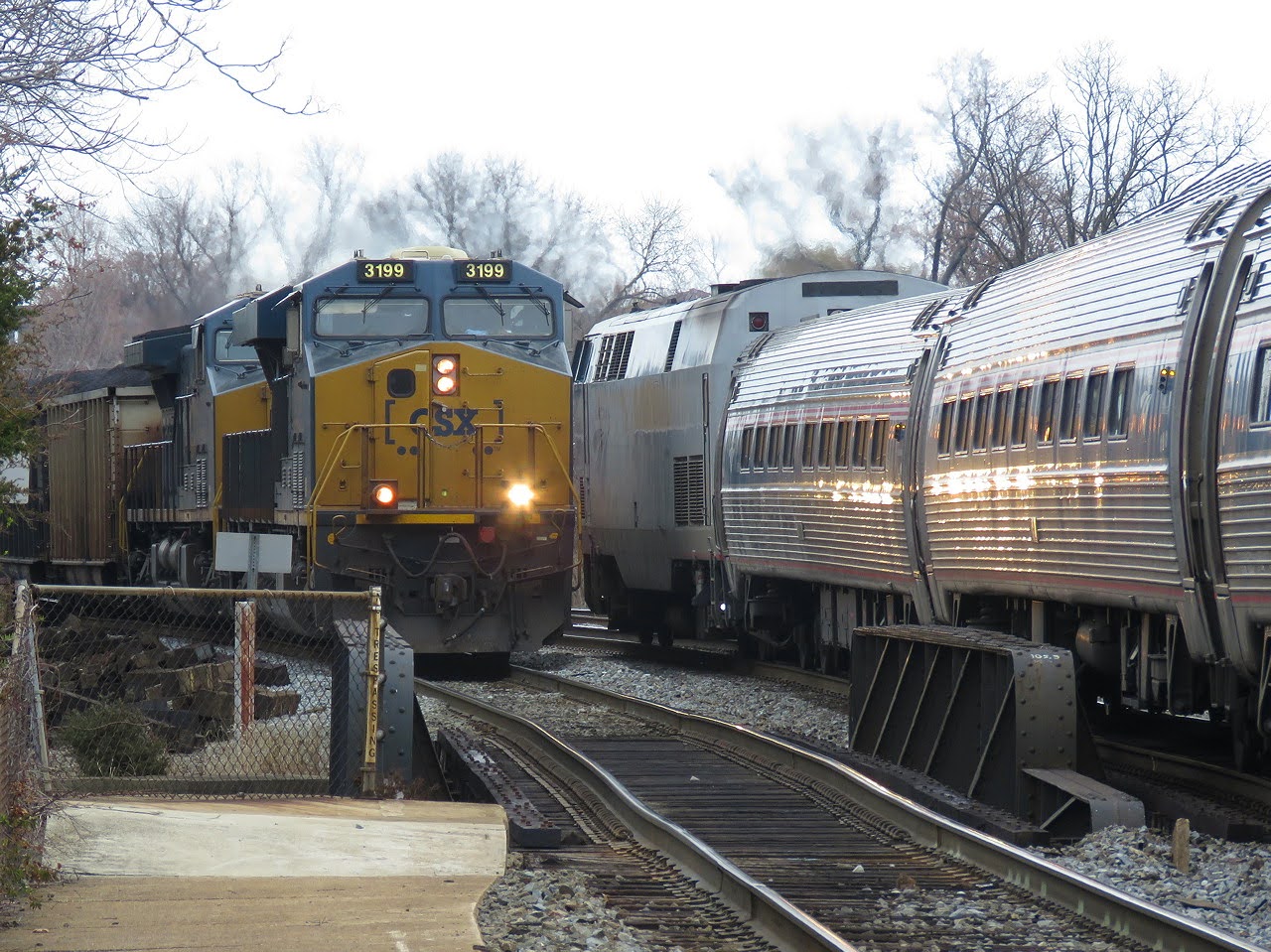
As Train 88 was doing its work, a loaded southbound CSX coal train rounded the bend led by ES44AC #3199 and CM44AC rebuild #7202, with ET44AC #3463 pushing on the rear.


The joint station at Alexandria was served by a confederation of southern railroads, namely The Southern and the Richmond, Fredericksburg and Potomac. According to the info board it opened for service in 1905.
 

Saturday, February 18, 2023

23-02-18 PHOTOS: WINSLOW Exposed

Winslow Junction makes a frequent appearance on my visitation schedule, but since the Southern Railroad of New Jersey changed ownership in the 2010's, there has been far less to see and do as the yard full of old passenger cars, F-Units and Alcos has dwindled after successive waves of scrapping. However the bones of the old high speed railroads to the boardwalk are still in place if one knows where to look and over President's Day in 2023 I took one of my DC area railfan friends down to show him this gen of South Jersey rail history and make use of our expiring Amtrak companion coupons. Although much of Winslow was unchanged, we were treated to a few unexpected surprised. The full set of photos ( mirror ) includes both those Winslow surprises and other content from the Amtrak journey to Philly and back.

I'll start things off with this view of Amtrak Acela power car #2036 departing the BWI Airport station. Not sure why I was there, but this was a few days before heading up to Philly.


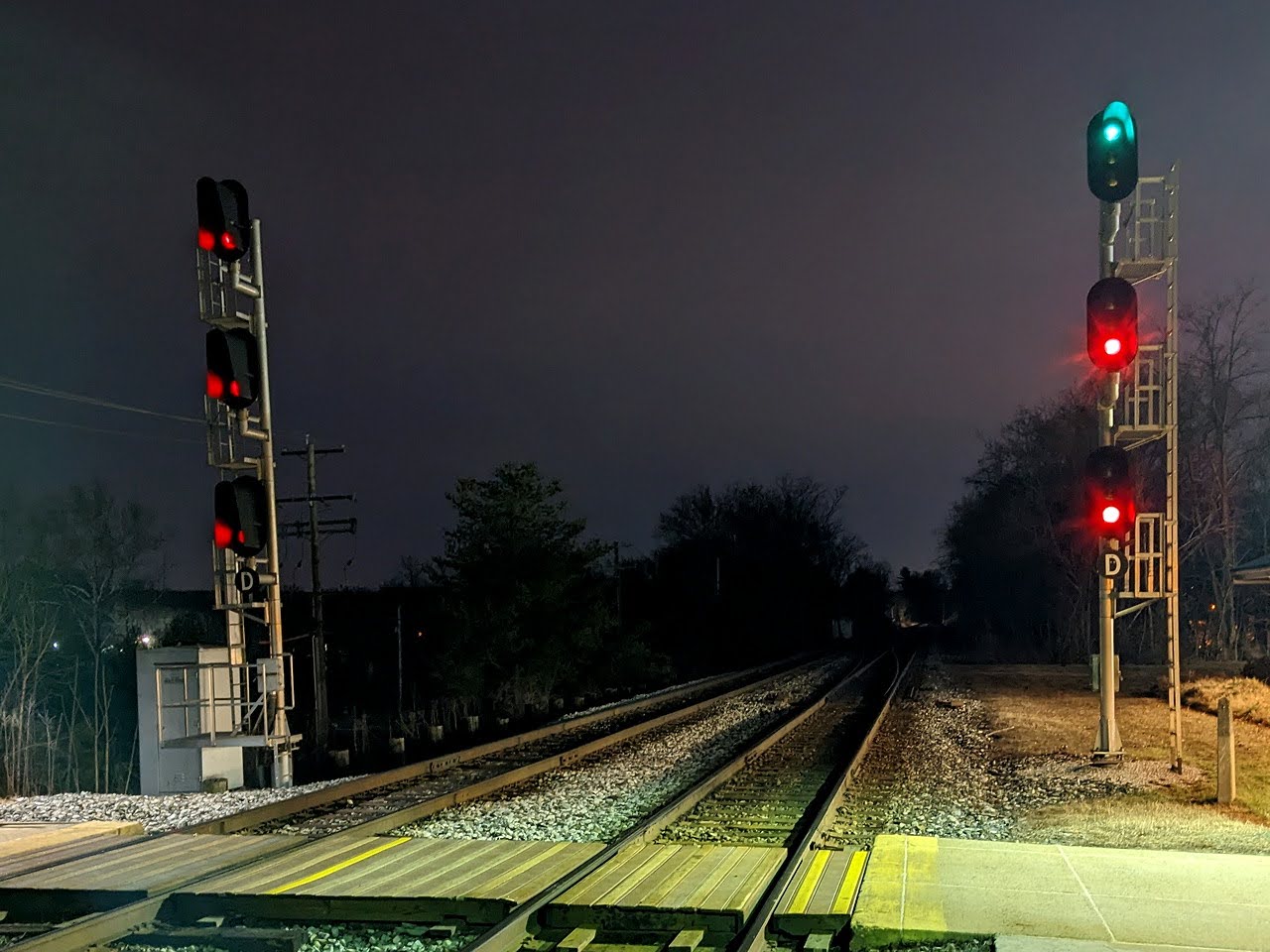
I recruited the same friend to be a reserve on my local pub trivia team. To avoid the horrendous DC area traffic he catches the MARC Cemden Line to Dorsey where I can pick him up. When his train is on time he will meet a westbound train from Baltimore and arriving a few minutes early I found the track #1 signal at DORSEY interlocking displaying Clear for said westbound move led by MARC split level cab car #8058.


The eastbound train from Washington arrived with cab car #8051 on the end. Ridership on the line has been growing, but is still well below pre-COVID levels.


Heading up to Philly on the 7am Acela with power car #2022 leading. With the BOGO coupon this premium service only cost us each about $25.


Completing the cross town transfer from 30th St Station to South Jersey with SEPTA Silverliner IV #184 and PATCO car #1104 (see departing for 15th/16th.).


Winslow Junction was hosting the same quartet of MLW M420 locomotives, #3517, #3519, #3578 and #800, which still in the NYO&W paint job that indicated the personal railfan interests of the former owner.


Our first surprise of the day was CMSL GP38-2 #2661 switching cars on the Conrail interchange up on the former Atlantic City RR (Reading) main line. For some reason I thought Conrail still delivered the cars to Tuckahoe, but I guess this makes sense what with the passenger operations at Richland.