CSX's Brunswick Yard in Brunswick, MD is a perennial visit on my calendar as the town provides the best food and beverage options near a number of natural recreation resources. In my last visit in December of 2020 I commented on the precarious situation of WB Tower that was slated for preservation, but left unsecured and vulnerable to fire. A little over a year later I just happened to be in the area after an Appalachian Trail hike and decided to pop by after lunch to see what was up. The full set of photos that also contain content from elsewhere on the Metropolitan Sub and Mid-Atlantic region can be accessed here ( mirror ).
Brunswick, MD is the location of the yard for MARC Brunswick Line service to both Brunswick and Martinsburg, WV. Each main track platform is split by a large parking lot at the west end of Brunswick Yard. The B&O era station is well kept although no longer maintained or staffed by CSX.
In a bit of good news, WB TOWER had been moved off its old foundation and relocated to town owned land as part of the Brunswick History Museum. The site was still a work in progress and stairs had yet to be built for access to the operator's level
Brunswick Yard has seen significant loss of activity since the PSR craze took hold. The only locomotives on hand were a trio of road units including AC4400 #528 and ES44AC's #943 and #844.
My next stop was the fairly new TUSCORORA interlocking at Milepost 39 on the Metropolitan Sub a few miles east of the Old Main Line junction at Point of Rocks. The full crossover was installed new as part of a ~2014 re-signaling and capacity expansion project partly funded by state and local governments to bribe CSX into allowing for the future expansion of MARC Brunswick Line services.
Next stop is the Garrett Park MARC station MP36PH-3C #22 arrived when an outbound afternoon train.
Over the past 20 years the NJT RiverLINE has been far more useful than I assumed when it first opened. In addition to serving as a cheaper substitute to the SEPTA R7 for connecting to NJT at Trenton and the occasional access to the Camden waterfront, the RiverLINE has also served me as a Park N Ride alternative to Hamilton and, more recently, created a second NJ loop option for my SEPTA winter fan trips. In the Spring of 2022 I discovered a new use when driving down from North Jersey with a friend. They needed to stop near Doylestown, PA while I was looking to continue down to South Jersey. The solution was to drop me off at the turnpike adjacent Florence Park Ride station where I would then continue to my destination. Of course I am going to do a post based on the resulting photos that you can find here ( mirror ).
The Florence station is located at the northern end of a double track segment that runs adjacent to the Conrail Burlington yard. Although freight use of the RiverLINE track is time restricted to overnight, the Burlington Yard is seperate from the RiverLINE with direct access to many local industries and can operate during daylight hours.
The RiverLINE uses a system of timed meets to get a 15 minute headway on a line with a good amount of single track operation. On this day northbound LRV #3508 was the first to arrive and wait for the southbound.
This arrived in the form of LRV #3510.
Heading south past the freight yard, CSX GP38-1 #2531 was waiting its next call to duty.
While riding I tried taking some cab view videos with mixed results. The first one covers the arrival into Burlington and Beverly stations and the second one portions in Pennsauken and Pavonia.
Juniata Terminal SW1500 #9625 and associated PRR caboose was sitting at the Pavonia Yard RiverLINE facility where it handles various work and rescue duties.
When the gray is in the air and the ground is turning to mush its probably time to take another trip up the Hudson valley to document one of the best preserved examples of New York Central signaling anywhere. For the better part of a decade I have been working to replicate my PRR Main Line signal survey on a smaller scale and with most of the easy locations checked off I am having to go after higher and higher fruit. In 2022 my targets was the Milepost 79 signal bridge, just a few hundred yards north of the historic Hyde Park station, the Milepost 108 masts near Linlithgo and the station and interlocking at Hudson, NY. I also documented some of the "new" (2009) searchlights installed by CP in the Mechanicville area. You can find the full set of photos here ( mirror ).
First stop was Hyde Park where I caught Amtrak P32AC-DM #702 passing under the NYC vintage signal bridge with a southbound Empire Service train.
My next stop was a point north of CP-103, which unfortunately had recently had its small target searchlight signals replaced, to catch a northbound Empire Service train led by non-heritage P32AC-DM #706.
Amtrak's train tracking feature is pretty useful as it is now super easy to ensure a train encounter at every stop. At the Milepost 108 automatic signal location I managed to snag a Phase III heritage painted P32AC-DM #713 with a southbound Empire Service train.
Unfortunately I was a day late an a dollar short to document the searchlight signals at CP-114, but the new LED target type color light signals are making use of the same Conrail era cantilevers that even have remnants of the old contrast paint.
For all of its car culture and highway building sprees, the greater Dallas-Fort Worth metroplex has some pretty comprehensive rail transit. Not only does Dallas have the fairly expansive DART light rail system and a pair of streetcar routes, but there is also a traditional commuter line to Fort Worth and two DMU based rail lines that connect Denton to Dallas and Fort Worth to Grapevine/DFW Airport. The latter, known as TexRail, opened in 2019 and in the spring of 2022 I was given an opportunity to ride it. Other topics covered in this photo set ( mirror ) include some general DART and Dallas Union Station stuff as well as TRE and the Fort Worth Intermodal Transportation Center.
Arriving in from Love Field via a DART Orange Line train on LRV #163 seen here at the St. Paul St station. The city was much emptier than pre-COVID and like many other cities transit ridership had collapsed.
The next morning I headed to Union Station to catch the TRE commuter line to Fort Worth. F59PH #121 was hanging out with a typically short TRE consist.
I went to go get some breakfast a diner across the street and when I returned #121 had been replaced by #124 and an eastbound Union Pacific freight was passing through through with ES44AC #5515 leading and AC4400 #6457 behind.
Even in the spring of 2022, in Texas, COVID safety theatre was still a thing with a chain keeping people away from the cab car cab and thus preventing any photos being taken out the front or back.
Although the terminal for TRE and TexRail is at the more downtown Texas and Pacitic Station, I got off at the newer intermodal transportation center as there was simply more there to see and do. TexRail makes use of eight Stadler DMU trainsets with 4 coach sections and one central power unit. Although FRA "complaint", and thus able to run on the same tracks as TRE, TexRail trainsets make use of semi-high platforms and require a separate berthing area as can be seen with #108 here.
Not all of my trips are blockbusters that cross state lines and/or involve hundreds of miles of travel. Some are completely local affairs or the side effect of a lot of regular NEC travel between Philly and Baltimore. March of 2022 was one such period of regular local travel and I have consolidated it into a set of photos ( mirror ).
Starting things off at the BWI Airport Rail Station we have Amtrak ACS-86 #646 at the head of an afternoon Regional.
SEPTA Silverliner IV #353 at Market East.
PATCO rebuild car #1065 heading westbound at 8th and Market.
Three PATCO trains at Haddonfield with #1080, #1114 and #1122.
SEPTA Silverliner IV #336 on the Suburban Station Ramp.
Back in the DC area I caught Amtrak Super Star Train 92 as it approached Crystal City on the former RF&P. The post-Covid staff shortage caused a consolidation of Florida Service trains with the Meteor being annulled and come of its consist transferred to the Silver Star. This resulted in the unpresented 7 Viewliner lashup seen here behind P42'sDC #188 and #190.
In February 2022 I was able to able to ride most of the MBTA's Cambridge trolleybus network for the first, and unfortunately last time as it was shut down and scrapped about two weeks after my visit. I was actually quite lucky as the shutdown lined up with my annual late winter trip to the Boston area via Amtrak's NEC that provides the opportunity to utilize any remaining discount and upgrade coupons. The full set of photos ( mirror ) includes both legs of the NEC round trip as well as use of Boston's subway network to reach the trolleybus terminal at Harvard Square.
Although my trip began at Amtrak's BWI Airport Rail Station, I was not catching my Acela Express train from there, even though I arrived in time to see #2029 departing northward. The 10am departure from Washington offered a better price point as well as the ability to ride the entire NEC instead of just most of it. Instead I boarded MARC cab car #7851 in the opposite wirection to begin my trip.
My Acela trainset had power car #2012 on the rear seen here at the typical AX departure platform at Union Station.
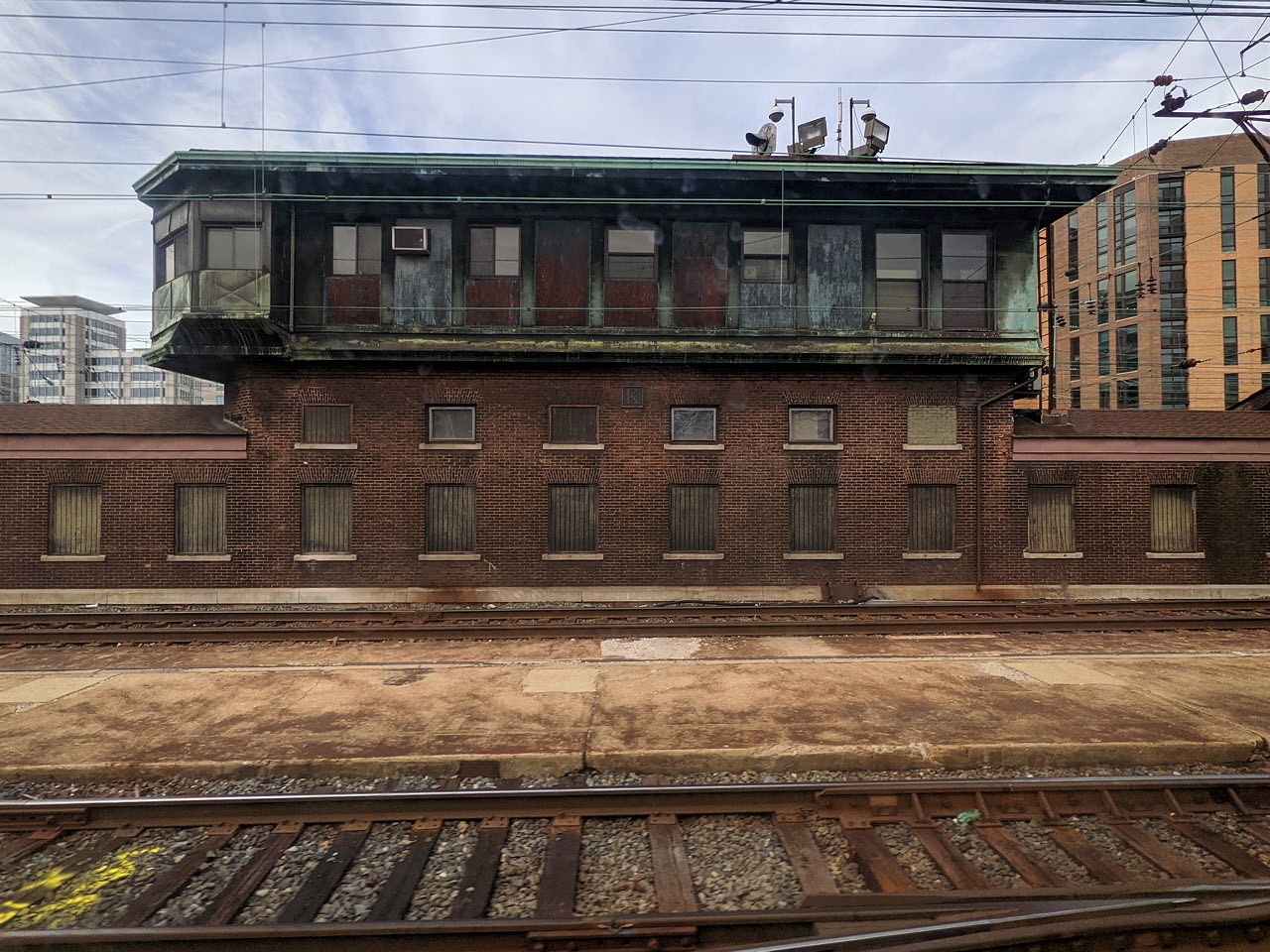
K TOWER hanging on, LANDOVER looking sad and ZOO with new windows and a PRR keystone.
One of the nice parts of taking the Acela is no Trenton stop!
At at Manhattan Transfer my Acela was routed on the less frequently used track #1 due to Amtrak ACS-86 #667 being stopped on track #3 while a conductor fouls track #2 to carry out a hotbox inspection on an Amfleet.
A PATH train passing HUDSON tower en-route to Newark.
#2012 at New York Penn during the extended station stop.
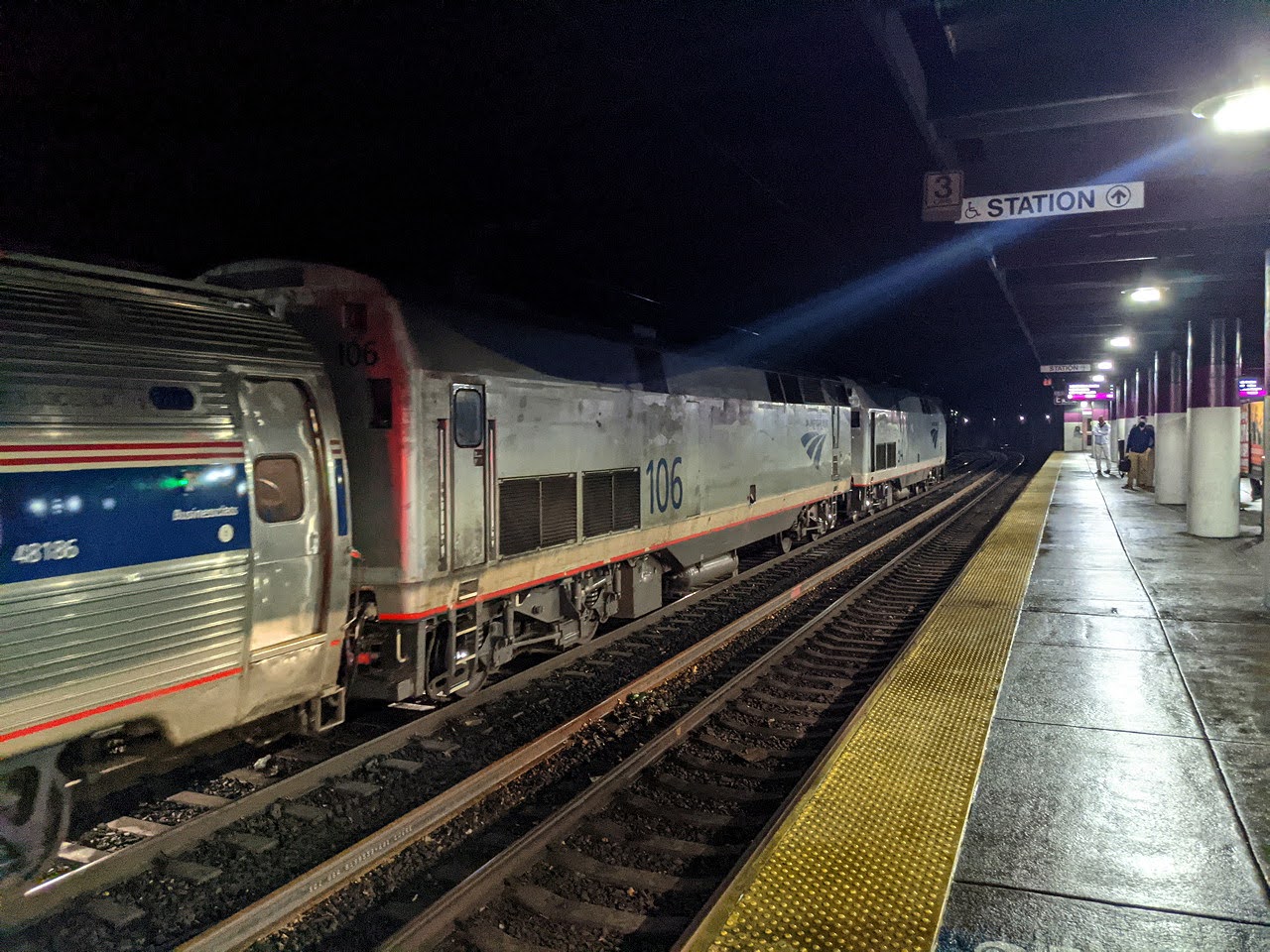
P42DCs #106 and #99 leading the Lake Shore Limited at Boston Back Bay.
The next morning I was heading to Harvard Square via Green Line Type 8 trolley #3889 and 1800 series Red Line car #1840.
Although greater Boston once featured quite an extensive trolleybus system, all but 3 routes were shut down by 1963. Those that remained were saved due to the construction of an underground transit tunnel in Harvard Square in 1958 where the exhaust from diesel buses would present a hazzard in the confined space.
Unfortunately both the Routes 71 and 73 had been bustituted that morning due to a problem with the overhead wires. The MBTA was never a fan of the operational complexities of trolleybus operation and the wealthy residents of Cambridge were increasingly hostile to the "unsightly" overhead wires. By 2022 the need to invest in both the overhead power system and new vehicles gave the T an opening to bustitute the entire operation.