Search This Blog

Saturday, October 26, 2019

19-10-26 PHOTOS: Viva HARRIS Tower

I've never been a huge fan of Las Vegas, however I would always get pushback from people because aside from a 4 hour stint being stranded at the Las Vegas airport, I had a pretty strict personal Vegas boycott going on. Well in October of 2019 a paid-for work related conference had me packing my bags for Sin City and I am pleased to say...that it was even WORSE than I had anticipated. Yes the city is fake and tacky and overpriced, but the rail attractions that did exist were a major pain to get to despite only being a block off The Strip. The people who frequent Vegas were just the worst and the omnipresent security made doing anything with a camera generally unpleasant. As a result of all this and more, most of this photo set (mirror) will come courtesy of a trip I took to HARRIS tower the week after. You heard it here first. Harrisburg, PA is way better than Las Vegas and I'm assuming there's a now casino there as well.

We begin in the totally not Las Vegas location of Magnolia, NJ where I caught the power from the Conrail SAO laying over while the crew was out for lunch. Like the 4 men in a jeep seen in post war Vienna, power consisted of NS GP38-2 #5302, CSX GP40-2 #6238 and a former Southern high hood GP38-2 #5226.


Rolling out of the Philadelphia Suburban Station 20th St portal en-route to 30th St Station.

Running into Amtrak Acela power car #2016 and Veterans painted ACS-86 #642 at 30th St.


My conference was at The Venetian, it was...insulting.

I stayed at the Treasure Island because I got a Priceline thing, it was...a hotel.

The TI was adjacent to SANDS AVE interlocking on the UP Cima sub. The signals were...completely uninteresting.

The Las Vegas MonoD'oh was 1 super-block off strip, so hard to get to, and super expensive. I didn't bother ponying up for a joy ride.

Friday, October 11, 2019

19-10-12 PHOTOS: Metro North Drawbridges

Since Metro North replaced all of its signaling and retired the M2/4/6's and FL-9's, it has been a pretty dull railroad. After all, how many pictures of M8's and P32AC-DMs does one need? (Hint, not that many.) However, MNRR still has a few things going for it, an an interesting electrical system with components stretching back to 1906 and a series of drawbridges with build dates going back even further. In 2019 I teamed up with a couple of local enthusiasts and we went about visiting a number of Metro North's historic New Haven line drawbridges including COB, WALK, SAGA and PECK. You can view the full set of photos here (mirror).

We start off at the COB movable bridge (SS29) in Cos Cob, CT with an Amtrak Acela Express power car #2039 passing over the span while a Metro North high rail truck sits on the out of service track #2.

Passers by often mistake this structure on the west end of the bridge for an interlocking tower, but it is actually the New Haven railroad's power dispatcher's office that controlled the entire 25hz AC power network. The New Haven system of 1914 and modified over the years uses an autotransformer architecture with 22/24kv feeders supplying 11/12kv overhead contact wires. Cos Cob was chosen as the site of the power dispatchers office because it was also the site of the power plant supplying the 25hz electrification power.

Here we see an MNRR New Haven bound train comprised of M8 cars passing by the Cos Cob power tower. The electrical switchgear mounted on the overhead gantry dates from 1914 and is still in service for catenary sectionalization. 

Here a Stamford local passes a Grand Central bound train at Cos Cob.

 
Here we have a video of a train of M8 MU cars passing through the Cos Cob Station without stopping. Even on weekend Metro North operates two service zones with locals running to Stamford and express trains to New Haven making stops after Stamford.


Here is another video of a westbound weekend Amtrak Acela Express train with power cars #2032 and #2034 passing an eastbound Stamford local at the Cos Cob station. Note the slow speed of the AX caused by the curve and SS29 COB movable bridge.


The old Cos Cob power station was shut down in 1986 and subsequently demolished and turned into a public park over the ensuing 3 decades. This park in turn provides an excellent view of the Cos Cob drawbridge, which was built in 1904 by the American Bridge Company and consists of two independent, parallel rolling bascule spans, one for each pair of tracks.

The bridge sees the most openings on the New Haven line, being immediately downstream of a marina and also has some of the least restrictive opening policies. For a while the daily departure of a party boat around 5:30pm would require an opening during the evening peak and anyone standing at the railfan window of the 5:09 New Haven super express out of GCT might get quite the scare as the tk1/3 bridge was lifted as the train passed by on the still closed track 2/4 span.


The 1906 New Haven electrification project between New York City and Stamford was the first of its kind in the world. To deal with the complexity of figuring out how to string 11kv overhead wires across a movable bridge, the New Haven Railroad just chose not to, leaving a gap in the overhead lines across the drawspan that passing trains need to coast through. The wire on both sides raises up to leave the pantograph at maximum extension, eliminating the need for the engineer to raise and lower the pans themselves.


The ban on DDT has made various railroad structures attractive to osprey and other coastal birds. As disrupting an active nest is illegal, Metro North has placed this owl puppet to try and scare the birds away so the nest can then be removed.


The SAGA movable bridge (SS52) in Westport, CT was built in 1905 and later electrified in 1918. During my visit both tracks 2 and 4 were out of service, allowing for this photo from the end of one of the double platform bridges at the adjacent Westport station.

Westport is known for its pedestrian walkway which allows one to get right up close to the action, such as this eastbound Amtrak Regional train with Amtrak ACS-86 #650.

Thursday, October 10, 2019

19-10-11 PHOTOS: Staten Island Railway

The Staten Island Railway is an odd duck to say the least. Ostensibly still an FRA railroad, it is run more like a transit system with no connection to the national network and a variety of FRA waivers. While the equipment consists of NYCTA St. Louis Car R44's, the line is equipped with Baltimore and Ohio Color Position Lights and cab signals? This strange situation has its roots stretching back to the 19th century, but today most of my interest is centered on the B&O CPL based signaling system and to a lesser degree, the R44s. I have ridden the SIR on two other occasions, the first in 2000 when I only had a film camera, the second in 2004 when I went over to see what was up with the re-signaling project. A required secondary trip for the SIR is the related Staten Island Ferry to be prepared for the requisite photos of the Statue of Liberty and downtown when you check out the full set of photos here (mirror). In addition I went out to get pictures of remaining classic interlocking towers on the IND Fulton St line.

Kicking things off south of Baltimore early in the AM, the brutalist BWI Airport Rail Station has been rebuilt as a coffee shoppe.

 
Proceeding to downtown Manhattan via the PATH, I emerged from the underground at the new Fulton Transportation center and its billion dollar view of the sky.


Taking photos of the defunct Central Railroad of New Jersey Communipaw terminal is perhaps the one rail related thing one can do on the Staten Island Ferry.

The free Staten Island Ferry is the most affordable way to get photos of the Statue of Liberty and Lower Manhattan.


Most of the 10 tracks at the St George ferry terminal are used for mid-day car storage. The 61 R44 cars, built by St. Louis Car in 1973, make up the entirety of the fleet. #400 shown here, is not the class leader as their numbering starts with #388.

The 290 NYCTA cars were retired in 2010 due to a surprise discovery of frame cracks and corrosion. With a lighter duty schedule and different maintenance regime the SIR cars were not affected and are now approaching their 50th year in service. Here numbers 392, 450 and 446 can be seen at the railroad east end of the station platform waiting their next call to service.

TOWER B was constructed by the B&O around 1952 and housed a GRS N-X type interlocking panel to control the St. George terminal and eventually the other end of the line in Tottenville. Although the 2004 CTC project consolidated dispatching functions in a new TOWER A built on the other side of the terminal, the terminal interlocking logic inside the original tower was not replaced and TOWER B still serves as a alternate control center with a replacement panel interface.

Since forward views from the SIR cars are limited to a peephole, frequently blocked by the crews, I didn't have much to do until I arrived at my destination of Huguenot. Here we can see #400 passing by the eastbound signal at WOLF interlocking, approaching the signal at POND interlocking displaying a Clear signal indication.

Friday, October 4, 2019

19-10-04 PHOTOS: Homewood Jct

The town of Homewood, PA sounds like it has some association with the steel mills in the Monongahela valley or perhaps the neighborhood in Pittsburgh. In actuality Homewood and its Junction is west of Pittsburgh in the Beaver River valley at the point where the PRR Fort Wayne line strikes out westward from the valley to make its way overland to Alliance, OH and points beyond. To avoid confusion with CP-HOME on the Pittsburgh Line, the interlocking at Homewood Jct was designated CP-WOOD and consisted of a full crossover and the connection to the Koppel Secondary track which continues up the valley, eventually joining with the former Conrail Youngstown Line. CP-WOOD was last rebuilt in he mid 1990's along with the Fort Wayne Line cab signal project, retaining its PRR position lights and with all of the re-signaling going about I scheduled a visit in conjunction with my October 2019 trip to the Pittsburgh area. Ultimately, all my attempts at signal documentation would be thwarted, but I did manage to capture a reasonable amount of NS freight action. You can find the full set of photos here (mirror).

Arriving at the location of CP-WOOD, I discovered that the interlocking hadn't just been re-signaled, it had been removed and relocated as the amount of traffic on the Koppel secondary did not justify the annoying of maintaining main line crossovers on a curve. The junction part of Homewood Junction had been reduced to a hand operated switch on track #2 with a station sign referencing the adjacent Buttermilk Falls.


The old crossovers had been dumped in the weeds next to a new cab signal indication change point situated 34.4 miles from the east end of the Fort Wayne Bridge in downtown Pittsburgh.


The loss of the adjacent interlocking had already affected property values in the town, with railfan housing abandoned and falling into disrepair.


The junction with the Koppel Secondary was in the form of a wye track, but the north leg had connected to track 2 via a hand throw switch since the 1990's rebuild. Note the width of the right of way which used to support 4 tracks as part of the PRR's New York to Chicago "Broad Way".


Consulting the overhead on Google Maps, the most likely location for the new CP-WOOD was on a stretch of track west of town and I proceeded to the Foxdale Road crossing where I caught the first doublestack intermodal train I would encounter that morning led by NS C40-10W #7521 and AC44C6M #4139.


The new cantilever signals at CP-WOOD needed extra wide arms to span the double width RoW.


A second intermodal train soon showed up, led by NS C44-9W #9551, crossing over from track 1 to track 2.


Driving to the other end of the interlocking, a Clear signal on track #1 indicated the impending arrival of yet another eastbound intermodal train, this one lef by ET44AC #3659 and AC44C6M #4190 running elephant style.


Saturday, September 28, 2019

19-09-28a PHOTOS: Railroad Museum of Pennsylvania - Outside

My 2019 tour of the Railroad Museum of Pennsylvania continues as I move into the outdoor exhibit yard where the rolling stock deemed liable to dirty the floor with their rusty wheels are left to mingle with the stoners and the goth kids. For those of you who missed the indoor part of my tour you can find it here. Also included in this segment will be my return to Philadelphia after getting dropped off at the Paoli SEPTA station. Like before you can see all of the photos from this set here (mirror).

The star attractions of the outdoor exhibits were PRR M1 Mountain #6755 and K4 Pacific #3750. The 301 M1 Mountains built during the 1920's were used as a fast freight hauler for high priority, low density merchandise trains. With 4000hp available, they were roughly equivent to an SD70M and the large drivers meant they could also be used in passenger service. In practice this was rarely necessary as the 425 K4 Pacific's were available in such numbers to make stand-ins unecessary. The most numerous class of Pacific ever built, the K4 developed 3600hp and after large numbers were displaced by Atlantic region electrification, the PRR found it easier to double or triple head its premier passenger trains with K4's during the depression, with no new passenger equipment being ordered until the T1's of 1942.


Nicknamed the Brick Shithouse, the General Electric E60, represented by Amtrak #603, was a 6000hp freight derived passenger locomotive used by Amtrak for its heaviest and longest trains between 1972 and 2003. Somehow heavier than a GG1, the C-C freight trucks led to high speed derailments and poor tracking at speeds over 90mph. It's poor performance led to the purchase of the AEM-7 to replace the GG1's in high speed service.


Budd Metroliner #860 is perhaps the last remaining Metroliner with some of its propulsion system and original interrior intact, the rest having been converted into unpowered cab cars Although capable of speeds up to 165mph, the Metroliner was crippled by an over ambitious analog control system that proved to be an unreliable mantainence nightmare. Entering service in 1969, they were all out of service or being used as coaches by 1985.


Also outside were PRR L1 Mikado #520 and H10 Consolidation #7688, both missing their tenders and undergoing restoration and asbestos abatement. The 575 L1s' used the same boiler as the K4 and filled the same freight role as an SD40 or SD45, being later bumped from some of the fast freight jobs by the newer M1 Mountains.


19-09-28a PHOTOS: Railroad Museum of Pennsylvania - Inside

I'm not a fan of railroad museums in the same way I'm not a fan of zoos. The photo angles are usually poor, the photo opportunities aren't very unique, the equipment isn't doing anything, the equipment isn't going anywhere and, at least to me, the environment doesn't seem very meaningful. Perhaps more importantly I find most Museums to be an exhaustible resource in that the utility of repeat viewings rapidly decreases because the collections are largely static. These reasons explain I logged a gap of nearly 20 years between visits to the Railroad Museum of Pennsylvania, despite it having a superb collection of rolling stock from my favorite railroad. In fact it had been so long since I had been to the RR Museum of PA that my previous trip was documented with a film camera. The good news was that my lack of attention meant that I had plenty of things to take photos of without incurring wasteful duplication. While the collection has seen some unfortunate removals, notably the Pioneer III's, it had also gained items such as the Amtrak AEM-7 and E60 with others seeing cosmetic restorations. With something like a $25 admission, putting off a return visit for two decades was clearly a high value proposition ;-)

You can see all of the photos from this set here (mirror) and unlike most of my photos photo sets that are mostly signals and infrastructure, this set is non-stop rolling stock.

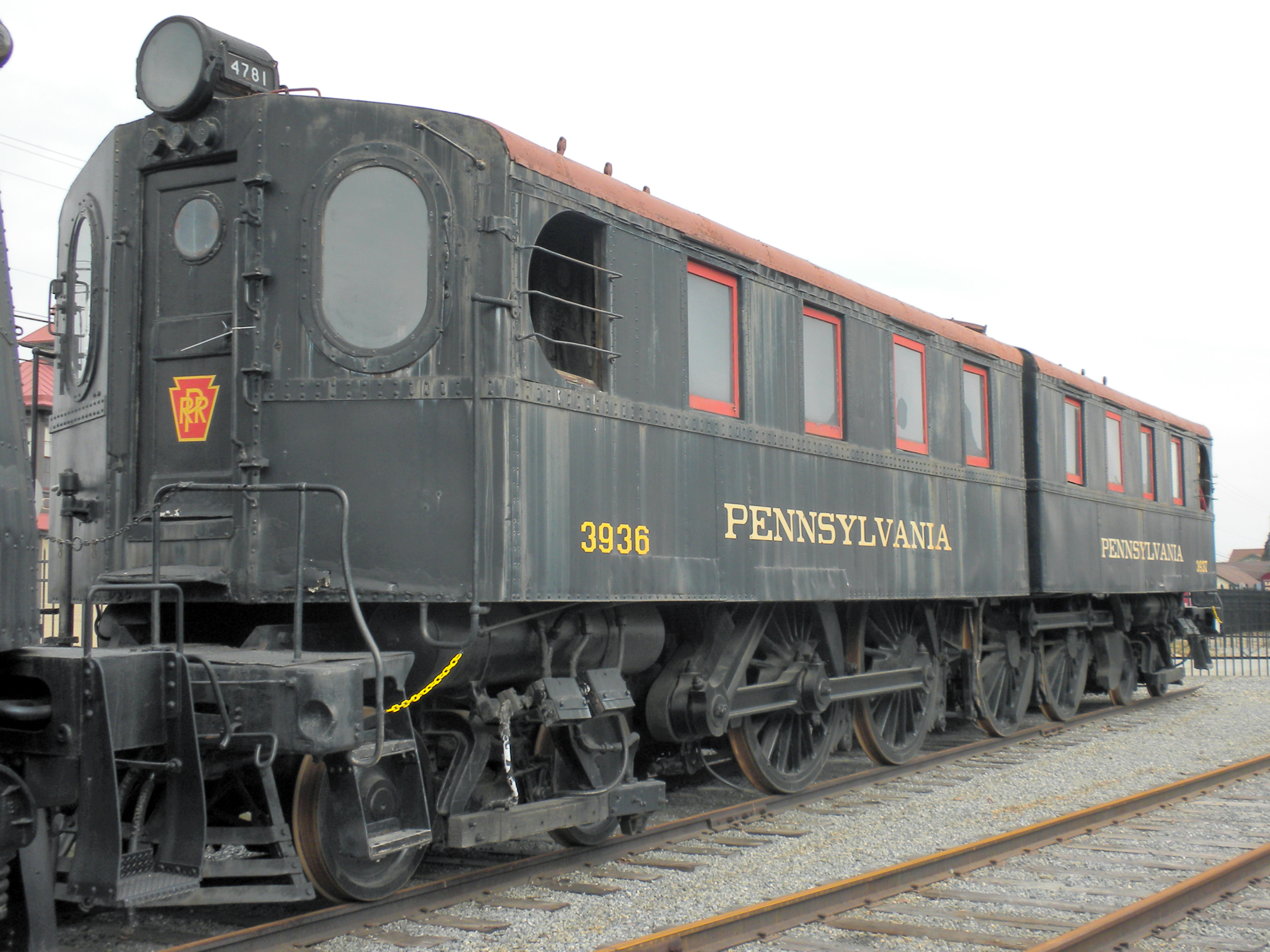
For promotional purposes the museum has parked some of its collection on a pair of tracks outside the main facility. There seems to be a sort of history of Northeast Corridor traction going as three of the four items comprise mainstays of NEC electric haulage, A PRR DD1 (1911-1933), a PRR GG1 (1934-1980) and an Amtrak AEM-7 (1981-2016). PRR DD1 #3937/3936 was one of 33 of its class built for the 1911 Penn Station electrification project. Each end of a DD1 was effectively an independent locomotive which resulted in the PRR giving a separate numbering each end (locomotives were then dispatched using a separate Electrified Zone Number). The rod and jackshaft driven steam locomotive style driving wheels were powered by a single monster 2100hp Westinghouse DC motor inside the box cab carbody for a total of 4200hp, which was a lot in 1911. Since being parked outside since at least 2010 ##3937/3936 has suffered from significant vandalism and deterioration from the elements.


Pennsylvania Railroad prototype GG1 #4800 was built in 1934 as the first of 139 other units that would follow and was the only one constructed with riveted skin. Identified as a national Mechanical Engineering Landmark, #4800 is actually owned by the Lancaster Chapter NRHS and is only on display at the museum. For this reason the historically priceless locomotive sits outside in the elements and a generally unrestored condition.


I had had been under the impression that Amtrak AEM-7AC #915 had suffered from a fire, but I guess I was wrong. Fortunately a DC AEM-7 example (#945) was preserved by the Illinois Railway Museum. 


Moving inside the museum the train hall is divided between the original, low ceiling dimly hit half and the newer, high ceiling brightly lit half. The hall has four through tracks, with a lot of space devoted to wooden equipment that would not do well outside as well as equipment that has been cosmetically restored. 


PRR E2/E7 Light Atlantic #7002 was re-numbered prior to preservation in honor of the original #7002 which set a world land speed record in 1902 of 127mph. General anti-PRR sentiment resulted in the probably record never being acknowledged. Superheating and other improvements led to many E2 and E3 class Atlantics being reclassified as E7's before being retired between the 1930's and 1950's.


The PRR Class A5s were the largest 0-4-0 switchers ever built and represented the PRR's propensity to beef up existing locomotive types as opposed to investing in unproven technology. Built into the 1920's, the A5s' were an absolute monster with 38 sq ft of grate area, power reverse and superheating. #94 is the sole remaining example of this class and has had the sheet metal around the boiler removed due to asbestos abatement.


The parade of thicc PRR locomotives continues with G5s 4-6-0 Ten Wheeler #5741. The 90 G5 locomotives were the largest and most powerful series production 4-6-0's ever built and formed the backbone of the PRR's non-electrified suburban services until the arrival of diesels. Most commonly encountered around Pittsburgh, G5s also operated north of Baltimore, in South Jersey and on Long Island where the LIRR operated its own fleet of 31.


The 2-8-0 Consolidation was the GP38 of the PRR's steam era freight fleet with over 3000 of all types on the roster with 1700 of those being class H6 like #2846 shown here. This insane number of locomotives hints at the generally low availability of steam traction with large periods of down time needed to service the boiler, which was further impacted by the need for frequent shop overhauls or other major repair work.


This chonky beast is PRR Class E6 Heavy Atlantic #460, notable for beating a commercial airliner in a race to deliver the newsreel footage of Charles Lindbergh's return to Washington, DC to New York area cinemas. The victory proved the death knell for the fad of air transportation and ultimately lead to the continent spanning high speed rail network we enjoy today. Unlike the G5s', the E6 Atlantics were only the second largest type ever built, with the trophy belonging to the Milwaukee Road's A class. They could still produce over 2400hp and were in service well into the 1950's.